
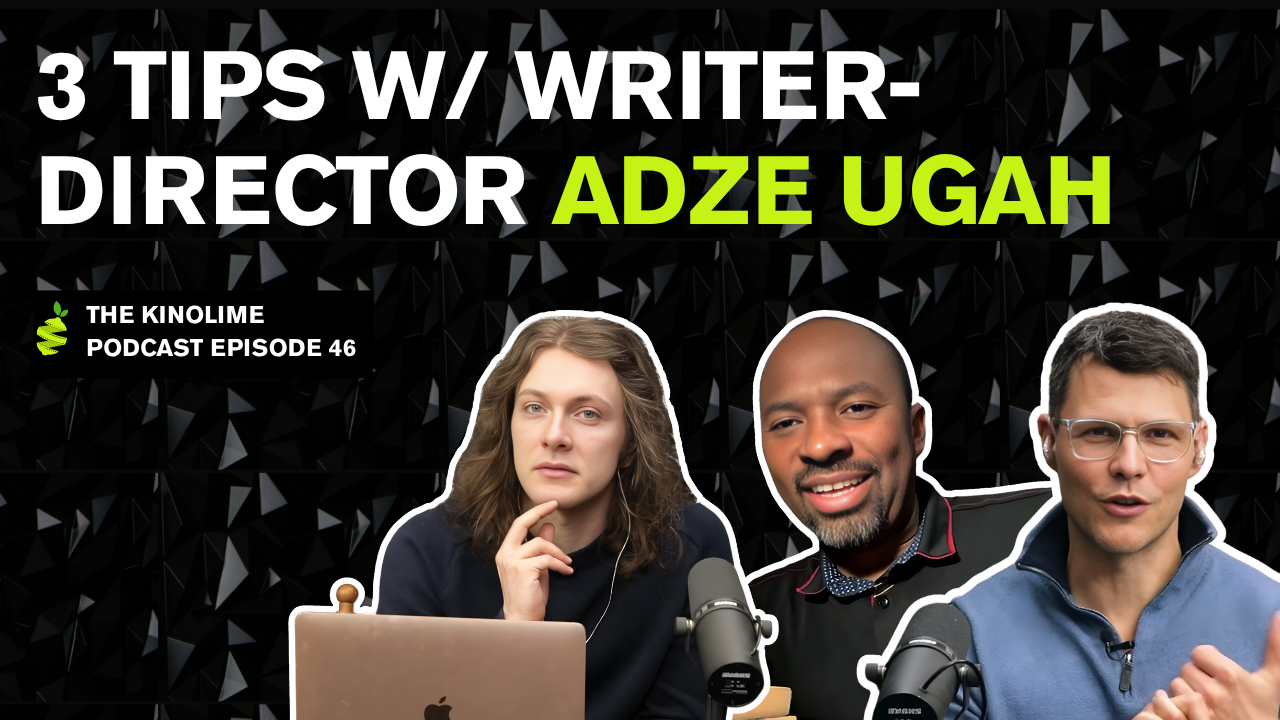
Show Notes
Guest Profile: The episode features acclaimed South African-based director Adze Ugah, diving into his journey from consuming bootleg VHS tapes in Nigeria to helming massive television epics.
Creating His Own Luck: Adze breaks down his rise in the industry, explaining how he started as a humble 3rd Assistant Director and made himself completely indispensable on set, eventually earning his way into the director's chair by the show's third season.
Directing a Historical Epic: The conversation covers his experience directing major action sequences for Shaka, the most expensive and massive television production in the African continent's history (often compared to a South African Game of Thrones).
The Crucial Lesson of Vulnerability: Adze emphasizes that technical skills mean nothing without personal truth, advising filmmakers that they must courageously inject their own point of view, fears, and life experiences into their narratives to connect with audiences.
Exploring Themes of Belonging: A deep dive into Adze's narrative focus reveals his continuous gravitation toward stories about the fundamental human desire to belong, find acceptance, and navigate community ecosystems.
Processing Trauma Through Cinema: In a raw and vulnerable moment, Adze explains that his recurring focus on resilient female protagonists facing impossible odds stems subconsciously from his childhood desire to protect his mother from an abusive father.
Partnering on "Something Like Molasses": Adze discusses his upcoming Kinolime feature film, Something Like Molasses (written by competition runner-up Nina), praising the script for bravely tearing down conservative societal norms to expose authentic, messy human truths.
The Healing Power of Art: Adze eloquently compares the cinematic experience to therapy, describing it as a willing altar where audiences and creators go to take themselves apart in order to begin the process of putting themselves back together.
Key Takeaways:
- Daring Career Pivot: Knowing his traditional parents would forbid an arts career, Adze secretly enrolled in a South African film school, leaving his engineering studies behind and dropping the news on his family just an hour before leaving.
Full Transcript
[00:00]
What was the best lesson that you're like, man, I distilled this from film school and this
[00:05]
say, you know, this has really helped me? The thing that kind of like more or less shifted my
[00:11]
perspective about storytelling that kind of changed everything for me was when I understood that
Read Full TranscriptCollapse Transcript
[00:16]
it was about the filmmaker first. I began to understand the value of being able to write and direct
[00:22]
because you know it's in that way it's filmmaking, you know, you're not just directing traffic,
[00:27]
you know what I mean, you're telling stories.
[00:40]
Hey everybody, welcome to the Keenaline podcast. It's John Schram.
[00:44]
Danny Murray.
[00:45]
Man, do we have an amazing guest today? I've been wanting this for weeks and I always keep
[00:49]
bumping it back, but now we have Adday Uga from South Africa. Here, the director of the upcoming
[00:56]
feature, hopefully very soon, something like Malassas, which was our runner-up in the first competition.
[01:02]
Adday, what's up?
[01:04]
Ah, what's up guys? So good to be here. Jeez, I've been looking forward to this more than you
[01:08]
have as far as I'm concerned. I think that yeah, on the excitement level, we're both humming
[01:14]
in at a 10. So there's so much to talk about. We want to talk about the biggest South Africa show
[01:20]
ever in Shaka that you direct, the upcoming, you know, something like Malassas, but before we get
[01:26]
into it, we want to know our audience wants it. I want to know more about you. Okay, so maybe if
[01:31]
you don't mind, we'll just get right into it. Take us through. Who are you? Like, you grew up,
[01:38]
and you started loving cinema. We're here. We're here all day. So let's just rock and roll.
[01:42]
It's okay. I mean, but as far back as I can remember, I've always wanted to be a filmmaker.
[01:49]
That's a line from Goodfellas, if you picked up that. Of course.
[01:52]
The referee. Ever since I was kid, I was going to be a mobster, right?
[01:59]
So originally, I was born and raised in Nigeria, right? And life was tough, you know, but I was
[02:07]
kind of very lucky because my mom was a social worker, and my dad was like an engineer. He worked for
[02:15]
the National Broadcaster, you know, in Nigeria at that time. And we called them the Nigerian
[02:22]
television authority, which is, which we, in short, we say we call it NTA. Anyway, long story short,
[02:28]
is that even before we had a TV, you know, like I was that kid that was obsessed with anything
[02:34]
in motion picture. The moment I saw something on screen, right? I was just glued, mesmerized, hypnotized.
[02:40]
I couldn't move. Don't make the mistake of sending me to go get water or a knife or a fork,
[02:47]
because if I happen to come across a television set with something playing on it, I'll forget
[02:53]
about the knife from fork or the glass of water. That's how I was about anything on screen.
[02:59]
I just, it was, it was like very, very compelling, you know, and, and, and as the years went by,
[03:07]
I found myself increasingly pulled by narrative. I'm like I was understanding and figuring out for
[03:12]
myself, you know, like, you know, the, the codes, the tropes, the stuff that just made movies work.
[03:19]
And I was that kid that was, I'm quite, what's the word? I'm quite empathic and every time I feel
[03:26]
something, right? I can't wait to share that feeling with somebody else. So if I watch a movie and
[03:31]
the movie touches me, I'm the first person in the crowd, whether it's in class or a group of friends,
[03:37]
telling them about this movie, I'm like, man, guys, I've seen this movie. So I was just
[03:40]
learning around, but I mean, like, he was just like the best. And the next thing you know,
[03:44]
I'm telling everybody the story and they're all enraptured and basically listening and,
[03:48]
basically eating off my hands. Like, I got so good at telling, you know, kids, you know,
[03:54]
that I played around with, stories about movies that in class, in, in grade school,
[04:00]
when the teacher wanted to like, you know, keep the class busy, wash that something,
[04:05]
she called me up and made me stand in front of class and then tell the class. No way, really.
[04:11]
Really, that's kind of what it was like. So I was the one, that was the story teller.
[04:15]
They had, you know, I forget what book when I first started screenwriting, maybe it was Sid Field
[04:19]
or Robert McKee, they say to learn the elements of telling the story, practice telling stories
[04:25]
or pitching your story to friends, because you naturally get into a flow about, you cut out the fat,
[04:30]
you know, you focus on the meaty stuff. So I love, I already had that instinct that a young age
[04:34]
to captivate your fellow students. But I want to know quickly, because you touched on something
[04:40]
really great about being an F, I'm an empath as well. What was your first big movie moment as a kid?
[04:45]
Like, is there a first movie that really touched you, that really blew you away, that you're like,
[04:49]
oh, OMG, this is what, what I have to do? Well, there were several, but, and, and let me just,
[04:56]
let me just say, I'm a, for a kid, my age, do a very inappropriate, but, you know, I get it.
[05:02]
I was all about the very first film that had me in awe of storytelling was actually full metal jacket.
[05:11]
Stan, how old were you when you saw a full metal jacket?
[05:15]
I don't know, maybe, maybe 12, 13.
[05:17]
Oh, okay, I thought you were going to say four or five.
[05:22]
I would like, the thing about Nigeria, I was that you didn't really have like a structured
[05:27]
film, watching community of society. The only way we consumed motion picture was through VHS tapes,
[05:35]
you know, and bitermax tapes that came in through exports or imports rather.
[05:41]
And, and, and, and then movies you could watch on TV. I mean, there was a cinema culture,
[05:44]
but then, you know, you couldn't really see Hollywood films and cinemas in those days,
[05:48]
especially in Nigeria growing up at that time. That was like, you know, 80s and early 80s.
[05:54]
So, it was mostly through these VHS films that came in that, you know, I had already played in
[05:58]
cinemas across the world and now they were straight to video and then they will come into the
[06:03]
country and then you find neighbors who had access to them and then you go home to their houses
[06:08]
and then you watch. And I remember full metal jacket and so basically there was no information,
[06:12]
if you know what I mean, there was no kind of like marketing that hit us, considering it was coming
[06:16]
out. There was no magazines, nothing to reference to say, oh, you know, go watch the next mission
[06:22]
impossible, no. It was just random luck, you know, that you came across a film that touched you,
[06:27]
you know, and so the only way you could find good films was to watch everything, you know,
[06:32]
because there was nothing to tell you whether the film was worth watching or not. You know,
[06:36]
so everything that came my way I watched and luckily for me, you know, I had a voracious
[06:41]
apartheid for watching movies. So I could spend the entire day like morning to night just putting
[06:46]
tapes into the VCR and watching and watching and watching till either the head blue or something
[06:51]
happened. So that was how hectic it was for me. My mom was a social worker and she was also very
[06:56]
good at storytelling. She told wonderful stories and I think I got that bug from her and my dad
[07:01]
working for the national broadcast at the time also was able to bring in VHS tapes, you know,
[07:06]
and so I found my appetite being fed, you know, per se in terms of always watching movies, watching
[07:12]
movies and then sharing that experience with my friends. So that was a big thing for me. So I
[07:16]
remember full metal jacket making a big impression. I remember good fellas making a massive impression
[07:21]
you know. The very first VCR film that my family got access to watch was The Man with the Golden
[07:28]
Gun, you know, the 007. Oh, yeah, 007. Yeah, wow. Okay. Yeah, not a great film, but you know,
[07:33]
there's some stuff in there. But in terms of the impression that like, oh my god, you've got to make
[07:37]
movies for a living. You've got to think about making movies for a living. It was full metal jacket
[07:43]
and good fellas. Now mind you, in Nigeria or basically even in the continent, there was really
[07:48]
no structured film making training institution. There was no schools. If you wanted to study from
[07:54]
you had to leave the country and mind you, there was nobody in my orbit when my circle that was a
[07:59]
filmmaker at no relative. That was a filmmaker at no uncle, no cousin. I didn't know anybody who
[08:04]
knew anybody was a filmmaker. Like it was completely something foreign to my family. Yet you could be
[08:11]
a doctor, you could be an engineer, you could be a lawyer, you could be anything. But film was not
[08:17]
even in the equation at all as far as a career choice. So it was not something I even considered
[08:21]
because the only way that could have been a career choice is if I left the country. I found myself
[08:26]
in varsity studying engineering and then after a while, I realized that I was spending more time
[08:32]
and money on film books than I was on engineering books. And it was clear that if I did not make the
[08:39]
switch, I was going to have a very miserable life. And then fortunately for me, I think some time
[08:44]
or on 1998 or 99, the government in Nigeria basically opened a film school and I went there.
[08:52]
I just want to know what did your parents think, right? You're leaving engineering. You decide to
[08:57]
go into this venture where it's not, you know, South Africa is a bigger hub of filmmaking than
[09:01]
Nigeria. But still, you're, you know, it's I think every parents' worst nightmare to have their
[09:05]
child say, I'm leaving a stability path to go on the path of the arts. What are they? How was
[09:10]
their reception to your dream received? It was like, you could imagine how hard breaking it was for
[09:17]
them. Even your dad, the broadcaster, I'm surprised because he was in a business that, okay. Yeah,
[09:23]
I was, yeah, because I mean, as far as he was concerned, it wasn't really, I mean, he knew he
[09:28]
was more forgiven than my mom to be honest. But then you know, remember, he was an engineer also
[09:33]
for the broadcast. Okay. So yeah, it wasn't the creative. Yeah. So he thought there was, there was
[09:39]
more of a career path in being the engineer as opposed to being the creative because I think he knew
[09:44]
what the creatives were earning and really like, I just want to know, how did your mom, what did your
[09:49]
mom say? Was there a set, do something that burned in your mind that, you know, like my mom is
[09:53]
Marissa Tome from my cousin Vinnie. So if I, you know, when I broached her that I was pursuing this
[09:59]
path, I mean, the, the amount of F bombs that came out of her mouth, but I love your mom. But
[10:03]
what, I'd be like, what did your mom say? Like, was there a funny line? I'm just trying to get into
[10:07]
sites, your family, dynamic. So, so here's the thing. So, so I, I, I had to be creative about how I,
[10:13]
I basically, you know, broke the news because I knew that they won't let me go. I knew that they
[10:20]
will, yeah, basically emotionally blackmail me and tell me everything and give me sure.
[10:25]
I was in the world, why I shouldn't do this. So, I didn't tell them, right, that I was going till,
[10:31]
I was sure that I was going. Okay. And I wait till till the last day. So basically, what I did was,
[10:37]
I'd, I'd already registered with, at the film school, I'd paid like the first tranche of school fees,
[10:43]
I'd secured my accommodation, everything, because where this film school was, was about five hours
[10:48]
drive from the state where, you know, my family was living in. So, I'd done all of that, you know,
[10:55]
without them knowing. And then on the day that I was supposed to resume on campus, was a day I told
[10:59]
them that I'm today like, and about one o'clock, I'll be getting on the bus and I'll be head into
[11:05]
film school. So, I, I did not give them time to react and not give them time to process. I dropped
[11:11]
the bomb. And then in an hour or two, I was out of the house on my bags, stayed to film school.
[11:16]
Wow. Okay. Yeah. That's impressive. I like that. That was it. It was the only way I could, I could do it.
[11:23]
You know what I mean? And I'm sure there was heavy resentment. You know, I, I would have loved
[11:28]
to have been a fly in the, you know, on the wall in the room after I'd left what they said or what
[11:33]
they thought. But I'm sure it was, I mean, when I think about it now, I must have been very harsh,
[11:38]
you know what I mean. Okay. So you get to sound that for a while. You're in this, you're in
[11:41]
film school. It's blowing your mind. I'm sure. Right. And tell me about that experience when you,
[11:46]
when you got there. Now, so film school in South Africa was fantastic, you know, because the,
[11:53]
the studies in Nigeria were very theoretical. I mean, there wasn't that many, that much, I mean,
[11:58]
because I wanted to study film. Nigeria was becoming famous for being a video economy, you know,
[12:03]
a home video economy, digital film. But I wanted to study film, you know, like,
[12:07]
study law, yeah, working, 60 millimeter, 35 millimeter, all of that. And so, so that, that,
[12:13]
that's what South Africa offered. So when I came down, it was everything that I imagined, you know,
[12:17]
I mean, next thing, you know, I'm, I mean, classes and I'm now, now handling 60 millimeter,
[12:23]
millimeter camera, writing treatments for, for, for stories. And, and, and the thing about film,
[12:29]
the film school in South Africa, it wasn't like, oh, if you wanted to be a writer director,
[12:33]
it wasn't always a given, you know, they had kind of like, assess you first and then decide,
[12:38]
hmm, I don't think you'd be a good director. So maybe you should take in, take editing or cine or,
[12:43]
or something else. So, there was that risk that I wasn't going to be taking into the directing class.
[12:51]
And miraculously, there was no struggle, they were like, yep, you're going to direct. So,
[12:55]
it's fine. You can stick with your first option. And out of everybody, out of all the foreign
[13:00]
students that came in, you know, to study film that year, I was the only one who actually was
[13:05]
allowed to study the director. Now, from Canada, from India, from Kenya, from Brazil, they all
[13:12]
found themselves doing other things. Now, when you got in, did you want to film school with the idea
[13:16]
of, I want to be a writer director? Did you think just I wanted to be a director? Like, what was your
[13:21]
initial ambition? I wanted to be a director, but then that's when I learned that the writing part
[13:26]
was also very important. Actually, in our context, you know, because I mean, it's like a tourism,
[13:31]
you have to be put to kind of write and direct. And what for me, you know, over the years,
[13:38]
I began to understand the value of being able to write and direct, because, you know, it's
[13:43]
in that way, it's filmmaking, you know, you're not just directing traffic, you know what I mean,
[13:47]
you're telling stories. And that for me was important. And the film school in South Africa,
[13:52]
it's called After for short, the South Africa School of Film, drama, what, you know, long,
[14:00]
long, long, long, long, like all from schools do have long names, insisted that this had to be the
[14:04]
way. And so if you couldn't write, you wouldn't be able to direct. And if you could direct, and you
[14:08]
couldn't write, that was a problem. So it was about, you know, going through the ropes learning that,
[14:14]
and I had fantastic lectures. It was a very fabulous environment in terms of learning, hands-on
[14:19]
experience, you know, generating competencies. And of course, you make your films, you know,
[14:24]
you make your system, you make your film, you're 35 millimeter film, you know, and you'll sit
[14:28]
through all the entire process. And everything, it was like that tedious, you know, making the
[14:32]
film, having to cut, cutting yourself, yeah. Yeah, yeah, yeah, all of that, we did all of that.
[14:38]
And you learned the discipline, you know, and the patience of it, because film, I mean, it's not
[14:44]
like now that, you know, oh, I can do 70 takes and be fine. You have to kind of go, okay, I've
[14:50]
got one take, go two take because I've got three or four, five rolls of film. So everything had
[14:56]
to be precisely planned, you know, I mean, so we come from that school where literally, you know,
[15:00]
the training was that intense because the resources were scarce in terms of, you know, film roles
[15:06]
that you had you could shoot on. There was no digital video digital film at that time. It only came
[15:11]
in much, much later, you know, so filmmakers now, you know, don't know what they missed.
[15:16]
So in your experience of film school, could you tell us, what was the best lesson? I mean,
[15:22]
I'm sure there was thousands of great lessons from film school. What is the one lesson that you're
[15:26]
like, man, I distilled this from film school and this say, you know, this has really helped me.
[15:31]
The thing about telling stories, you know, like we spoke about empathy right, earlier on.
[15:36]
And you watch somebody else's experience, right? And then you go, you know, that's touching,
[15:42]
that's wonderful, right? And then when it's time to tell your own story, the big mistake many
[15:47]
people make is they don't put themselves in their story. You know, so it's like, it's almost
[15:53]
like an objective approach as opposed to subjective one. So you find yourself telling a story that
[15:59]
is kind of, you know, neither here nor there because you are refusing to kind of
[16:04]
take an approach over lens to see the story through. In other words, you're not putting yourself
[16:09]
in it. And I think the biggest lesson, the thing that kind of like more or less shifted my
[16:14]
perspective about storytelling that kind of changed everything for me was when I understood that
[16:19]
it was about the filmmaker first, the storyteller first, right? And his point of view, his experiences,
[16:26]
how he, he, he, he, he imposed his will per se, you know, on the subject matter, you know,
[16:33]
how he relates with that. And then you put that in the story. I love that. Well, I just, sorry,
[16:38]
I just love that. And just for our viewers at home, this is a screenwriting lesson that, you know,
[16:43]
Tarantino even says the same thing is that every movie he makes, hello, he's ever a friend call him
[16:48]
up and be like, hey, like, was I that character because he takes his real life experiences and puts
[16:52]
them in the film? And I think for those at home that are, you know, where do I go? How do I make my
[16:57]
screenplay pop off the page? Like what Adzi is saying is put yourself in a usual real life experience,
[17:02]
your, your mother, your father, your cousins, everything, doesn't have to be verbatim or literal.
[17:07]
It's a metaphor, but I think to instill that human experience into that, that's what's going to
[17:12]
make stuff pop off the page, right? Adzi, I mean, I think that's, I couldn't have said it better,
[17:17]
John. That's exactly what it was. And that shifted things from me because I had made films in the
[17:22]
beginning and I could tell it. I mean, I was like, I'm like, you know, you always think of for granted
[17:26]
that when you make a movie, it'll be great. You know what I mean? Of course. Everybody thinks of
[17:29]
a granted. I'm going to make a great movie. And then you know, you write it and you go,
[17:33]
oh, because you wrote it, you love it. And because you shot it, you love it. And then when it's put
[17:37]
together, people aren't connecting with it. And then you're wondering, guys, don't you see what I
[17:41]
see? And they're like, no, we're just not feeling anything. And you wonder, okay, what am I doing wrong?
[17:45]
What am I doing wrong? But until I learned that lesson, what you just said now, that was when things
[17:51]
had a change. Okay. I realized that honesty and honesty, transparency, vulnerability, you know,
[17:57]
authenticity, you know, about yourself in your work is actually what connects you with other
[18:02]
people, you know, and it requires you being courageous and it'll be both the otherwise, you know.
[18:07]
What are we doing? What are we doing? Yeah. What are you doing? Exactly. You're making news
[18:11]
reels. Don't do that. Love it. Yeah. Danny, how do you think for you, like, does that manifest in your
[18:18]
work with like recurring themes, recurring dramatic arguments? Is there kind of like a specific
[18:26]
through line that you kind of view that empathy through on all your stories? I'm always fascinated by
[18:34]
belonging, you know, belonging acceptance. I don't know why that's a big deal for me. Maybe that's why
[18:40]
I found myself resonating so much with full metal jacket and good fellas, you know, because it's always
[18:45]
only fundamentally it's about belongings about, you know, being part of a community and sometimes
[18:51]
with outside or maybe you don't even fit in, but you want to belong, you want to fit in. So, I mean,
[18:56]
for me, that's always a start to point because I feel like as human beings, that's always, you know,
[19:01]
our thing, you know, we're always part of an ecosystem, could be our family, our school, you know,
[19:06]
our neighborhood, you know, and then that basically like, you know, it's it, it, it, it, it,
[19:13]
it carries on as we grow on as a human being. And, and, and I mean, when you think about every
[19:18]
relationship, what do you want from a relationship, you want to belong, you know, you want your
[19:22]
partner to accept you and, and, and you know, with all your works and all your, all your flaws and,
[19:29]
you know, your fabulousness. So, so that's always for me like an entry point, you know, because it's
[19:34]
a, it's a big thing for me, you know, just to belong, just to be accepted, you know, so when you
[19:40]
think about all the various ships and sizes, that can actually manifest in a story that always
[19:44]
is the first entry point for me. It's interesting that you brought that question up because I saw
[19:49]
one of your interviews at Z where you were mentioning about Tyler Perry always bringing his mother
[19:54]
into his films, right? And, right, that's the same theme and I would say Michael Mann has
[20:00]
same themes throughout his films. Yeah. But yeah, there is something that always stays with us,
[20:06]
I find that fascinating. So everyone at home, is there a theme that resonates with you that you
[20:12]
would maybe want to explore as you could see, Adzi and the other filmmakers, there's something that
[20:16]
bubbles up. Maybe it would be good to figure out for yourselves at home, is there something that
[20:20]
bubbles up that you maybe you want to explore that maybe you're not exploring and maybe that'll
[20:23]
help with your work. So you're, you get out of film school, you get your diploma, you know,
[20:28]
rolled up and then what, what happens next? I always love when people leave film school. What are
[20:33]
you doing? By the time I was a graduate from film school, I couldn't even afford to finish being
[20:38]
my school fee. Yeah. You know, that was kind of how hectic it was because I had to try it every,
[20:42]
you know, every way that I could to pay the bills and, you know, I was getting little support.
[20:48]
Of course, my parents came around after a while and then they were trying to help me, you know,
[20:52]
because they knew that now is on my own, but you know, the little that they could do wasn't really
[20:56]
enough to kind of like keep me, keep me sorted and all of that. But so yeah, by the time we
[21:01]
took time to graduate, I hadn't finished being my school fees. So I was allowed to graduate,
[21:05]
but I wasn't given the diploma, you know, so I didn't have it in my hand to go, yeah, there it is.
[21:11]
But the good thing was that I had a show reel, you know, because I had films that I'd done while I was
[21:16]
in school, you know, I had, I had a 60 millimeter film, a 35 millimeter film, so I had these films
[21:21]
and do a good films. They could stand anywhere as, you know, good short student films. So I was lucky I
[21:27]
had those. And then, you know, I put them on onto VHS tapes and then send them out to production
[21:36]
companies and journalists, and they were saying, hey, my name is Adziroga and I'm looking forward,
[21:40]
here's Maryl, take a look at what I've done, see if you know, you don't mind working with somebody
[21:44]
like me. And of course, I got a few calls that said, oh, nice word, but you know, nothing. Then one
[21:50]
company, I think it was called Penguin Films, you know, and they specialized more in making TV
[21:56]
stories in for South African television. And they were like, look, they have a position open for
[22:01]
third assistant director, you know, but if I'm keen because they're about to start a project and
[22:09]
well, you know, it's up to me to decide if I would like to do that. But I was like, okay, I've never
[22:14]
been on a professional film set before, you know, I've done student films, you know, it's student
[22:19]
your classmates and stuff like that. So now that he has the chance to work on a professional set,
[22:25]
you know, but as a third assistant director, and here I was, I thinking, oh, third assistant director,
[22:29]
that means I've got some directing to do, little did I know. Third assistant directing has
[22:34]
nothing to do with directing. Nothing to do with directing, no.
[22:36]
Then they were directing. But then I formed myself in that space, I took the job and I'm like, okay,
[22:41]
but I did not relent. I was hungry for knowledge. So I was always, you know, in everybody's face,
[22:49]
the director's face, the A.D.'s face, you know, I was that person who was like the dog's body.
[22:54]
There was nothing that I did not do. If you wanted coffee, I'll get it for you even if it was
[22:59]
my job. If you wanted a tampon, I'll get it. I didn't care. I was that person who just wanted
[23:04]
the wheels of the production to keep on rolling. And you know, by the time I got the scripts, I read
[23:09]
the script, I said, our director in the scripts, you know. And by the time we had done the show,
[23:14]
the producer was so impressed, right? They were like, okay, we're doing a season two and would like
[23:18]
you not to become the second assistant director. I'm like, okay, that and it meant more money. And I'm
[23:24]
like, yeah, I'll do it, you know? And then by the time they had wrapped up the second season of
[23:28]
the show, which was like another three months of work, they were going on to another show.
[23:33]
And the producer was like, would you be keen on directing? And I'm like, holy moly, you know,
[23:39]
I'm like, why not? You know, but then as, you know, the universe and God will have it.
[23:44]
Another offer came from another job. And that was that was with Angus.
[23:50]
Which we'll get to Angus, but I got to stop you there because again, so many great tidbits here
[23:55]
for everybody at home. This is a perfect example about when you are passionate and it
[24:01]
breeds in you and you're any opportunity, he took a third AD job and manifested through
[24:08]
work and persistence and just learning, learning, learning and devouring, devouring, devouring into
[24:13]
a directing job. Like you can do that. I remember when I started out screenwriting, I read every book
[24:17]
under the sun, I called up everyone I could, anyone that would meet with me, I would and you push
[24:21]
and push and push and push and like you create your own luck. That's what I'm trying to get
[24:24]
it here is I believe in luck, divine intervention, of course, but you create your own luck. And that's
[24:29]
what Edzie did here. He created his own luck. He didn't just sit back and all, only third
[24:33]
third AD, this is terrible. He manifested through his hard work. He created luck and I think that's
[24:38]
what you got to do is take any opportunity to know about it, how small and just give it your all
[24:43]
because good things are going to come out of that. Yeah, on that note, that first gig you had,
[24:50]
your first professional gig as a third AD, did you have any almost like, you know, welcome to
[24:56]
the actual business moments? Like you're like a, I guess, day or interaction that I guess shocked you
[25:08]
in terms of what it actually took to be a professional compared to the student films.
[25:13]
cliche we have here is like, welcome to Hollywood, you know, that welcome to Hollywood moment. Is
[25:18]
there something that on set that kind of just what you knew? It was really because I think
[25:26]
weirdly enough the first thing that made me feel like, okay, you're in the big leagues now,
[25:32]
was when the units locations manager handed me my radio. Oh, yeah, the radio. That's huge.
[25:40]
So I get the radio and you know, it's like, now I'm part of this network, you know, this hive,
[25:50]
this army, you know, that is making this TV series for South African TV and it is humbling to say
[25:58]
the least, like I think I almost had a tear. It didn't matter that I was at 380, it was just great
[26:05]
to be part of this massive machine and you know, as even though like I said, being a third 80 had
[26:10]
nothing to do with directing, but you know, you're first on set, you know, before air anybody else
[26:16]
you're receiving the actors, you're processing them, you know, getting them to make up, to wardrobe,
[26:21]
you know, and you're standing next to TV stars, South African TV stars, you know, and they're
[26:26]
depending on you to kind of just get into the groove of things and that was my first entry, you know,
[26:32]
into into that space and the overwhelming responsibility of being the person that
[26:39]
that ush as the number one on the call sheet, you know, from from their pickup vehicle to their
[26:47]
caravans or it was just something else. Yeah, it's a big deal, the the walkie talk is a big deal.
[26:53]
Yeah, for me it was a big deal. Yeah, it was like, damn, the first time I had a walkie talk in my
[26:58]
life, you know, so it was also like a huge huge huge thing, you know, and yeah, and that was
[27:04]
that was the beginning. So you started these directing gigs, when was when did you transition from
[27:09]
the TV side to the film side? So here's the funny thing, you know, South Africa is mostly a TV
[27:14]
economy, you know, I mean, they are films, we've got cinemas here, Stekinica, New Metro Cinemas,
[27:20]
and they're like about 800 of them in the entire, 800 screens in the entire country, and most of the
[27:25]
films that we see, of course, are Hollywood films, you know, so cinema culture in South Africa
[27:30]
is mostly Hollywood films are supposed to locally meet for South African films. And I've been working
[27:36]
on TV projects, TV series for a long time, then one day, right, I, this is now me working
[27:44]
in South Africa with bomb, right, and we had done a series called Jacob's Cross, I mean, and that
[27:48]
was the first time Angus and I and Desri work together, and this series called Jacob's Cross,
[27:53]
Pan-African TV series, and it was fabulous. And then we had the opportunity of attending a workshop,
[28:00]
right, and guess who was in town to give the workshop for about two weeks, the one and only
[28:07]
about Mickey. So here we were sitting down and getting school by Robert Mickey in terms of story,
[28:15]
you know, you know, the French. I love his book here. So here was the right director for
[28:20]
film school, but ever since I left film school, I wasn't writing, I was just directing for TV.
[28:25]
So this is now, this is now what almost, almost 10 years after leaving film school, right, and
[28:34]
Mickey comes and gives us this course on story. So I tried to put what I learned to practice like
[28:40]
straight away. I began writing a script now based on Mickey's, you know, what do you call it,
[28:46]
his principles and everything. They had their own, everybody has their own, what do you call it,
[28:52]
adaptive formula for screenplay writing, you know, and in film school, in our film school,
[28:57]
it was called the emotional theme bundling structure, that's what it was called, the
[29:02]
ETB structure. And now, so Mickey had his own, and okay, so I'm like, okay, this is school. So I said
[29:08]
to try Mickey's out. So I said a writing script based on Mickey's structure, and I was just writing
[29:14]
and I was experimenting. So I wasn't writing for to shoot anything. I wasn't writing to produce,
[29:19]
I was writing to kind of put your practice and I'll write it and then I'll read it and then I'll
[29:25]
like, hmm, it's not working. And then I'll go back to the text and then I'll write it again. I
[29:29]
think I did it for, I did it for about three years, three, four, I think maybe a three, four,
[29:34]
five years, I'm not too sure now, but I remember always going back to this script and writing it,
[29:38]
just trying to get down to, just trying to, you know, do as opposed to just, you know, learn.
[29:45]
And then I was it, and I left the script and I walked away, you know, when it was done. Like I said,
[29:51]
I wasn't pitching it to anybody, it was just my personal way of, you know, putting to practice what
[29:55]
I've learned. Then I'm not even in South Africa, I go back to Nigeria for something personal,
[29:59]
and then I get a phone call from a writer that I once worked with, and they're like, do you have any
[30:06]
feature films, scripts that you would like us to produce? Then I'm like, hmm. And they're like, yeah,
[30:12]
I'm like, I've got something that I wrote, which was out of practice, more than anything else, you
[30:17]
know, not that it was, you know, it was not, I'm not intending it for anything, but so they're like,
[30:23]
okay, let me just send it to them and then, you know, they'll let me know what they think. I sent it
[30:26]
to them and they'll blow it away, they were like, no, we love this. When are you coming back from
[30:30]
Nigeria? I'm like, now I'll be back in South Africa like in a few weeks, they're like, please,
[30:34]
when you come we should talk. So of course, when I landed back in South Africa, they were like,
[30:38]
they've got this amount of money, it's not a lot of money, but you know, they keen on producing my
[30:42]
phone, the script. And I'm like, wow. And and pretty much that was the beginning of it. So that was my
[30:48]
very first South African feature. It was a feature film title, Goat Heling. It became a cult classic here,
[30:54]
like, you know, really quirky, you know, like, you know, run and gun, kind of like Robert Rodriguez,
[31:00]
when you imagine you're like that, that, um, Rache kind of vibes, but this was like my own,
[31:04]
you know, my own fascination with something that kind of like, um, well, yeah, you know, and then,
[31:10]
and that was it. So that kind of began my feature film career, you know, for like, of a better world,
[31:16]
because, you know, because it went to film festivals here, it showed, it didn't win any awards anywhere,
[31:21]
but it was a very, very popular film with the public. It was like, this is what they wanted to
[31:26]
say, do I have to be entertained, you know, doing a fun, they want to enjoy story narrative for what
[31:29]
it was. And ever since then, it's been just, yeah, I've been that person that they come to,
[31:36]
oh, please do this, do that. And, you know, XYZ. But you're still doing both, right? You're still
[31:41]
doing feature films and TV, which we'll get into Shaka in a second. So because it's absolutely,
[31:46]
I'm assuming that in the South African landscape, it's, it's tough to probably just be a feature
[31:52]
film director. You have, because of the infrastructure of being mostly television based, right? You,
[31:57]
you have to do both. Yeah. Is that fair to say? Yeah. Yeah, you have to do both. I mean, you can't
[32:02]
make a living if you're making only feature films, you know, that's, that's the reality, because
[32:06]
they're always fine between and also because, you know, the budgets are always higher and it takes
[32:10]
a while to get the money. And, and the truth is, you don't always get that money back from the
[32:15]
cinemas because everybody's, your film has to compete with Hollywood films if you know what I mean.
[32:20]
Yeah. So your film is going to go out to cinema and compete with fast in the
[32:24]
furious. So you're working, you're doing both, right? So, and yeah. Now, when do you get the call
[32:32]
for Shaka? Because for everyone at home, Shaka is, I correct me if I'm wrong, the, is this the
[32:37]
biggest South African TV show ever made in terms of production size and budget, etc? You,
[32:44]
you could say that because in the last, so there was originally a Shaka Zulu version made in 1987.
[32:53]
That was, I think, an eight-part TV series, eight-part TV series, 1987. And, and that was kind of
[33:00]
privately funded by, I think, a mining company. And, and that TV series, right, if you, you can
[33:06]
Google it, Shaka Zulu, you know, the original 1987 version. I mean, it's grossed over like, not
[33:14]
grossed, you know, in terms of licensing fees, it's, it's made close to five billion dollars or so,
[33:20]
worldwide. Dollars. Because of how, yeah, I think from mum is taken, but I started to be corrected.
[33:26]
Wow. And, Google it, you will see, it's, it's made, it, because it's so popular, you know.
[33:31]
Well, it's like a, the South African game of thrones, the story, if anyone, you know, doesn't know.
[33:35]
What it was. Yeah. There were like plenty of like English, like well-known aylisters in the film,
[33:40]
in that particular series. Robert Powell was there. Robert Powell was the guy who, who played
[33:46]
Jesus in Jesus of Nazareth, if you remember. Yeah. One time ago. Yeah. The blue eyes. So anyway.
[33:51]
So anyway. Yeah. Blue eyes exactly him. Yeah. So anyway, that was the last one. And it was
[33:58]
successful. So now, here we are, how many years later, I think, 20, 20, almost 30 years later.
[34:04]
And, and multi choice, which is the biggest broadcast, right, on the continent, the biggest cable,
[34:10]
pay TV broadcast on the continent, you know, want to do another version. But of course, I mean,
[34:16]
bombed. I've, like I said, I've been working with Angus and Desiree on other shows, you know,
[34:21]
consistently. And when they pitched to do another Shaka Zulu series, but then this time, of course,
[34:29]
told through the point of view of the indigence, because the first one was told through the
[34:34]
point of view of the Europeans that came in and settled and found the Zulu nation. But this one was
[34:38]
more about, okay, telling the story from the point of view of the Zulu themselves, you know,
[34:43]
and they pitched that to multi choice, you know, which is the, like I said, the biggest
[34:49]
cable provider on the continent. And they said, yes, but of course, the budget had to be right.
[34:54]
I mean, to be honest, you know, when you think about the budget, right, it's massive for us because
[35:00]
on the entire continent, no sure how cost it this much to make ever. It's that expense. At that time,
[35:07]
the budget allocated for the series was the biggest on the continent.
[35:13]
Even though when you compare it to what, you know, your budgets are in Hollywood, it's nothing.
[35:19]
You know, it looks awesome. I mean, you know what, Ron, we're going to throw up a, for everyone at home,
[35:23]
we're going to throw up a quick trailer for Shaka to show the amazing work as he's done. All right,
[35:27]
Ron Rolls right now, please.
[35:57]
So everyone now has seen the trailer for Shaka. We see how grand the scope is. But if you,
[36:01]
like, go try and find and watch it. It's amazing. Odds, he's done great work. So sorry, Odds, he
[36:05]
going back in biggest show in South Africa. You know, I know we were talking, you know,
[36:10]
throughout your last shoot on, I think you're in the third season.
[36:13]
Yeah, so we go on and make this show. We do the first season in 2022. We did the third season,
[36:21]
I think 2024. And we have just finished the third season. Yeah.
[36:26]
And when we're in edit, we're in post for the third season, which is of course the last season,
[36:30]
you know, and now this one is the South African Game of Thrones.
[36:35]
How many, how many shooting days did you have? Because I know when we were talking about
[36:39]
molasses, which we're going to get into next. So how long was this shoot?
[36:42]
Each season pretty much is like about a five, six months shoot.
[36:47]
That's that's how long. Okay. You know, yeah, but it's insane. But that's nothing compared to
[36:52]
Game of Thrones. Like Game of Thrones take like one month to shoot one battle sequence. If you
[36:56]
remember battle of the battles in season five, took them like two days to shoot.
[37:00]
But that in hard home are my two favorite episodes of Game of Thrones. Yeah.
[37:05]
The battle of assages. Oh, exactly. So, so yeah, so we don't want to do, we don't do
[37:12]
into badly because we should have battle scenes. We should have battle scenes in basically like a
[37:16]
day or two back and so on five days. And because I have a knack for action, like we're pretty much,
[37:23]
so I do a lot of action scenes. And I've kind of, I don't know how to say that I'm sounding a bit
[37:30]
silly, but it's something that I enjoy doing a lot like, you know, directing action, blocking action,
[37:35]
and doing like having scenes with that, you know, there's like a lot of violence and stuff like that.
[37:39]
I kind of pull it off quite well. So, so for the for all seasons, I was always the
[37:45]
the action unit director, even though I did have my own episodes to direct. But if there was like
[37:50]
a battle sequence in somebody else's episode, our direct that sequence for that director.
[37:56]
Oh, that's great. You're like, you know, David Leach, right? David Leach, that's only
[38:00]
does this make action films, right? You like action violence. It's good. So, okay, you're filming,
[38:04]
the big, you know, Game of Thrones TV show in South Africa. Now, KinoLine enters your orbit,
[38:11]
right? And we don't have to get into the details of how we entered your orbit, but there's a
[38:14]
Durban film institute in South Africa that we connected with. So, our runner up in the,
[38:20]
or as a third place, I can't remember it, but the first competition was a screenplay that everyone
[38:24]
at home knows called something like molasses, which is an incredible drama that takes place in
[38:29]
South Africa. We call it the South African movie light. It's Danny Reddit immediately during
[38:34]
the first competition, flagged it. I read it immediately, fell in love with it. So, we give Nina
[38:39]
an option and we're like, all right, we're going to go out and try and make this thing, right? And
[38:42]
so we have to go to South Africa, get a director to be authentic. Now, Ezzy, this is without, you know,
[38:47]
paying you off ahead of time, you know, you get this email from, I guess it was the Durban film institute,
[38:52]
this screenplay called something like molasses. You read it, okay? What was your first thought
[39:01]
upon reading something like molasses? And also before you even answer that, why even read the
[39:07]
screenplay that was coming from this unknown, this startup company called Keenaline, you know,
[39:12]
tell us a little bit about that process. As far back as I can remember, here's that quote coming
[39:17]
back again, you know, working on TV for as long as I have and they're making the odd feature from
[39:24]
here and there, you know, I had just done a film. My second South African, when I say my second
[39:32]
South African film, I mean, my second South African film that I had written and directed, right? And
[39:40]
it was a film called Sierra's Goad and it had won the best South African feature at the Durban
[39:45]
International Film Festival in 2024. So, and I didn't expect that to happen because it was also
[39:52]
one of those things I was having fun with in terms of, you know, or let me just put myself on
[39:56]
on the page and then put myself basically on the screen and the frame. Let me explore my own issues
[40:02]
through this story. Let's put it that way. And that happens and then that puts me basically in
[40:07]
the orbit of the Durban International Film Festival people, you know, because the moment molasses
[40:14]
came to them, they were like, we know your director and they referred, I believe, me to you guys,
[40:22]
that you should speak to the adze. And then I got the script. Now, I've since for a very long time,
[40:29]
since, I mean, that script that I had shot, you know, that one of the Durban International Film
[40:35]
Festival best South African feature film had written years ago. And for moments taken, I think,
[40:41]
even before COVID, you know, way before COVID happened, I've written that script and I've been hungry
[40:46]
for what is, like, where am I going to get a story that really, really challenges me, that forces me
[40:53]
to come to terms with my own fears, my own hopes and my own demons, you know, like something that
[40:59]
really shakes you up and makes you go, okay, you know, is this who we are as a species, you know,
[41:06]
as is this our humanity being put to the test or being put under, you know, under the spotlight
[41:12]
pretty much. And that's exactly what molasses do when I read it. I was like, whoever wrote it,
[41:21]
this has got to be the bravest person that has come across. And for so many reasons, you know,
[41:31]
African society by nature, we are very, very conservative, you know, there's everything about
[41:38]
image, you know, there's a lot, we were obsessed by how people perceive us, you know, we're
[41:43]
obsessed by how we look, you know, how we show up, you know, it's not because of vanity,
[41:50]
but nobody wants to be judged, if you know what I mean, nobody wants to be to be to be
[41:56]
critiqued in the way that questions your humanity, you know, everybody wants to, you know,
[42:03]
fit in perfectly and no questions asked, you know, sure, nobody wants to be the freak, you know,
[42:09]
that's, it's, it's a might be a thing in other places, but for us, you know, just going with the
[42:13]
floor being part of the pack is safe and you will get by. molasses, when I read it, it didn't sound
[42:21]
like it was coming from somebody who wanted to be part of the pack. This is somebody who was writing
[42:26]
something that for them was practical, like they needed to vent, they needed to say these things
[42:33]
and I could see the, and I could feel these things are coming from a place of truth.
[42:39]
It wasn't sensationalized drama for drama's sake, you know, the context in which the story is
[42:49]
written and what the characters are going through is, it's hardcore and the crazy thing is,
[42:56]
it is not as rare as you might think, you know, it is easily the experience of so many characters
[43:05]
living in South Africa, you know, what was on the page there, but I have never come across
[43:11]
an expression of it in such a way that it did on the script when I read molasses.
[43:18]
And if anyone that doesn't know Nina, I mean, Nina is incredible. We've had some interviews,
[43:23]
you can go in our archives and pull up our interviews with Nina, but she's a brave individual.
[43:27]
What's even more, I guess, frustrating is that this was her first screenplay. I mean,
[43:33]
she hit it out of the park on her first screenplay. I think it's like her second pass of her first
[43:38]
screenplay or maybe even her first pass. I mean, it just shows you the crazy talent that she has.
[43:44]
And believe it or not, you were on a list of directors she wanted this. So I asked her,
[43:48]
like, who would you want to direct this? And you were one of two or three people. So when
[43:52]
Durbin came back and said, I said, oh, I know that name. You know, she's like, oh, yes, yes,
[43:57]
yes, yes, yes, yes, so it ended up, you know, working out. I don't know the serendipity or
[44:03]
regions or alignment, but but yeah, I think I think we're all, I mean, I want to speak for myself
[44:11]
and maybe, okay, I can't speak for Nina. It's not fair to do so, but with those, you know,
[44:19]
the brokenness that I felt needed to be expressed in molasses that I felt was, so here's I think,
[44:26]
I always feel like, you know, people can go to therapists, right? And then basically part their
[44:31]
hearts and souls and their problems and then, you know, get something that might help them get
[44:36]
all the my go to church, you know, and then meet a priest or a pastor and and but in reality,
[44:44]
you know, it's things that you normally wouldn't want to volunteer to do if you know what I mean.
[44:51]
It's like these altars, I call them altars, right? Are not places that you would willingly go to
[44:57]
to kind of, you know, have yourself torn apart so that you can be fixed. I mean, there was a
[45:03]
very beautiful film I saw. I can't remember the name, but with Jig-Gillenhal, where the film starts
[45:08]
with this statement, in order for you to fix something, you have to first take it apart, you know,
[45:13]
and for me, that was what molasses was doing to sticking some things apart and, and, you know,
[45:21]
film, cinema, whether it's, you know, you're watching it on the big screen, you know, in the theatre,
[45:27]
watching at home, nobody forces you to go there. People gravitate to work that big screen,
[45:33]
you know, willingly and for them to come to that altar willingly to have issues such as the ones
[45:41]
in molasses, you know, addressed, you know, because it is taking apart what you think you know
[45:48]
about yourself and then putting it back together again in some shape or form. Well, that's what you
[45:51]
would do post the film, of course, and the film doesn't do that for you, but accepting to embrace
[45:56]
that subject matter, you know, as a writer and also even as an audience member and then for us,
[46:01]
also as, you know, people who hope to create it, it's about that, it's about fixing ourselves,
[46:07]
you know, or starting the journey of fixing ourselves by first tearing, ticketing ourselves apart,
[46:11]
and that's what that script does. It, it's close to home for so many, you know, and it will be necessary,
[46:23]
necessary treatment, you know, on a sole level for whoever comes across it. I know it was for me
[46:31]
when I first read it. Upon your first reading, I think almost every person I've spoken to,
[46:38]
kind of like latches on to a different character, you know, there's three family members we follow,
[46:45]
and almost every person I know who's read this just feels like they are, like, is completely
[46:52]
engulfed in everyone, but, but like always kind of latches on to someone in particular.
[46:58]
Is there a character on your first read that kind of gravitated you into the story and is like,
[47:04]
I need to do this? So one specific family member. Without a doubt, it was Zizu. It was Zizu. And there's
[47:13]
a backstory to this, and I have to say this, it's strange, right? So every single film that I've written,
[47:20]
right? And that I've directed that I love, you know, had a had a female protagonist.
[47:31]
Like I don't have anything that I've done that has a male protagonist. And this is not by choice.
[47:37]
So the other day I was going back to myself, I'm asking myself, why am I always gravitating towards,
[47:43]
you know, female characters who really have to go up against impossible odds to just,
[47:48]
just surviving thrive. Why? Why? Why are these stories always speaking to me? Like, I mean,
[47:54]
I mean, was I female in my past life? You know, what is it? You know, why am I always gravitating?
[48:00]
And then I realized, I realized something that I think it has to do with my mother.
[48:06]
Yeah. You know, I think that I was thinking about it, and I don't know if she ever gets to see
[48:12]
this. I'm in trouble. But you know, because my mom and dad had a very, I mean, I, early memories of
[48:19]
them, I'm still alive, by the way. My dad was quite the paycheck, if you know what I mean,
[48:24]
that he was quite the male man. He was quite the, you know, I'm the man of the house. And that
[48:29]
often meant that, you know, he got abusive many times, you know what I mean? And when he got
[48:35]
abusive, he took it out mostly on my mom. And me being the first child, I was the first born,
[48:42]
subconsciously, I always wanted to be able to protect her and defend her against, you know,
[48:46]
their views. Subconsciously, that always kind of, you know, becomes the thing when I see a
[48:52]
female character and a story. I can't help but picture my mom needing to win,
[48:58]
needing to fight and win and come out on top, especially when the odds are stacked up against that.
[49:05]
So maybe that's what I'm dealing with. That's the deal when I'm dealing with in almost all
[49:09]
my explorations when I write, when I direct. And I suppose my last is, you know, when I look at it,
[49:15]
you know, it's not too far from that framework for me.
[49:20]
Great art does this, right? Where you read, watch, view something and it may not even be the
[49:27]
author's intention, but there's something about great art that you find meaning in for yourself.
[49:33]
Yeah, you can talk about the movie for a while. Yeah, and talk about the movie.
[49:36]
Yeah, and also like different interpretations, right? So it's incredible that you have that
[49:42]
self-exploration to see within yourself about your own motivations and what you're gravitated
[49:48]
towards as a filmmaker because there is always something that, you know, we're after as creatives.
[49:54]
We're trying to solve this one issue in our lives and the great storytellers have that ability
[50:01]
to have that a moat and come out. You know, it's unblocked. Whereas Nina, like, let it rip. It was
[50:06]
an open gusher of emotion. Yeah, it's really incredible. For everyone at home, we'd have it on
[50:13]
our website, something like molasses, go to the archives, please read it. It's truly like a master class
[50:18]
on writing. I would say even if you're looking at it from like an early draft phase to see a screen
[50:23]
place so raw, but what she does so well, it really hits you. It's really worth a read. And, you know,
[50:30]
we have God willing, you know, the film diversion coming soon where we're trying to piece all the
[50:36]
pieces together to make it, but, you know, we've ads yet to helmets. I have no doubt with you
[50:42]
leading the way it's going to be an incredible film brought to life. And the bomb team, which
[50:47]
Oddsie's mentioned many times on this podcast, Angus and Desire. I think Angus was nominated for an
[50:52]
Oscar as well on the bomb site. These are our South African partners. So Oddsie's got a great
[50:57]
team over there and we think it's going to be a killer film. Oh, no, we looking forward to it.
[51:02]
It's, I mean, I mean, the anxiety is always there, but, you know, are you going to nail this? Are
[51:08]
you going to get it wrong? But I think the film gods are, they've brought us together for a reason.
[51:15]
Yeah. You know, the such a thing. And I think that the reason is to bring this material out
[51:22]
to the world and make them really stand up and take notice because it's, it says something about
[51:29]
our humanity. And I think it's important that, especially in the template we live in right now,
[51:33]
you know how it is. Yeah. It's too much going around and you wonder, who's there's even anybody
[51:39]
remember what it means to be decent anymore? You're very thoughtful, Oddsie. I mean, again,
[51:44]
people go, go stalk his Instagram. He's got some amazing interviews. You're very thoughtful.
[51:50]
Not only film maker, but human being. I've really, I truly cherish our interactions. Every time
[51:55]
we get a chance to go on the phone with you, I know it's very different. And I learned this
[51:59]
working overseas in the European market, specifically the French film market. It's just
[52:04]
outside of the Hollywood bubble, people have a different perspective of film and how they approach
[52:07]
filmmaking. And you said it, you know, you're just always thinking of the humanity from it. And
[52:13]
I want to just thank you. So on the behalf of the Keenalime team, you've been amazing. And I really
[52:17]
thank you for coming on board, giving us your time, your creative input. We really think it's
[52:24]
going to be something special, but you're really not only a great filmmaker, but an amazing person
[52:28]
as well. So thank you so much for all that you do. Thank you, John. How was it? Takes one to know
[52:34]
when you're there. You go. And to both of you, I say, Ditto. I'm grateful. You've been both great.
[52:43]
Adzi, thank you so much for your time. Go get some sleep. I know it's getting late there.
[52:47]
We'll have you on again because there's so much still more to talk about with our
[52:50]
Malassia's journey. And thank you again. And we'll speak to you soon.
[52:57]
Guys, this has been fun. I really, really appreciate this opportunity. Thank you so much. Can't
[53:01]
wait to do this again. Can't wait. Can't wait to start with the Malassia. Yeah, same.
[53:05]
And we'll see you all later.