
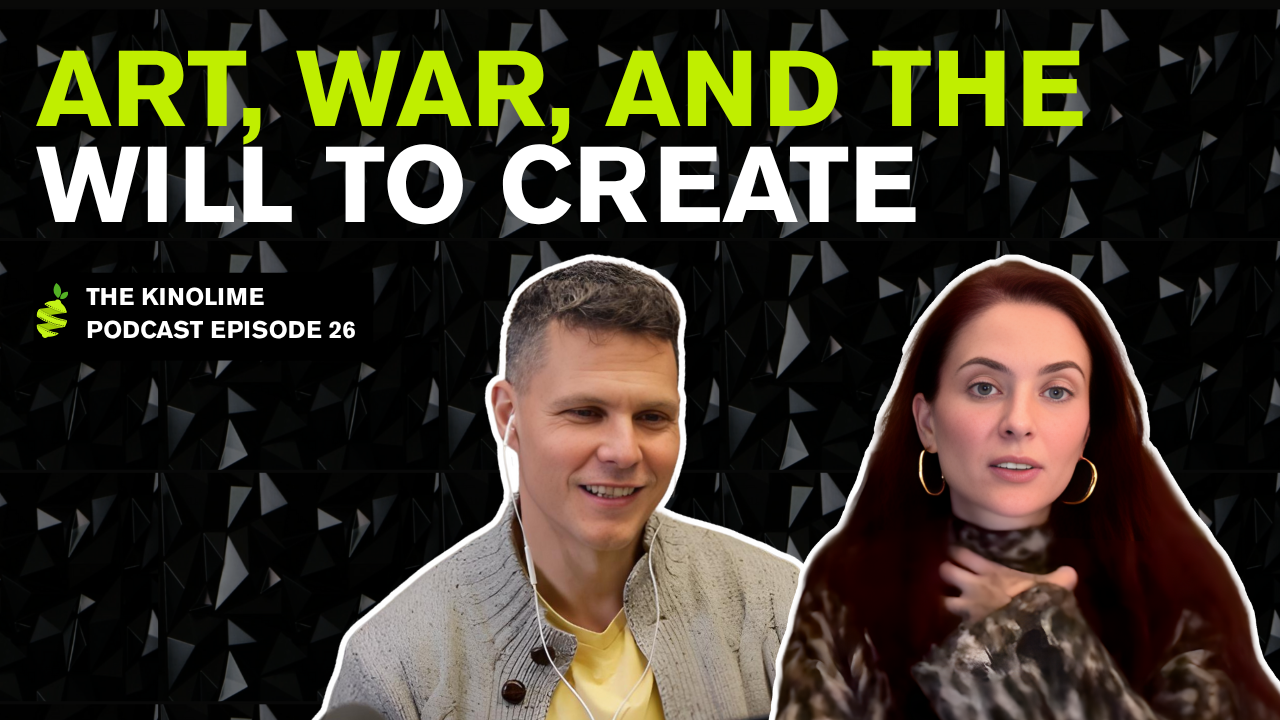
Filmmaking in War: Alice Biletska & Our House Is on Fire | Kinolime Podcast Ep 26
JS
Hosted byJohn Schramm
AB
With guestAlice Biletska
Review on your platform
00:0000:00
Show Notes
📝 Episode Overview
Join us for an unforgettable, deeply intimate conversation with filmmaker Alice Bilkestra, the first Ukrainian director admitted to the prestigious American Film Institute (AFI). Alice shares her powerful journey of returning to Ukraine in early 2023 to shoot a narrative fiction feature film completely independent of traditional insurance, navigating active missile sirens, blackouts, and strict military curfews. From the existential questions of why storytelling matters in the face of conflict to cinema's responsibility to foster radical hope, Alice offers a breathtaking look at creative resilience and the vital role of cultural diplomacy.
🚀 Key Takeaways from the Interview
Filming Under Fire: Alice and her production team shot a narrative feature in early 2023 without insurance, adapting daily schedules around active bombing alerts, blackouts, and mandatory curfews.
The Fiction Struggle: While Ukrainian documentaries are successfully earning global prestige, Alice sheds light on the steep structural challenges facing local narrative fiction films due to a necessary lack of state funding during wartime.
Combating War Fatigue: Alice argues that narrative cinema is a critical tool for cultural diplomacy, allowing audiences worldwide to look past generic news statistics and truly step into the shoes of characters facing structural survival.
Key Takeaways:
- Deviated Path to AFI: Before breaking ground as the first Ukrainian director accepted into AFI, Alice pivoted away from degrees in finance and art history to pursue her true calling in theater and short filmmaking.
- Shift to Magical Realism: Beyond her confidential upcoming film projects, Alice is currently putting the final touches on a new book that explores human transformation and the realities of war through the lens of mystical magical realism.
Full Transcript
[00:00]
I think it was a big question for all of us, you know, like, what are we?
[00:05]
Who are we?
[00:06]
Why are we telling stories?
Read Full TranscriptCollapse Transcript
[00:07]
Why is this important?
[00:09]
Is this actually even important?
[00:11]
Like is selling stories when such horrendous events are happening?
[00:15]
Is it important or is this just like an indulgement in something?
[00:19]
You know, so I think all of us and every crew member that was there, everyone knew exactly
[00:26]
where they were there because we were like, this is so important to all this story, to
[00:31]
get it out, to get it out into the world, for people to see what, you know, resilience
[00:37]
is, what love is, how it changes, how it changes, who are you in the end of the day?
[00:52]
Welcome everyone to the Keino Line Podcast.
[00:55]
Oh man, do we have a treat today?
[00:57]
We have Alice Beletska, filmmaker of Our House on Fire coming to you from Ukraine.
[01:02]
I'm in Germany right now.
[01:04]
You're in Germany right now, but a Ukrainian filmmaker who made a fantastic film, Our House
[01:09]
on Fire, which premiered in Kiev two weeks ago or ten days ago and also in Berlin.
[01:15]
So we're so excited and thankful that Alice has taken the time to join us.
[01:19]
So Alice, welcome.
[01:20]
Thank you for joining and giving us the time.
[01:22]
And man, I think I've seen photos of you as a blonde and you threw me off just now with
[01:27]
the cherry red fire.
[01:29]
I love the hair, by the way.
[01:31]
Yeah, well first of all, thank you for having me.
[01:34]
I think yeah, I dyed my hair half way through the editing process.
[01:39]
I woke up one day back in Ukraine.
[01:42]
We were massively bombed and I'm like, you know what?
[01:45]
Life is so short to be blonde.
[01:48]
So why would I not just change into dark cherry?
[01:52]
So I love it.
[01:53]
It looks great.
[01:54]
And I'm happy that you chose to dye your hair, not shave your head.
[01:57]
Yeah, yeah.
[01:58]
Because in an editing process, that could always get the inkling to just buzz it off.
[02:02]
But so you're in Germany right now.
[02:04]
So you had the premiere last week in Berlin.
[02:07]
Congrats on that as well.
[02:09]
So this must be a whirlwind.
[02:10]
I mean, you go from, you know, the impetus of the film, which we'll get to.
[02:14]
But now here you are finally getting people to have eyes on it,
[02:17]
to premiering in Kiev and Berlin and...
[02:20]
Yeah, no, I think it's always very...
[02:24]
You know, you're getting your baby out and you get people to see it,
[02:29]
you get to see reactions to hear thoughts and reviews.
[02:34]
So it's always a very, you know, in a good way stressful process.
[02:39]
And we've been very lucky because we've been getting really good feedback,
[02:45]
a lot of emotional.
[02:48]
A lot of emotional, not only just reviews, but also just by the people, you know,
[02:53]
and it was both on Ukrainian and German side, which I think is a testament to the whole crew
[03:00]
and the whole process that it's working.
[03:04]
So yeah, absolutely.
[03:05]
And what a process it is.
[03:07]
I mean, the film's great and fantastic.
[03:09]
But I'd love to go back to Alice Pre-Filmaker, you know, what got you into film.
[03:16]
I don't know the Ukrainian film world at all, so you can educate us on that too.
[03:21]
But I would love to know, like, how did you get into it?
[03:23]
Like, what would you do?
[03:24]
Did you always have a passion for film?
[03:25]
Like, tell us a little bit about yourself on the film side.
[03:28]
I wanted to be in film since I was a child.
[03:31]
And then my dad was very rigorous on me that I will end up dead somewhere
[03:39]
in the alley with, like, no nose and rotten teeth, because I'm not going to have money for anything.
[03:47]
So I got in finance degree, and then I got an art history degree.
[03:51]
So I was working a lot.
[03:53]
But then at some point, when the war in 2014 started, I was like, you know what?
[03:58]
It's too bad.
[03:59]
So I started shooting.
[04:02]
Tired films, and I started, you know, playing with theater a little bit more.
[04:07]
And then I lived in Paris for some time, and I kind of started in my theater,
[04:10]
and you're there.
[04:11]
Then back in Ukraine kind of continued with short films, experimental films.
[04:16]
And then just at some point, I was like, this feels right.
[04:21]
And I think this career is so hard that I think you better try to do anything else.
[04:29]
And I tried.
[04:30]
I was, you know, a journalist, an educator, an artist, and like so many other things.
[04:35]
But this was the only thing that felt very like, this is what I meant to do.
[04:42]
Sure.
[04:43]
And it's interesting that you went from finance, which is more left brain,
[04:49]
but then you had that you snuck in there, the art history.
[04:51]
So clearly you're drawn to the arts.
[04:53]
I would be a horrible finance.
[04:56]
It's like horrible.
[04:58]
The only class that I loved during my bachelor's degree from finance was, you know,
[05:04]
history of culture.
[05:05]
I would have been absolutely horrible.
[05:07]
And then I went to, I was the first Ukrainian director to be admitted to AFI,
[05:14]
American Film Institute in LA.
[05:16]
Wow.
[05:17]
There I got my third degree.
[05:19]
So I kind of, you know, along the way, have had the time and luck and chance to get,
[05:26]
you know, a lot of introductions to different forms of education.
[05:31]
And if I heard you correctly, you mentioned the war, but from 2014.
[05:34]
Correct.
[05:35]
Okay.
[05:36]
So then 2014, you got into, you decided to screw it.
[05:39]
I'm going to go for it.
[05:40]
And then you're making short films, you're an AFI, take us to our house on fire.
[05:47]
And that idea, obviously, you know, I don't know if you had some,
[05:51]
I would love to just know where that came from and the impetus and the creation of that.
[05:56]
So basically in 2022, the full, the full skilling of Asian started in Ukraine.
[06:01]
And I was in LA at that point, absolutely devastated and heartbroken,
[06:07]
just as, you know, every Ukrainian and I was volunteering and I was working.
[06:12]
And I was like, I can't do anything that's not connected to Ukraine.
[06:17]
And I was offered some jobs in LA and I'm like, I just physically cannot do it.
[06:21]
So I wrote a script and I was kind of, I mean, looking back,
[06:28]
it's a weird decision to write a script that's going to take place in Ukraine during the war.
[06:35]
Like logic didn't appear there.
[06:38]
Like who would finance this?
[06:40]
Who would make this happen?
[06:41]
It's like, I was just like, this is the only thing that I can do and I want to do.
[06:46]
And then luckily enough, I got to meet Brian Perkins, who is our producer.
[06:53]
And I was like, this is the script, this is the idea.
[06:55]
I want to go to Ukraine, I want to shoot.
[06:57]
I don't care that the war is still happening.
[07:00]
We have to go, we have to make it, we have to show the world what's going on.
[07:04]
You know, what it takes for a person to be part of, you know, part of this.
[07:16]
And I think what humanity is during the war and to kind of a love letter to Ukrainian people in general,
[07:24]
you know, because everyone thought that Ukraine is going to fall in three days.
[07:28]
So it's a testament to like, no, the people, the people, you know.
[07:36]
And I, so Brian really liked the script and then Brian got connected with Danny and Oleg and Israel.
[07:46]
And those guys were incredible enough to be like, let's go.
[07:52]
It's shooting during the war.
[07:54]
It was no insurance, it was no nothing.
[07:56]
Yeah.
[07:56]
You know, it's like, so we were the first production, the first narrative production
[08:04]
since the full-scale invasion got to start, you know, got to shoot the movie.
[08:09]
Maybe not the first one, maybe like the second one or something like that.
[08:12]
But it was in early 2023 and it was, it was insane.
[08:17]
It was, you know, bombs, cryptos, no electricity and just this feeling that somehow we're going through the end of the world,
[08:29]
but also the beginning of something.
[08:31]
Sure.
[08:32]
Very important.
[08:33]
Yeah.
[08:34]
And for everyone at home, that doesn't know, just to give you a little bit about the story.
[08:37]
It's about a woman who, you know, you creating, but living in Los Angeles comes home for her brother's wedding.
[08:44]
And then the invasion happens and her choices and deciding to stay and torn between family and love.
[08:50]
And it's really, really powerful.
[08:52]
But, you know, Alice and the crew like shot during the war.
[08:56]
And I'd love to know, you know, some stories about that, but they set this film, you know, with the main character's journey inside the actual war,
[09:05]
which is like pretty incredible.
[09:06]
So, like, I mean, I know everyone wants to know like, how was that like filming during the war, you know?
[09:13]
It was, you know, funny enough.
[09:17]
I think people get, you know, just used to something super fast.
[09:23]
So for us, yes, we were living, you know, like we got bombed and then I'm like, okay, everyone is fine.
[09:31]
Everyone is cool.
[09:31]
We have to continue to make the day.
[09:33]
Yeah.
[09:34]
And we're bombed during the night.
[09:36]
And then the next morning we, you know, we go to sad.
[09:40]
We have breakfast.
[09:41]
We'll discuss, you know, is everyone alive?
[09:43]
I was everything happened in it.
[09:44]
And then I'm like, okay, guys, we have to make the day because also we have the curfew.
[09:48]
So we cannot be shooting too late.
[09:50]
I'm proud of the curfew, yeah.
[09:51]
So in a way, we were not just telling this story.
[09:56]
We were living the story.
[09:58]
So in a way, I think it was a big question for all of us, you know, like,
[10:03]
what are we?
[10:04]
Who are we?
[10:05]
Why are we telling stories?
[10:07]
Why is this important?
[10:08]
Is this actually even important?
[10:10]
Like, is selling stories when such rendous events are happening?
[10:14]
Is it important or is this just like an indulgement in something?
[10:18]
You know, so I think all of us and every, you know, crew member that was there,
[10:24]
everyone knew exactly where they were there because we were like, this is so important to all this story
[10:30]
to get it out, to get it out into the world.
[10:33]
For people to see what, you know, resilience is what love is, how changes you,
[10:38]
how what changes you're in, who are you in the end of the day when you're, you know,
[10:43]
face to face with evil, what is humanity with all of that?
[10:47]
So I think as we were putting those questions on screen, we were also living through them, you know?
[10:53]
So I think it became, it became super personal for all of us.
[10:59]
Were there any close calls on production?
[11:03]
Like, is there anything that stands out at a particular event that was when you were filming it, you know?
[11:09]
Yeah, we had, we had our production design.
[11:13]
People staying on the location because they couldn't leave because of a crew view.
[11:19]
Yeah.
[11:20]
And I believe the bombs were dropped like 500 meters away from the location while they were there.
[11:28]
So, you know, stuff like, yeah, it's just, and you're like, okay, or like in May,
[11:36]
um, the bombings were insane and it would be like happening through the entire night.
[11:41]
And then in the morning, you haven't had any sleep and you still wake up at five.
[11:45]
I mean, you get up at five because you haven't slept and you go back to set it.
[11:49]
And you just basically hope that it doesn't hit you.
[11:54]
And obviously we had one of the people on, on set, you know, part of the production.
[12:00]
They were monitoring all the time, you know, if there is air sirens,
[12:05]
what kind of bombing are coming, you know, what kind of rockets or shaheads or what is it?
[12:11]
Ultrasonic.
[12:12]
So like, they were constantly tracking whether we have to close the sat or not to go to the bombshell.
[12:17]
So like things like that, which, you know, being there, you make it feel normal
[12:25]
because you have to normalize it to go through it.
[12:28]
Then obviously looking back, you're like, oh, damn, that was.
[12:31]
Yeah, I remember speaking of Brian, yeah, you know, we were giving some notes on the script.
[12:37]
They were one of the early drafts and he was just, they were just talking about just,
[12:40]
oh, I was just, you know, how to go into the bombshellter before like we're being
[12:44]
bothered with air siren.
[12:44]
It was just, you know, for someone who's never been involved in that, very jarring.
[12:48]
And he was just sort of like, this is what you do.
[12:51]
And, you know, you're, you're trying to live and then same time make art.
[12:57]
It's right, it must have been interesting.
[12:58]
You mentioned something about how war changes you.
[13:01]
I'd love to know how war has changed you as a filmmaker.
[13:06]
I think the way it changes you as a filmmaker, it kind of,
[13:14]
makes you understand what's actually important and what's not.
[13:16]
And then at some point you look at a lot of movies and you have really hard time relating to it
[13:22]
because you're like, guys, it's not a problem, you know, or this is now what the world is.
[13:29]
Or, you know, the behavior of the characters quite often you look at it and you're like,
[13:35]
it's super infantile or quite often, it's just, it doesn't reflect
[13:44]
the struggle that's actually going on in the hearts of people because, you know,
[13:50]
the world is, is falling apart.
[13:53]
So I think cinema has that responsibility, either to reflect it or to give an answer
[14:04]
or to some kind of a feeling of what could be done for either to stop it or to survive it.
[14:12]
So I'm in big believer this days and to in movies about
[14:18]
transformation, about belief, about hope, about how we should be helping one another to go
[14:28]
through whatever the hell is happening, you know, and how we can be the radical change in the
[14:33]
system for it to never happen again. So I think from that perspective, like I didn't watch
[14:38]
when the war started, when the full-scale invasion happened, like I didn't watch movies for like a
[14:43]
year because it was like, I'm like, I cannot relate to quite a lot of issues of people because it
[14:50]
just doesn't seem, you know, or I could have been watching a lot of like fantasy movies.
[14:54]
Yeah, yeah, just to get out of it. Yeah, I can imagine.
[14:57]
Just like a complete ask if it is. So yeah, I now believe a lot in the movies that are
[15:04]
but love about freedom about humanity about just this, how do I believe in what can be changed to
[15:14]
try to prevent this, you know. How has the Ukrainian film business evolved since the war?
[15:22]
I don't, again, maybe you can educate our viewers and everyone on the Ukrainian side,
[15:26]
but are there a lot of films being made right now? Is it, you know, all dead?
[15:33]
So there's been a lot of documentaries have been done and some amazing documentaries,
[15:40]
like on my editor, he's also a director of a great movie that got into Can, Film Festival,
[15:47]
and you know, our production cows that we worked with, Taber, they got to produce some fantastic
[15:52]
documentary films that are like traveling over the world, but obviously, it's just a
[15:57]
little bit too soft to know who won an Oscar for his documentary. So I think documentary
[16:02]
world is developing, but fiction is tough because there is basically no state funding to be shooting
[16:12]
narrative things, which I think is a problem because obviously, when some whites happen,
[16:19]
because the money is going to, you know, to the front lines and like to more things that are
[16:25]
urgent these days, but also I think where unfortunately Russia is winning is they produce so many
[16:35]
movies, they produce so many propaganda movies that travel around the world and they create this
[16:43]
narrative above Russians in general, you know, so I think this is where the cultural diplomacy
[16:49]
of Ukraine has to be much stronger and I think in general, if you look in the history, you know,
[16:56]
when, when, whatever government comes to power, they usually invest a lot of money into culture,
[17:01]
because when they understand that's the front where that can be change in and integrating those
[17:07]
new values and all of that. So, Ukrainian Ukraine has a lot of incredible filmmakers, super talented ones,
[17:15]
you know, before the film was based on a lot of pictures and festivals and etc.
[17:21]
But this day, it's quite complicated. Yeah, that's interesting you talked about the cultural
[17:27]
diplomacy. You know, obviously we know the bad versions of how the Nazis did their propaganda,
[17:35]
but then you have post-World War II, the Americans, the French, and the British, you know,
[17:39]
making hopeful films about how to rebuild and what was life like in a post-World War world.
[17:47]
Hopefully, Ukraine can scratch up some funds or other countries can chip in to make sure those
[17:52]
voices have an avenue to make those films, because I think that's post-World War II. You see,
[17:58]
even like Tolkien who wrote, but lower the rings, right? It was about his experience from the
[18:05]
front lines in World War I and what he saw. So, I think there's a lot there that we could learn from,
[18:10]
and we, you know, it's so desperate to get those funds, yeah. Yeah, and I think in general, like,
[18:15]
art of 20th century is just a witness of the radical change because of the war, you know, and
[18:22]
everyone that questioned, like, is there a world after, you know, Auschwitz or all of those things.
[18:30]
So, I think it needs to be much more stories, need to be told. Also, for people, because
[18:36]
in the Western world, a lot of people are a bit tired, you know, from that kind of whole narrative
[18:42]
about the war, and everyone is like, yeah, it's been going on for quite some time at this point.
[18:47]
And everyone's like, yeah, I think creative narrative movies is actually, that it becomes so much
[18:53]
more emotional engaging because you get invested into the characters. Yes.
[18:58]
With the characters, you get to move along and you get to be in their shoes, and then you get to
[19:03]
go home and be like, oh my god, what would I do? Yeah. If that happens to my family, if that comes
[19:10]
to my house, what do I do? And I think the more people pose those questions, the better it is for
[19:17]
the entire world in general, you know? Couldn't agree more. So, let's talk about some happy things. So,
[19:23]
you make this movie. This is your first narrative feature. And you put the hard work, you're editing,
[19:30]
you're dying your hair. Now, the first premiere in Kiev, right? Take us through what you're feeling,
[19:38]
that opening night, when all your hard work, you know, and almost, you must feel like you have a
[19:44]
country on your back too, right? Like this for this film, you know, in a way. Yeah. It was, I was so nervous
[19:53]
that I couldn't even think clearly. And I think the moment when you see the entire room of like
[20:01]
three or 400 people, you know, go in there and you're like, oh my god. Yeah. So, I couldn't watch the
[20:08]
movie with them because I'm like, there's no way. But I think what was scary for me is that,
[20:17]
when we were shooting the movie in 2023, I didn't think, and none of us thought that we were going
[20:24]
to be showing the movie still during the war in 2025. Yeah. That's interesting. Yeah. You know,
[20:33]
because I was sure that by the time we're going to be screening it, that's it. You know, your
[20:38]
cream is going to win. So I think it was that. And we got so many such emotional feedback. And I
[20:49]
think for a lot of Ukrainians, you know, it's insanely hard to watch because it gets you back to
[20:57]
20 years. That mindset. Oh, yeah. Oh, yeah. And it's tough, you know, and I think it's kind of also
[21:05]
a good testament to the movie in general that it's so realistic in the emotional portrayal of what
[21:13]
was happening and for this family. It's right. People are like, oh, we were in board all the time.
[21:21]
So I think for me, that was important to people like we a lot of people said that, you know,
[21:27]
they had some kind of sort of catharsis because you see the story on screen,
[21:33]
or some of them were like, this is insanely hard to watch. Yeah. I can see that.
[21:39]
Oh, yeah. But it was, I was nervous, but it was, you know, key of, you know,
[21:44]
created us very warmly. And that was, that was very important. Not just for me for the entire,
[21:50]
you know, crew and producers. I mean, everyone, it's, you know, it takes a lot to make movies.
[21:56]
Yeah. And especially one with such, you know, subject matter. And like you said, it's still going.
[22:02]
And who knows when it will end. But what, what is next for you? You know, so now you have this movie,
[22:09]
you've birthed this child. It's out in the world now, right?
[22:13]
To a degree. So what is, what's next with you? What are you working on? What do you want to do?
[22:20]
So I'm finishing a book right now. And yeah. And what's it about?
[22:27]
So it's, it's actually connected to the world as well. But it's kind of more in the vein of magical
[22:32]
realism. And that I get that, you know, every new door that the character opens, she gets to the
[22:39]
new version of herself, to the new city and to the chin of the, of the world. So it's kind of
[22:44]
that idea that we have so many sides of us. And it's interesting, you know, it's magical realism.
[22:53]
So it's much more brutal and honest and mystical and all those things. So I'm finishing that. And
[22:59]
then I have a couple of movie projects that I cannot talk at the moment. But yeah,
[23:04]
things are interesting. So, you know, movie business. So what is one thing that you could give advice
[23:09]
to filmmakers, writers that has helped you through your journey or anything that you've learned
[23:14]
through this filmmaking process that you would love to share? Oh my god. Well, I mean, this
[23:20]
will build me a couple of times. And I think in general, the more I talk to filmmakers,
[23:26]
especially have experience with like, you know, longer form mats, you die a couple of times
[23:34]
making it. And then you kind of got resurrected. And then you die again. And since you got a
[23:41]
it's it's it's a brutal process. It's beautiful, but it's brutal. So I think what's important is
[23:50]
I mean, I have a whole I've been created a whole notebook for myself of things that I've learned
[23:55]
into this. Like it was doing pre-production production post-production. So it's a pretty step up
[24:03]
the way. I'm like, where did I fuck up? How to not do this again? And I remember I was working back
[24:10]
in the day. I was working as an assistant of a director on a featuring LA and used to like every
[24:15]
evening he would sit down and he would write all the mistakes that he did. Oh, I love that.
[24:19]
And it's great attitude in general. Like it thinks you forget things so fast. So fast.
[24:28]
So I think here is like constantly being like, okay, okay, what are the other things? But I think it's
[24:33]
also have the belief of what you're saying is important and why is important? Have an amazing
[24:43]
team of people who both support you, but also whose opinions you trust enough to challenge you.
[24:50]
And this way the movie is going to become so much better. Yeah. And don't die over doing this.
[24:59]
If the word die is going to be in there, it's going to be hair, right? That's the only thing to say.
[25:04]
Die your hair. I die your hair. Well, it's just great. I mean, they do say to change it up, right?
[25:09]
If you're creatively stuck, I know Aaron Sorkin when he went to change the weather, you know, some people
[25:15]
change their hair. It's I get it. But don't you remember me? I said, love it. But Alice, thank you so
[25:23]
much for taking the time today to join us. If you're in New York next, come by the studio. Let's do
[25:28]
an in-person interview. We'd love that. We'd love to have you here and best of luck. And everyone,
[25:34]
we don't have details yet, but our house on fire will be coming at some point. We can stream it.
[25:39]
Watch it, support the film. It's incredible made by an amazing filmmaker. So, Alice, thank you
[25:44]
so much for joining today. Thank you for having me and asking such wonderful questions. Okay, my
[25:49]
pleasure. I'll speak to you. Yeah. Ciao.