
Master the Fundamentals of Screenwriting & Building Stories that Stick | Kinolime Podcast Episode 19
DM
Hosted byDanny Murray, John Schramm
Review on your platform
00:0000:00
Show Notes
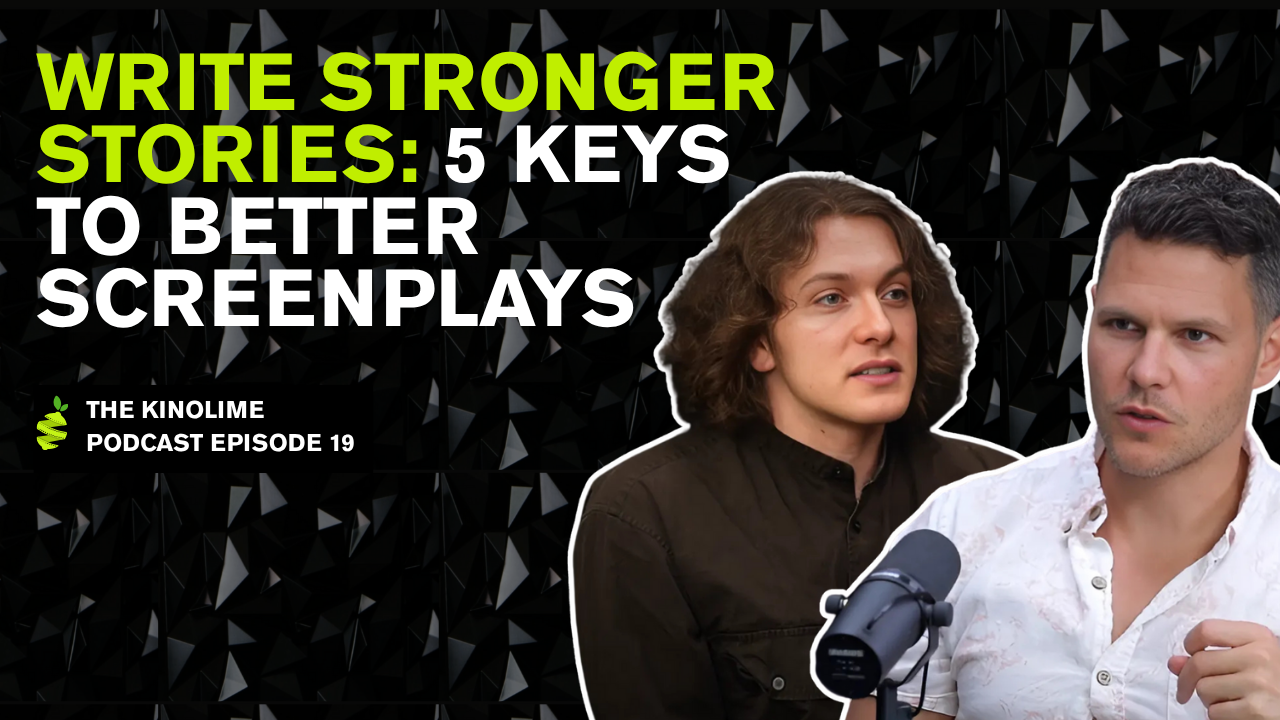
John and Danny provide an encouraging overview of the current Hollywood spec market, noting an increase in sales compared to previous years. To help writers prepare their screenplays, they offer five tips:
Focus on the Premise: A compelling premise is essential because producers and studios often purchase a script for its underlying idea. When presenting stories to industry professionals, ensure your logline is clear, elevated, and effectively communicates the film.
Make Descriptions Stylistic and Concise: Avoid overly long blocks of text and try to include more "white space" on the page. Use these brief descriptions to establish your unique voice, tone, and the pace of the story rather than just providing utilitarian details.
Establish a Central Narrative Question: Every screenplay needs a "burning question" that drives the reader to want to see the conclusion. This does not necessarily need to be a mystery, but it must be a compelling goal—such as a character overcoming a personal obstacle—that you test by checking if the reader cares about the resolution at any point during the script.
Use Subtext in Dialogue: Avoid "on the nose" or purely expositional dialogue. Instead, rewrite lines to convey information through character-specific tone and style, ensuring that every line reveals something about the character or what they are afraid to say.
Create a Strong Antagonist: A great antagonist should stay a step ahead of the protagonist, keeping them at a disadvantage and creating a significant mountain to climb. This constant pressure helps maintain narrative tension.
Full Transcript
[00:00]
cool exercise you can do at home when you have some dialogue that maybe feels a little
[00:04]
on the nose or expositional.
[00:06]
Okay, write the exposition first.
Read Full TranscriptCollapse Transcript
[00:08]
That's fine.
[00:09]
But then how are you going to say what you're trying to say in another way?
[00:13]
You're saying, will you go with me to the dance?
[00:16]
Is there like another way to say that that's more characteristic like, hey, like, got
[00:21]
planned Saturday night?
[00:22]
Like, that's a bad idea.
[00:23]
But take what you want to say from exposition and say it another way that's more inherent
[00:29]
in the characters like tone style, etc.
[00:32]
All right.
[00:41]
For all you spec writers out there, there was some great news that was released on
[00:44]
no film school and some other outlets a few weeks ago regarding the spec market in Hollywood.
[00:49]
All right.
[00:50]
So as of the time of the writing, I think it was mid-August, there was eight spec sales
[00:55]
in the month of August compared to, I don't know, four or the year prior or year or whatever
[01:00]
it was.
[01:01]
The numbers were very encouraging for the spec market, which really boasts well for you
[01:06]
writers out there that want to try and sell your screenplay.
[01:09]
All I heard was when I came into the business that the spec market's dead, known as buying
[01:12]
specs, and you keep hearing that, hearing that, hearing that, and it's a little discouraging.
[01:15]
But now, spec market seems to be on an uptick thanks to weapons and centers and some original
[01:20]
movies.
[01:21]
So we have some tips for you to get your script ready for the spec market.
[01:24]
Boom, that's going to happen because I really feel a common.
[01:27]
John Tram here.
[01:29]
Danny Murray, see you.
[01:30]
Let's get right into it.
[01:31]
So we're going to give you five tips.
[01:33]
I'll go first just because I have three of two.
[01:35]
It'll be easier.
[01:37]
For my tip, when I'm reading any spec screenplay that's submitted to me or to the company, is
[01:42]
I'm all about the premise.
[01:43]
Premise is king, queen, everybody.
[01:45]
It's the land.
[01:46]
How this thing operates.
[01:47]
I want smart, inventive.
[01:50]
I want to see your film.
[01:52]
I know it sounds cliche, but it really does.
[01:54]
I want that hook.
[01:55]
Like, what is it that I'm going to be investing two hours of my life reading going forward?
[02:00]
And I think premise is the idea, you're putting it this way.
[02:04]
They're not buying your screenplay for the rewrite.
[02:07]
They're buying it for the idea.
[02:09]
So that's my idea number one is premise is king slash queen.
[02:12]
Day, your...
[02:13]
Before I even get on mine, like something all of a sudden, what John said about premise,
[02:18]
when I'm talking to people that work at other production companies, studios, other CEs,
[02:23]
and you are talking about stories that you're working on or scripts you've optioned and
[02:29]
potentially co-financing partners, things that people could have an interest in or help
[02:34]
you develop, they will usually say, hey, can you just send me a list of log lines?
[02:39]
And I'll just pick out which one thinks interesting, send me that script.
[02:42]
So your premise is pretty much that log line needs to be so original and elevated that
[02:51]
anyone that works at a studio in that list of great scripts that got purchased, what
[02:56]
want to look at?
[02:57]
Well, I would say it doesn't have to be, like I said originally, yeah, you wanted to
[03:01]
pot, you wanted to be able to see the film in that log line because it could be a drama
[03:07]
that maybe won't, it's not end of the world drama, but something that you could just see
[03:10]
it.
[03:11]
I think I don't love premises, premises, whatever.
[03:14]
When I read them, I don't, I can't decipher what's going on.
[03:18]
It's like, it was in different orders, you know?
[03:20]
So definitely work on your premise, make sure it pops.
[03:23]
D, tip number two.
[03:24]
Yeah, I would say, you know, as someone who this month will probably read 300 screen
[03:29]
plays, short, great, short film screen plays.
[03:32]
One thing that will take a script from amazing to great to okay, to maybe just forgettable
[03:40]
is if a writer's descriptions don't feel personal, you know, every writer knows the
[03:46]
whole, you know, keep your descriptions down to like four lines, try to keep them concise.
[03:52]
But something that I think it's lost is that is your real place where you can maybe make
[03:59]
your story really identify your voice as a screenwriter and your style as a writer.
[04:05]
And that seeps through to every other part of the story.
[04:07]
I remember in our last competition, a screenplay that we optioned, a character would be introduced
[04:12]
and the description would say something like, you know, this guy looks like a chemo patient
[04:18]
who got kicked down a flight of sticks.
[04:20]
Yeah, and in the great stories that I read, you could kind of just feel who this writer
[04:26]
is and what the style and pace of this story is going to be just from these really brief
[04:32]
descriptions.
[04:33]
Try not to just be brief and concise.
[04:36]
Be brief, concise and stylistic.
[04:38]
Love that.
[04:39]
To how you want the story to be and who you are as a writer.
[04:42]
And I'll hop on the brief part because it's very difficult for me to get through a screenplay
[04:47]
where I see like blocks of scene description.
[04:51]
Like the people just go into too much detail.
[04:53]
I think we love to see again, another cliche white on the page.
[04:58]
We just want to see a little bit of white.
[04:59]
I'm not one that needs to see a lot of white.
[05:01]
I know a lot of executives that I know producers want to see a lot of white.
[05:04]
I don't need a lot of white.
[05:05]
I just don't want to feel like I'm slogging through the description when like you could
[05:09]
do it from like six lines into two.
[05:12]
I think really tighten that up because you want to get to the meat of what's going on
[05:16]
in the scene quickly.
[05:18]
So all right, that's a great tip.
[05:19]
Tip number three, for me, a big one here is the burning question or what I would call
[05:25]
like the central narrative question.
[05:28]
I want to see, give me a question that I need the answer to at the end of your screenplay.
[05:32]
And it's like to be a mystery like a who done it.
[05:34]
Like I want to know like will the girl get the guy?
[05:37]
Will the father forgive his son?
[05:38]
Like I need to have that question.
[05:41]
I would love that question to linger when I'm reading because that's what I want to get
[05:44]
to the end of the read for.
[05:46]
I want to see what the end of that movie is.
[05:48]
That's why great novel writers can do that.
[05:51]
There's some question at the end.
[05:53]
And it's not to be so big like a mystery like I mentioned, but just something that I want
[05:57]
to see resolved or some cathartic or catharsis to happen.
[06:02]
So I really look forward to that when I get a good screenplay that I see that is I'm
[06:06]
like, Oh, I really need to know the end of this.
[06:08]
And how I judge this, I do a test, I'll like flip a screenplay and stop anywhere.
[06:12]
And I'll be like, do I kids page 67?
[06:14]
Do I care to read the end of this?
[06:16]
Is there a question that I need the answer to?
[06:19]
Most of the time it's no.
[06:20]
And that's how I know the screenplay doesn't hold weight for me.
[06:22]
So that's tip number three.
[06:24]
D, give us number four.
[06:26]
I would say, you know, when you're writing dialogue, make sure that even if it's just something
[06:33]
subtle, pretty much every line of dialogue should have some sort of subtext to it.
[06:40]
You know, if this is a spec, like I need to learn something from everything your character
[06:47]
says, what they don't say, maybe 10 times so far.
[06:52]
I've read about like 15 scripts today.
[06:55]
Almost all of them, you know, there will just be dialogue.
[06:58]
It's on the nose, yeah.
[06:59]
But you know, even if it relates to the plot, like if I am not learning who this character
[07:06]
is, what they're afraid to say out loud, different parts of them from every scene they're
[07:12]
in, you're wasting a scene.
[07:13]
I agree.
[07:14]
You know, you need to kind of orient your characters to make them complex beings that actors would
[07:20]
want to, you know, embody.
[07:22]
And a cool exercise you can do at home when you have some dialogue that maybe feels
[07:27]
a little on the nose or expositional.
[07:29]
Okay, write the exposition first.
[07:31]
That's fine.
[07:32]
But then how are you going to say what you're trying to say in another way?
[07:36]
You're saying, will you go with me to the dance?
[07:39]
Is there like another way to say that that's more character-centric?
[07:42]
Like, hey, like, got plans Saturday night?
[07:45]
Like that's a bad idea.
[07:46]
But take what you want to say from exposition and say it another way that's more inherent
[07:52]
in the characters, like tone style, et cetera.
[07:55]
Say without saying it.
[07:56]
Pretty much in, you know, try to do that in every line of dialogue that you possibly
[08:01]
have.
[08:02]
Yeah.
[08:03]
Just do something to challenge your characters underneath what they're actually saying.
[08:07]
Exactly.
[08:08]
TIP 5.
[08:09]
TIP 5.
[08:10]
Last one.
[08:11]
I'm all about that bad guy or bad person.
[08:13]
I think the antagonist must, I just, there was a spec screenplay that I read or I think
[08:19]
it's sold at the point.
[08:20]
It was called the infiltrator.
[08:21]
I forget the author's name.
[08:24]
Someone scooped it up.
[08:25]
And one of the best villains, like I've ever read on a screenplay.
[08:27]
I don't know even why they made this.
[08:29]
They haven't made this movie or they were trying to do a series about it.
[08:33]
Anyway, it was incredible and it got me turning the pages and not just make a great bad
[08:38]
guy because again, that's cliche.
[08:40]
But stay a step ahead of your protagonist.
[08:42]
I want a bad guy, an antagonist that just is kind of always ahead a little bit and it
[08:47]
again doesn't have to be like a murder mystery, you know, a killer you're trying to get.
[08:52]
But if something internal, you always want to feel that your protagonist is at a disadvantage
[08:58]
all the time to your antagonist.
[09:00]
I need that mountain to climb in a story to see will this person overcome this obstacle
[09:06]
in a force of antagonism.
[09:08]
So that's tip number five for me when I'm reading a spec.
[09:10]
Yeah.
[09:11]
So follow these five tips.
[09:13]
These are what we look for at a screenplay and hopefully you've found it enlightening and
[09:17]
inventive and we can't wait to read your screenplay.
[09:19]
Yeah.
[09:20]
Less description.
[09:21]
Whenever you finish applying these tips, come on down to kennelam.com.
[09:25]
Write a short, put it in our competition.
[09:28]
We'll read it.
[09:29]
Maybe mirror well.
[09:30]
We have a couple other guys.
[09:31]
It'll be great.
[09:32]
We talk about everything.
[09:33]
All right.
[09:34]
Thank you so much and keep writing.