
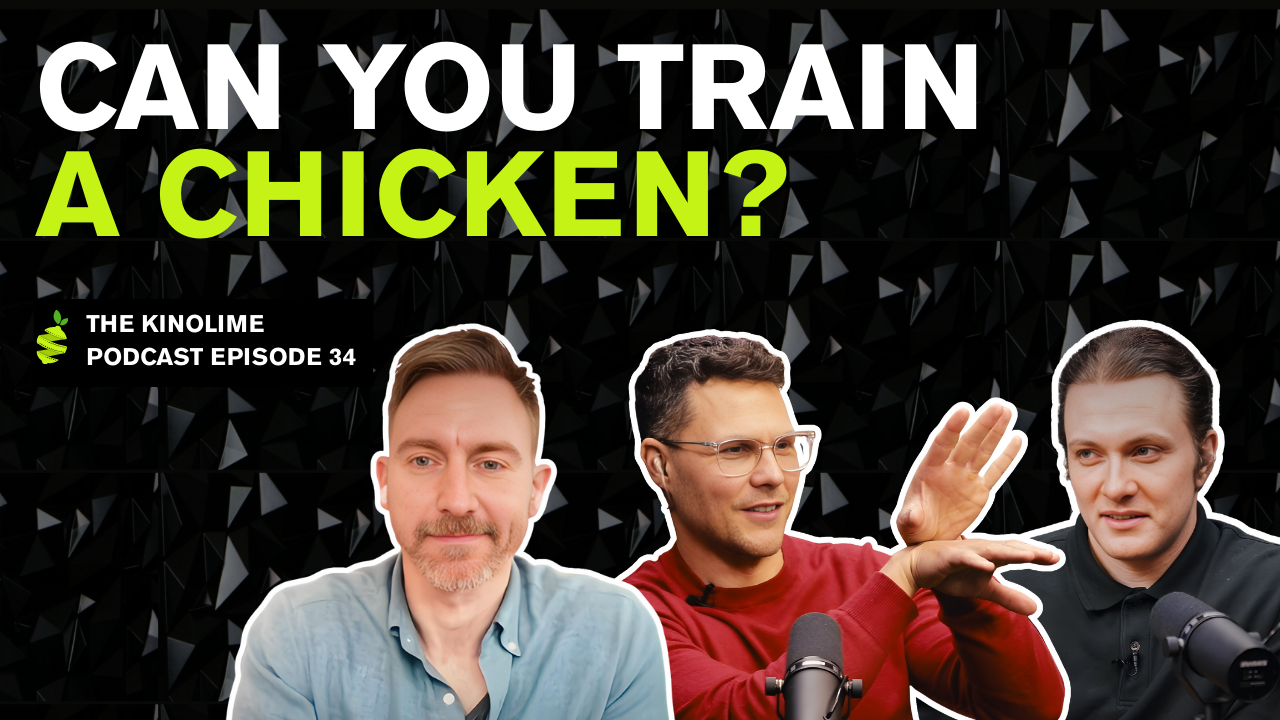
From the Chicken’s POV : Ian Samuels on Bringing Chicken to Life | Kinolime Podcast Ep 34
JS
Hosted byJohn Schramm, Danny Murray
IS
With guestIan Samuels
Review on your platform
00:0000:00
Show Notes
Ian Samuels discussed the development of his short film Chicken, which became a favorite among the Kinolime team during the competition. The hosts explained that Kinolime provided additional financial support to help move the project into production, praising Ian’s unique vision of making a chicken the emotional protagonist of the story.
Ian also described the film’s visual style, emphasizing immersive low-angle camera work and POV shots inspired by wildlife footage and directors like Darren Aronofsky. He referenced experimental ideas such as attaching a camera rig directly to the chicken to create an intimate perspective where the audience experiences the world through the protagonist’s movements and reactions.
The discussion then shifted toward the realities of independent filmmaking, particularly financing challenges. Ian explained that while he hopes to shoot the film soon, the timeline depends heavily on securing additional funding. If financing falls short, he plans to creatively scale back certain production elements while preserving the emotional core and artistic intent of the project.
The conversation concluded with reflections on Ian’s lifelong interest in filmmaking, including childhood movies he made using his cats as actors. The Kinolime team thanked him for sharing his work and encouraged him to continue collaborating with them in future competitions. Ian noted that the competition gave him the momentum and confidence needed to push the project toward production.
Key Takeaways:
- major part of the conversation focused on the challenge of filming with a live chicken. Ian is working with a professional bird trainer and plans to combine real animal footage with puppetry and carefully designed POV cinematography. Rather than requiring the chicken to “act,” the film will rely on editing, eyelines, framing, and movement to emotionally connect the audience to the chicken’s perspective.
Full Transcript
[00:00]
I'm in touch with an animal trainer, a chicken trainer.
[00:03]
Who's excited about it and then there's going to be some puppetry too.
[00:07]
So we're figuring that out.
Read Full TranscriptCollapse Transcript
[00:09]
Can you train a chicken?
[00:10]
I will find out next week when I meet with this trainer who is,
[00:15]
she says she just got off a pigeon show so she's been working on this.
[00:19]
You can train I know. I don't know.
[00:21]
But she gets it supposed to be pretty smart.
[00:22]
I think we'll see TBD.
[00:30]
All right, Kino Limer's welcome. We have today with us Ian Samuels,
[00:38]
the writer of chicken and final three contestant of the short film competition.
[00:43]
We just wrapped a Kino Limer a few weeks ago.
[00:46]
Ian's with us live. Ian, what's up, man? How's it going?
[00:48]
Hey, great, great to see you guys again.
[00:51]
Yeah, you know, since we last spoke, obviously the competition ended.
[00:56]
Kino Limer loved your screenplay so much that we wanted to give you some additional
[01:02]
funds to provide you to making your dream a reality on your short film,
[01:07]
chicken, which is like, it's been an in-house favorite since like day one.
[01:11]
Danny was really big on it. I love chicken.
[01:12]
It turned loose on me and it just grabbed a hole to me.
[01:14]
Again, I told the sea and you like I got so angry watching Good Boy because I'm like,
[01:19]
you know, this is fine. But if there was ever a, you know,
[01:23]
dialogue with protagonist, that's an animal that needs to be on screen.
[01:27]
It should be a chicken. It should be a chicken.
[01:29]
So Ian, like, update us what's going on with you and check in and give us, give us all the,
[01:34]
the juicy. Yeah, well, you're, we're, so we're trying to figure out now how to put it together.
[01:41]
And I have, you know, I have a team that is ready to make it.
[01:49]
I think right now the question is just about, you know,
[01:53]
showing up extra funds to put it together. But I'm in touch with
[02:00]
an animal trainer, a chicken trainer.
[02:03]
It was excited about it and then, and then there's going to be some puppetry too.
[02:09]
So we're figuring that out. Can you train a chicken?
[02:13]
I will find out next week when I meet with this trainer who is,
[02:18]
she says she just got off a pigeon show. So she's been working for a while now.
[02:23]
I don't, I don't, but chickens are supposed to be pretty smart. I think we'll see TBD. But I think,
[02:29]
you know, the way that I've written this, it's, it's in some ways that the chicken is a little bit
[02:36]
like a puppet where you, you know, I will, we'll board the shots that we need to tell the story.
[02:41]
And then it'll be about capturing the chickens' eye line, looking at the right direction.
[02:48]
And then by association telling the story, she doesn't actually have to perform much.
[02:52]
At least, you know, there's no crying chickens or, yeah, I feel like you could have a POV shot
[02:58]
and then just like the beak on the bottom portion of the, the, the shot and just like the beak
[03:03]
and it's like going this way and you could just, yeah, we'll see what, after I talk to her,
[03:09]
we'll see what, you know, how much will be done with a real chicken and how much of the sort of,
[03:14]
there'll be an element of puppetry in here and that we can shoot over the shoulders
[03:19]
to keep the sort of, or, you know, for, and a wider shot, maybe we can get away with some puppetry,
[03:29]
but, you know, or are we doing a little bit more first-person shooting to tell the story.
[03:34]
So I need to talk to her about what's possible, then I think we'll find out on set too what we can,
[03:41]
well, we can pull off, but I'm like, I need to know how this ends up because like,
[03:48]
if you can't trade a chicken, then are you going to option or audible to another animal,
[03:53]
you know, or is it got to be the chicken? We can trade a chicken. We can trade a chicken. At least,
[03:57]
maybe not training, I'd say we can wrangle a chicken. We'll get the chicken in the right spot,
[04:02]
looking in the right direction. Yeah. Yeah. And we'll get the shot. I went up my, one of my first
[04:07]
movies I did was in, I was in fifth grade and I did Beauty and the Beast with my two cats,
[04:13]
and I'm not an animal trainer, but, so I, this has been in my, it's been my destiny for a while now.
[04:20]
Please tell me how your cats doing the, the waltz around the room is spinning. Yeah,
[04:25]
we set them up with it. My dining room table, I put food in front of them and film them walking
[04:31]
in different directions and, yeah, you can tell the story. That's great, then.
[04:35]
What's, when do you think, let's say, all goes well in your ventures of sorn up the last bit of
[04:41]
funding? When, when do you anticipate rolling camera on chicken? I think, you know, I'm trying to be,
[04:50]
to, to shepherd this through and there's a version where we shoot it in,
[04:55]
in March, if I can get the financing together, that's the big question. But otherwise, that's what I
[05:04]
am looking at. I got a bit of a hard question that in it's always something we, we, and we deal with
[05:09]
it too, right? It's like, don't have enough funds or your short funds. Um, like, my friend,
[05:14]
filmmakers, that, that happens all the time. What do you do? Because you seem like the person's
[05:19]
going to make this come hell or high water, right? So what do you do if the funds aren't there? Like,
[05:24]
you know, you're, you're still pushing through like, what is the plan? And I think it's,
[05:28]
it's important for filmmakers to hear this because it is like, something we face all the time.
[05:33]
In regards to making art, right? It's like, unfortunately, you kind of need the financial component.
[05:39]
Yeah, I mean, so I got to be because too, too paths to take then one is to keep pursuing the,
[05:50]
the financing and then, and then another is to sort of see where we can, you know, if there are
[05:57]
areas that we can scale back. Um, so, you know, treat the short a little bit differently,
[06:04]
be a little more creative about how we're shooting it to this less expensive. So we'll, we'll see,
[06:08]
which I have some ideas there. But the, the version that I want to make I, uh, ideally is, uh,
[06:15]
is top of my now. Do you feel like, because I guess I keep, you know, since first time I read it,
[06:21]
I kept thinking about kind of like the way you're going to be shooting. I know that it's like the,
[06:26]
the kind of chicken camera necklace is like, you know, part of it, right? Or like, uh, like a go pro,
[06:32]
kind of like, strapped around the chicken a bit, right? Are you kind of expecting most of this
[06:36]
to be like handheld? Like, is there, is there going to be a world where like, uh, if I'm home in
[06:42]
Los Angeles, I'm driving around, I'm going to see you like, you know, running around with like a
[06:46]
camera, a chicken trainer. Hopefully, yeah. You know, you're thinking like primarily handheld for the,
[06:53]
uh, uh, majority of like the journey shots. Yeah. I think, you know, we'll be,
[07:01]
yeah, I mean, I'll talk to my DP about how we want to approach it. But yeah, the camera will
[07:06]
be low to the ground, whether it's completely handheld or maybe it is on a little bit of a rig and
[07:12]
we're moving to the space for the chicken. Um, I think there was, I had this, I don't know if
[07:19]
it's possible, but I had this, you know, image at one point, it was those, um,
[07:27]
Darren Aronovsky snorey cam shots where he rigged the camera to the actor and the world is
[07:33]
moving around them. I thought, oh, wow, what if you could you do that with a chicken?
[07:37]
It's for that. As she moves her head around, you know, the chair stuck with her point of view.
[07:43]
Well, did you ever see that? I don't know if you're just like, I've seen that with Eagles or Falcons,
[07:46]
they've tied, they've attached to, have you ever seen those videos through their wild?
[07:50]
You see the birds like the hawks go like, that's incredible. Yeah, I really get into her.
[07:55]
Yeah. Her world and perspective, there's this shot that the car shot, the moonroof shot, where she,
[08:01]
she, she's, she's seeing the sort of the abstracted lights of the city. And we're going to get really
[08:09]
macro shots and the reflections in her eye and, you know, it reminds me a little bit also that, um,
[08:17]
that man shot where the Joker is leaning out of the car door. Yeah, yeah.
[08:21]
You know, in the world is sort of swirling by and swimming down the street. Yeah. Yeah, but
[08:26]
to get that kind of feeling, but with the chicken. So I, I, yeah, I think the idea is to be in her
[08:34]
point of view as much as possible. The world is pretty abstract that the extras are mostly legs,
[08:40]
except there's a kid in it that you see his face. But generally, yeah, we're, we're really
[08:46]
with her. Has this changed your relationships to chickens? Like, are you eating chicken?
[08:53]
How do you look at a chicken now? Different? Yeah, the, consider this is my, um,
[09:00]
conundrum. I, I love animals and I love eating them and I don't know how to reconcile that.
[09:06]
But yes, I am still eating chicken. All right. Um, but yeah, my dream is actually to have a chicken
[09:12]
of my own. So maybe this will be the incentive to do that. Well, whether it's a chicken of your own
[09:19]
or you're shooting your first frame, uh, we're so excited to see where your journey goes with chicken.
[09:24]
It's been an amazing, you know, experience for us to be a part of your journey. And we really
[09:29]
want to thank you for trusting Keenaline with your story and your vision. And we're like, we're
[09:34]
your biggest fans. So, you know, please keep us updated on as everything comes in. We just,
[09:39]
you know, wanted us to check in and say hello and, you know, hopefully, uh, you start rolling camera
[09:43]
soon. Yeah. Thanks for all your support. This, this, uh, competition definitely gave me the kick
[09:49]
that I needed to, um, to get this rolling. So I appreciate that. Well, we got to feature film
[09:55]
competition starting top of next year. So if you got a feature screenplay, send it into us. We love,
[09:59]
we love your work and love you as an artist. So Ian, thank you so much. Uh, and happy holidays.
[10:04]
Thank you. You too. All right. If you're a screenwriter, filmmaker, you've got to listen up
[10:08]
because here at Keenaline, we're opening up our third annual feature film 3.0 screen running
[10:12]
competition January 23rd to March 15th.