
Mob Mentality Deep Dive: What Made This Script Win? | Kinolime Podcast Episode 11
JS
Hosted byJohn Schramm
Review on your platform
00:0000:00
Show Notes
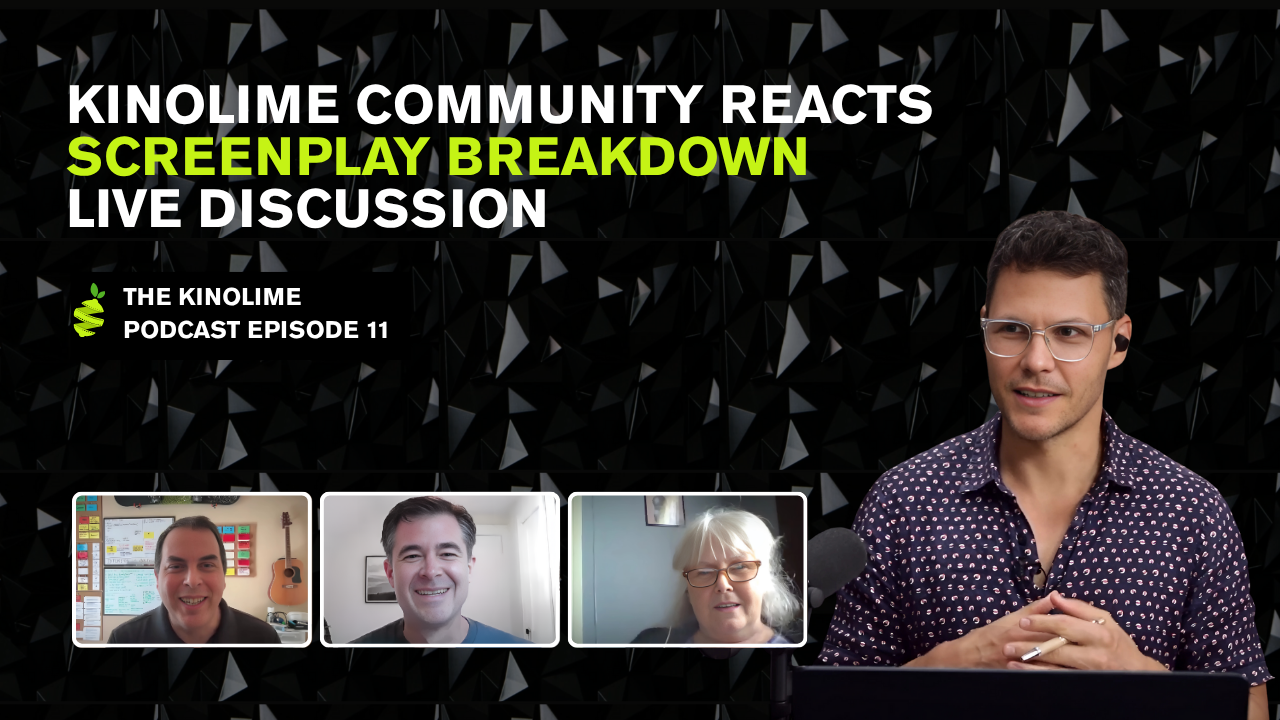
The video features a discussion with three avid readers—Cindy, Paul, and Stephen—who participated in the recent "Script to Screen 2.0" competition hosted by Kenolime. The conversation focuses on their experiences with the platform and a deep dive into one of the competition's standout screenplays, Mob Mentality.Guest Backgrounds and Kenolime Experience
The Guests:
Cindy, from Canada, is a writer, poet, and animal activist interested in supernatural genres.
Paul is a screenwriter from Kansas City with a background in radio, who now focuses on absurdist comedies and thrillers.
Stephen, based in New York, is a stand-up comedian and writer with experience in television production.
Platform Impressions: The guests expressed appreciation for Kenolime’s role in opening doors for undiscovered talent. They noted that the platform allows users to earn credits by reading scripts and treatments, which can then be used to obtain professional coverage services.
Discussion of Mob Mentality
The participants identified Mob Mentality as a favorite, noting that its high-concept premise—a 13-year-old boy who believes he is the reincarnation of John Gotti—was immediately compelling.
Key Strengths:
Consistent Tone: The guests praised the script for maintaining a consistent voice and tone from beginning to end.
Emotional Depth: While comedic, the story successfully balanced its humor with family dynamics and emotional stakes, particularly regarding the protagonist's relationship with his parents and his friend, Pudge.
Effective Hook: The opening scenes were highlighted as a strong example of how to quickly immerse a reader in a story's world and character voice.
Upcoming Competitions
The host provided updates for those interested in future submissions:
Short Film Competition: The submission phase for the upcoming short film screenwriting competition begins next month.
Feature Film 3.0: A larger feature film competition is scheduled to launch at the beginning of 2026.
Full Transcript
[00:00]
And, my mentality is just, I mean, 13 year old who thinks
[00:03]
he's the reincarnation of John Gotti.
[00:04]
Boom, that's all you need to hear to understand the entire script.
Read Full TranscriptCollapse Transcript
[00:08]
Sold.
[00:10]
So, such a simple comedic premise that, yeah, you get it right away.
[00:16]
And so, yeah, once I saw that premise, it's like,
[00:19]
okay, definitely on my list, I had to read this one.
[00:21]
Hello, Kenel Limers.
[00:32]
Welcome.
[00:33]
We're here with three special guests today.
[00:35]
We have Cindy, Steven, and Paul.
[00:37]
Some of our top form avid readers from the script, script,
[00:40]
a screen, 2.0 competition that just ended.
[00:43]
We're here to talk about mob mentality, screenwriting,
[00:45]
Kenelheim, all things.
[00:47]
So let's welcome today on the Kenelheim podcast.
[00:49]
We have Steven, Paul, and Cindy, guys, welcome.
[00:51]
Hello, thanks for coming on.
[00:53]
Thank you.
[00:54]
Yeah, so I'm John Schrammhead of Development here at Kenelheim.
[00:57]
But I would love to know who, introduce your names.
[01:00]
Tell us a little bit about where you're from.
[01:02]
And we'll start maybe with Cindy if that's okay.
[01:04]
My name's Cindy.
[01:06]
Obviously, from St. John New Brunswick, Canada.
[01:11]
Grandmother, animal activists.
[01:16]
I love to write.
[01:18]
I write poetry.
[01:20]
I write supernatural, otherworldly.
[01:24]
I actually am going to try and get a screenplay into you,
[01:28]
guys, the next round.
[01:29]
Amazing.
[01:30]
Amazing.
[01:31]
Basically, just right.
[01:33]
Love to read.
[01:35]
Love the horse on.
[01:36]
All right.
[01:37]
Obviously, love to read screenplays, right?
[01:40]
And Paul, my name's Paul Kenauer.
[01:43]
I'm actually a screenwriter out of the Kansas City area.
[01:48]
Used to work in radio for quite a long time
[01:51]
and switched to screenwriting about 10 years ago.
[01:54]
Had been writing full-time since then.
[01:57]
So started with sitcom scripts and then transitioned
[02:01]
into features.
[02:01]
So basically, I write absurdist comedies
[02:05]
and thriller with some horror features,
[02:08]
also in my portfolio.
[02:09]
So love to write.
[02:11]
Love to talk about screenwriting.
[02:12]
And I found keen-align last year and really was excited
[02:19]
to get into the group of scripts.
[02:22]
This year, they started reading, started on the treatments,
[02:27]
and just seeing the level of the treatments that
[02:30]
weren't involved in the competition as a screenwriter
[02:32]
was super excited about the ideas that I was seeing.
[02:36]
So yeah, I'm really happy to be here today
[02:39]
and happy to contribute in any way
[02:42]
that I possibly can to the great work that you guys are doing.
[02:45]
So thank you.
[02:47]
Thank you.
[02:47]
And Steve.
[02:48]
I see you.
[02:49]
Steve Russo, Rupin, New Jersey lived in New York
[02:53]
for a while in the city and now out on the island in New York.
[02:57]
So right where the new-
[02:59]
This is where mob takes place, man.
[03:01]
This is it.
[03:02]
Correct.
[03:02]
This is your style.
[03:03]
I mean, I'm from Long Island and this is our stomping ground.
[03:06]
My son is 11.
[03:07]
So in a couple of years, I'll have kids that
[03:08]
he'll have friends the same age as Natives in the script.
[03:12]
But working a little bit in television for a long time
[03:16]
in the back stage thing, nothing in production for a long time
[03:23]
have been a stand-up comedian for about 25, 30 years at this point.
[03:28]
And right, written about three or four pulse length spec scripts
[03:33]
and a couple TV pilots as well.
[03:36]
So all writers, I can't believe you.
[03:37]
The contest at any point, anytime next year.
[03:41]
That's right.
[03:42]
And we're going to be having some details coming out
[03:43]
to everyone at home about our feature film 3.0 competition,
[03:48]
which will launch top of 2026.
[03:50]
We also have a short film competition,
[03:52]
screenplay competition that we're going to be launching next month.
[03:54]
So go to keenalum.com and check on all the info and updates there.
[03:58]
And speaking of keenaline, I'd love to know,
[04:01]
I know Paul, you just mentioned before how you,
[04:03]
but we'd love from Cindy and Steve.
[04:04]
How did you guys find out about keenaline?
[04:06]
What's been your impressions thus far?
[04:09]
I just downloaded on Facebook.
[04:10]
Your advertisements on Facebook.
[04:13]
And I think it is amazing what you're doing.
[04:18]
As you have said, it's really difficult to get into this business.
[04:25]
Unless you're a well-known name.
[04:27]
Like I mean, everyone knows Stephen King.
[04:29]
He could sell dog crap.
[04:32]
You know what I mean?
[04:33]
That is true.
[04:34]
Yeah.
[04:35]
Like I mean, just the name connected to it.
[04:37]
So, and that the fact that the audience are the ones that
[04:43]
decide that is a major bonus.
[04:47]
I mean, you've opened doors that would never be open for people.
[04:51]
You know, it's a struggle, a real tough struggle.
[04:54]
And yeah, you guys are doing amazing work for people.
[04:59]
You're broadening, I guess, the spectrum.
[05:04]
There's a lot of great writers up there.
[05:07]
That will never get the opportunity.
[05:09]
But again, thanks to you, your company, and your dedication to help them.
[05:15]
We appreciate you.
[05:16]
We appreciate you.
[05:18]
Steve, how did you find out about keenaline?
[05:20]
I believe that the first place I saw it was on YouTube last spring.
[05:24]
So it was right after the last contest had ended.
[05:28]
So I had just finished something I was looking into where I could potentially
[05:32]
send or enter it.
[05:32]
And I found to keenaline on YouTube talking about the process and everything.
[05:36]
And when I went to the website, I was like, oh, I just missed it.
[05:39]
That gave me plenty of time to think about the next year.
[05:44]
So once the season started, I was really ready to start reading everything I could
[05:49]
and just get an idea.
[05:50]
And St. Paul mentioned, I found so many good, worthy scripts to be in the final.
[05:57]
I was like, oh, they're going to have a tough time picking from a lot of these.
[06:03]
Definitely.
[06:04]
And the access, definitely, as Cindy said, just the thought of trying to get in some place
[06:13]
has been so daunting over the years every time I've written something.
[06:17]
And even when I was in college, I interned a talent agency.
[06:20]
And nobody from there would even accept any outside submissions.
[06:23]
No thing that they don't go from.
[06:25]
Like, well, you guys kind of know me.
[06:27]
I interned here.
[06:28]
They're like, no, no outside submissions.
[06:30]
So just where do you send stuff when you finish writing it?
[06:34]
You don't show.
[06:35]
So a lot of times you enter a contest and then you never hear anything.
[06:38]
You don't know who read it.
[06:40]
You don't know anything about it.
[06:41]
And with the KindleLime, just the fact that you read all the scripts and you can build
[06:46]
up these credits and then get feedback from someone is amazing.
[06:50]
So it was so nice to actually hear from someone, oh, what they think, what they thought
[06:55]
of a part of your script, what they thought you could do better.
[06:58]
So it's been a really interesting experience and it's been great.
[07:01]
It's a chicken for the egg thing, right?
[07:02]
It's like, you need to get some representation to get your scripts looked at, but how do you
[07:05]
get representation and get in that inner circle.
[07:08]
And we just believe in the power of original voices and unknown talent, or undiscovered talent,
[07:14]
I should say.
[07:15]
Because look at mob mentality.
[07:16]
I mean, that screenplay blew me away when I first read it and we'll get into that in
[07:19]
a second.
[07:20]
But Paul, let's see here just quick how you found about KindleLime.
[07:23]
I participated in several online screenwriter groups.
[07:27]
Where we just trade scripts and trade notes and things like that.
[07:30]
It's been really, really super helpful.
[07:33]
I highly recommend it for screenwriters, especially if you're just getting started.
[07:38]
But one of the things they do on that particular site, it's called SimplyScripts.
[07:42]
I don't know if it's okay to mention it or not.
[07:45]
Yeah, sure.
[07:46]
They had posted that, you know, KindleLime had this contest and here's what was going
[07:50]
on.
[07:51]
So I decided to check it out.
[07:52]
And of course, you know, we're all naturally pessimistic.
[07:55]
You know, there are so many people, when you get into screenwriting, so many people kind
[08:01]
of reaching into your pocket trying to make a dollar off of your desperation.
[08:06]
And so I just started checking out what you guys were doing.
[08:10]
And just from the very first connection there that I see that you guys are doing a free
[08:19]
screenplay contest.
[08:20]
You're not even charging anything to do it.
[08:22]
So that kind of got my attention.
[08:24]
And like I said, then I started reading some of the, I didn't find it, you know, soon
[08:29]
enough to be able to enter myself.
[08:31]
But I saw a lot of value for me reading the treatments to see what was working, what wasn't
[08:38]
working.
[08:39]
And then once I got into the scripts, I think as a screenwriter, you should always be reading
[08:44]
scripts anyway.
[08:45]
Great way to learn.
[08:46]
We just had Fred LeBot on a hero while you were sleeping.
[08:50]
So that's going to drop soon.
[08:51]
You can check it out.
[08:53]
And besides being a big Hollywood writer, taught NYU and other universities, his first advice
[08:58]
to me when I met him was to read screenplays.
[09:02]
Watch movies and read the screenplay in front of you while you're watching the movie to
[09:05]
see the difference.
[09:06]
And so I'm glad you really hopped on to that value add of reading the screenplays on the
[09:11]
forum and through the website to learn about writing and seeing what other people do.
[09:17]
It is.
[09:18]
It's a great tool just for learning.
[09:19]
And then when I realized I was earning keynote lines for it, and then I could see what I
[09:25]
could get for the keynote lines.
[09:26]
I just told Mira before, I think that that's kind of one of the hidden secrets.
[09:33]
And I'm trying to tell as many screenwriters as I possibly can because I think Steve kind
[09:39]
of touched on it just a little bit.
[09:41]
But the ability to earn keynote lines just for what you should be reading anyway.
[09:46]
And then to get coverage service for it.
[09:50]
So just for reading six treatments, I'm going to sound like a salesperson here, but I really
[09:55]
love it.
[09:57]
Just for reading six treatments and six scripts, I was able to earn enough keynote lines to
[10:01]
get your enhanced coverage service.
[10:04]
And I don't know if a lot of people that are reading on the website know about that.
[10:08]
But I hope that the people watching this can discover that because it's a tremendous
[10:14]
value to be able to convert your time.
[10:17]
And like I said, something you should be doing anyway into coverage or call with an executive.
[10:22]
I know.
[10:23]
Go read.
[10:24]
And we're going to read your screen playing.
[10:26]
Give you notes.
[10:27]
Like you read, we read.
[10:28]
You know, it's an out-brainer.
[10:30]
And speaking of reading, right, let's talk about our favorite screen, well, my favorite
[10:34]
screenplay arguably.
[10:35]
I don't want to discredit everyone else, but I was mom really got to me.
[10:39]
I laughed just because of growing up.
[10:40]
I went to school with those type of kids and I received from that hood.
[10:44]
But let's talk about mom mentality.
[10:46]
So what initially drew y'all into picking that screenplay to read during the competition?
[10:53]
Was it during the final three during the top 26?
[10:56]
What drew you into mob?
[10:58]
For me, it was one of the first ones that I read and it came off of the treatment.
[11:03]
There were several of the scripts that the central idea just popped out of the treatments
[11:10]
decomposer.
[11:11]
It was really your final three for sure.
[11:15]
All of the central ideas were just like obvious hooks that you were like, man, I wish I would
[11:22]
have thought of that.
[11:23]
Gray premise, gray premise.
[11:25]
Yeah, I mean, in mob mentality, it's just, I mean, 13 year old who thinks this is the reincarnation
[11:30]
of John Gotti.
[11:31]
Boom, that's all you need to hear to understand the entire script.
[11:35]
Sold.
[11:36]
Such a simple comedic premise that, yeah, you get it right away.
[11:42]
And so, yeah, once I saw that premise, it's like, okay, definitely on my list, I had
[11:46]
to read this one.
[11:47]
We all want to know what happened to Nate and from a comedian I want to hear from Steve
[11:50]
and what drew you in and what made you pick mob to read initially?
[11:53]
So obviously from my stand-up background, I'm always interested in comedy.
[11:57]
Everything I write, even if it's not a straight comedy, is always going to have comedic
[12:01]
elements in it.
[12:02]
I just can't keep that out of the voice of a lot of the characters that I have.
[12:05]
So I'm always looking for comedies first of which ones that my, you know, compare
[12:10]
it either compare to mine or compare to other comedies that I've seen.
[12:14]
So from the premise, I was like, a lot of potential right away.
[12:20]
I was like, sounds good.
[12:22]
I read through all the treatments first because I actually didn't know that I could read
[12:26]
the whole full scripts at first.
[12:29]
So I kind of compared everything just from the treatments.
[12:33]
And to be honest, the mob meant that I've heard this about comedies in general.
[12:37]
You just sometimes don't get the voice from the treatment.
[12:41]
And I was like, oh, I thought, I really thought this was going to jump out me more than
[12:45]
I realized you could read the actual script.
[12:47]
And it was one of the first ones I read once I could do that.
[12:50]
And once the voice over starts and you see how they have the narration coming from him
[12:56]
and it just sticks to post to all the action.
[12:58]
I'm like, there's the voice.
[13:00]
You can hear it now.
[13:01]
Exactly.
[13:02]
Now you can actually hear the dialogue when it's such a difference when you read the
[13:08]
full script of it.
[13:10]
So yeah, totally once the premise that hooked me in, I was like, oh, I really want to know
[13:16]
more about it than the full script really got me where the treatment was like, okay, I
[13:22]
don't get white in it.
[13:24]
It's tough.
[13:25]
Treatment writing is an art like the late great David Lynch would say, he would say your
[13:28]
currency is your screenplay, right?
[13:30]
He doesn't do treatments or out, or he doesn't do pitch decks.
[13:33]
It's like my currency.
[13:34]
You like my movie.
[13:35]
Here's the screenplay.
[13:36]
That's the blueprint.
[13:37]
We put a lot of time in.
[13:38]
But the treatment I get, but yes, I agree.
[13:41]
It's tough to get that voice from a treatment.
[13:45]
And yeah, from page one, you just pick it up immediately with the voice over him looking
[13:49]
at the cement truck and talking about the first time he can kick his dad's ass.
[13:52]
I mean, it's just such a hook.
[13:55]
What was some of y'all's, yeah, now it keeps going.
[13:58]
It keeps going.
[14:00]
The consistency of the voice.
[14:02]
It's like page one to page 104.
[14:06]
It's the same tone on every single page all the way through.
[14:10]
And with comedy writing, I see, I read a lot of scripts and I see with comedies, it's
[14:16]
so difficult for writers to keep that consistent tone and that consistent feel from one page
[14:24]
to the next, from one scene to the next.
[14:27]
This script finds its voice on page one and it holds it all the way through 104.
[14:32]
And I think that's absolutely one of the strengths of the script.
[14:35]
100% couldn't agree more, very, very consistent.
[14:38]
What was some of y'all's favorite scenes or moments from mom?
[14:42]
What was like when you just like, I can't believe he went there.
[14:46]
This is great.
[14:47]
Cindy, maybe tell us something that stuck out to you from mom.
[14:50]
The lemonade stand.
[14:51]
I'm going around offering protection.
[14:55]
The ice cream vendor.
[14:58]
Then when he decided to take Pudge Ender as wing, you know, he's seeing the value.
[15:04]
Yeah, Pudge is fun.
[15:05]
Yeah.
[15:06]
Yeah.
[15:07]
And I think too when the scar on the neck was revealed to the daughter, it was like, yeah.
[15:16]
Now, that had a big emotional hook.
[15:18]
Yeah.
[15:19]
Yeah.
[15:20]
That had a big emotional hook.
[15:21]
I know.
[15:22]
He knows.
[15:23]
Yes.
[15:24]
He knows like joke after joke.
[15:26]
It had like depth reincarnation, family themes.
[15:31]
I mean, it was really well done in that regard.
[15:34]
Steven, what about you?
[15:35]
The first couple scenes where you're just being introduced to the world is perfect.
[15:41]
There's the right tone.
[15:43]
It's the right setup.
[15:44]
It's like, everything is there so that you know exactly what's coming in the rest of
[15:49]
the script.
[15:51]
Not action wise, but tone wise.
[15:53]
You just, they set the stage for the whole thing.
[15:56]
And I think that's a great before you head on.
[15:57]
I think for our listeners at home, I think that's a great lesson to learn is to grip your
[16:03]
reader early on.
[16:04]
Like the writer here at mob, if you read the first five, ten pages, you get it.
[16:08]
You get the character.
[16:09]
You get what's going on.
[16:10]
You get the world, everything.
[16:13]
This script in particular, just such a fantastic job of roping you in very early.
[16:16]
So read the first five, ten pages of mob.
[16:18]
Tell us what you think.
[16:19]
Sorry, Steven, continue.
[16:20]
Any time there's a lesson that I can throw out to the writers, I'd love to just chime in.
[16:24]
So then a little further in the first third also when he first meets Pudge in the new school,
[16:31]
he defends him.
[16:32]
He takes a beating.
[16:33]
He just keeps coming back for more.
[16:34]
Like that whole scene was really good.
[16:36]
And then he's laughing, smiling and the teachers come up, what happened?
[16:39]
Nothing.
[16:40]
What do you think?
[16:41]
Nothing happened.
[16:42]
What are you talking about?
[16:43]
Exactly.
[16:44]
I ain't no rat.
[16:45]
I ain't no rat.
[16:46]
I ain't no rat.
[16:47]
I ain't no rat.
[16:48]
I ain't no rat.
[16:49]
I ain't no rat.
[16:50]
Yeah, Steve, that's a great scene to point out because that's such a good script moment
[16:55]
right there.
[16:57]
When you really start to understand Nate and how he thinks, you know, that moment that
[17:02]
he's just taking on the chin for this kid that he barely, barely even knows, he's just
[17:08]
basically met in this moment.
[17:09]
That's a great character moment.
[17:11]
And I really do think that it sets up that whole relationship between Nate and Pudge
[17:16]
that I think is going to carry the entire project.
[17:21]
That those two working together, you know, through the whole movie is going to be, I think
[17:27]
one of the touch points that people are really going to be able to hold on to and watch
[17:32]
the two of them interact because it really is, Eric does a great job of setting up that
[17:37]
relationship and then carrying it through, you know, different relationship points and
[17:43]
testing that relationship and then eventually breaking that relationship.
[17:47]
And yeah, that's anything related with Nate and Pudge is a strength of the script.
[17:54]
With the relationship with his parents too, like to me, that dichotomy of his tradition,
[17:59]
like the tradition of his family then versus his new thing also, but the Pudge relationship
[18:03]
is definitely easy to choose.
[18:04]
Yeah.
[18:05]
And I thought another great moment was right at the end of Act One, turning into Act Two,
[18:09]
where he gets the confirmation from the medium who's basically, you know, oh yeah, you
[18:16]
are John Gotti.
[18:17]
I thought that was a great screenwriter's moment right there because he's basically, Eric
[18:23]
was basically giving us permission to buy into this central premise.
[18:28]
And now here we go.
[18:29]
Now we're going to run with the rest of the story from here.
[18:32]
And then as Cindy was saying, going straight from that moment then almost immediately into
[18:38]
all of the John Gotti type actions with the lemonade and in the ice cream truck, there's
[18:44]
a great transition and they're really fun part of this script.
[18:47]
And I love that because I think, you know, growing up in the 90s, you know, as a kid, you
[18:53]
know, the mob movies were everywhere, right?
[18:56]
You had sopranos, that's for the TV, then you had the comedies and Mickey Blue Eyes and,
[19:01]
you know, get shorty and analyze this.
[19:03]
And which are fantastic.
[19:05]
But we've had some distance from the mob genre now, right?
[19:07]
And I think this is the perfect time to come back in in a ode, you know, in a respect
[19:14]
to the genre.
[19:16]
But you know, but also in a way, flipping on its head a bit and kind of like, you know,
[19:21]
attack it, subvert it in a way from a comedic side and poke holes at the funny little expected
[19:27]
cliches we see in mob movies, but then twist it.
[19:29]
And I love the reincarnation angle myself.
[19:31]
I've done a past life regression before.
[19:32]
I'm really deep in that.
[19:34]
So when I saw the combination of like mob and reincarnation, like I was hooked and I
[19:38]
just love how he brought it into that and what it's like to be a kid to be confused about
[19:43]
your identity, you know, it's just, it was really fun.
[19:45]
What did you get, right?
[19:46]
Did you get new past life?
[19:47]
I died in the revolutionary war.
[19:49]
I was shot in the gut.
[19:50]
I mean, we can go on and on about that.
[19:51]
It was a crazy experience.
[19:53]
I love, I mean, yeah, I'm really, I don't get me starting a reincarnation.
[19:57]
But I totally feel, and they bring up the points too in the script where everybody's
[20:02]
like Cleopatra or, you know, Napoleon.
[20:05]
But then I think the, I forget the woman's name, the, the, the, the past life regressionist
[20:10]
said, oh, well, I just did someone who's like a barkeep, yeah, Dina, barkeep and whatever.
[20:15]
You know, so it is fun how they bring it back to that.
[20:19]
And I thought the parents were hysterical, by the way.
[20:21]
I want to hear supporting characters.
[20:22]
We know we all love Nate, but what, what'd y'all think about the parents?
[20:25]
I thought they thought their poor little boy was set.
[20:29]
You know, like they're saying about meds, meds, meds kept going to psychiatrists, meds,
[20:34]
meds, meds.
[20:35]
They were hoping to convert them into who they were.
[20:42]
But he knew who he was, you know, they had a great dynamic.
[20:46]
And I'm really happy that, you know, they were the kind of parents who don't just medicate
[20:50]
their kids and get it out of them.
[20:52]
Exactly.
[20:53]
They let them be who they are.
[20:54]
But they're, they're back and forth with each other too.
[20:56]
The two parents was a good, a good dynamic, not just with him.
[21:00]
Yeah, yeah.
[21:01]
It was great to see them struggle a little bit too, but not in, not in such an overt way.
[21:05]
You know what I mean?
[21:06]
It was like they were, they were supportive in that, in that fun comedic way.
[21:10]
But you could also see their struggle with the, with, with this whole premise around their
[21:14]
son and what he thinks.
[21:16]
So I thought it was a really good way to set it up to, to, you know, to be able to mine
[21:23]
so much comedy out of it just to by making them that supportive, but, you know, as any
[21:28]
parent would be, it's like, you know, is my son crazy?
[21:32]
Yeah.
[21:33]
No, it's fine.
[21:34]
Yeah.
[21:35]
No, it's super funny.
[21:36]
And they were supportive and loving and, you know, it's kind of, I love that.
[21:39]
It was, they, they had the right blend of comedy.
[21:42]
They felt a little caricature-ish, but in the best way, you know, they also felt real
[21:46]
which I love.
[21:47]
You could feel their struggle though too, right?
[21:48]
I mean, sure.
[21:49]
Yeah, yeah, yeah.
[21:50]
Oh, 100%.
[21:51]
I'm going to make sure last chance, the school, please make it work.
[21:54]
I know, make it work.
[21:56]
I know.
[21:57]
Well, we just wanted to say thank you so much from here, Keenaline, for the three of you amongst,
[22:03]
you know, many hundreds and thousands of others who have been voting and reading, you know,
[22:07]
that you're so dedicated to Keenaline and what we're doing.
[22:10]
And this is our way of like setting a little appreciation.
[22:12]
Like, come on the show, talk about story and we're going to be doing, doing many more of
[22:16]
these in the future.
[22:17]
And we just wanted to say thank you so much for reading and voting and being avid Keenalimers.
[22:23]
It really means a lot to us that you're giving us your time, your knowledge, your creative
[22:28]
energies.
[22:29]
So thank you so much.
[22:30]
Thank you.
[22:31]
I'm sure what you're doing is there's not enough things for what you're doing.
[22:35]
And I look forward to interacting with you in the forums and all the other screenplays
[22:39]
coming out.
[22:40]
Like I said, we have our short film competition that we're going to be launching the submission
[22:44]
phase next month in August with the voting starting after that.
[22:47]
So look forward to your thoughts on the short films and then the 3.0 competition starts
[22:51]
top of 2026.
[22:53]
Everyone home, get your screenplays ready, sharpen those pencils, get your final draft
[22:56]
booted up because it's time to get those screenplays in and start another round of this.
[23:01]
And thank you again from everyone here at Keenaline.
[23:03]
It means, you know, the world to us and we look forward to hearing from you all soon.
[23:07]
Thank you.
[23:08]
Thank you for your time.
[23:17]
Thank you.