
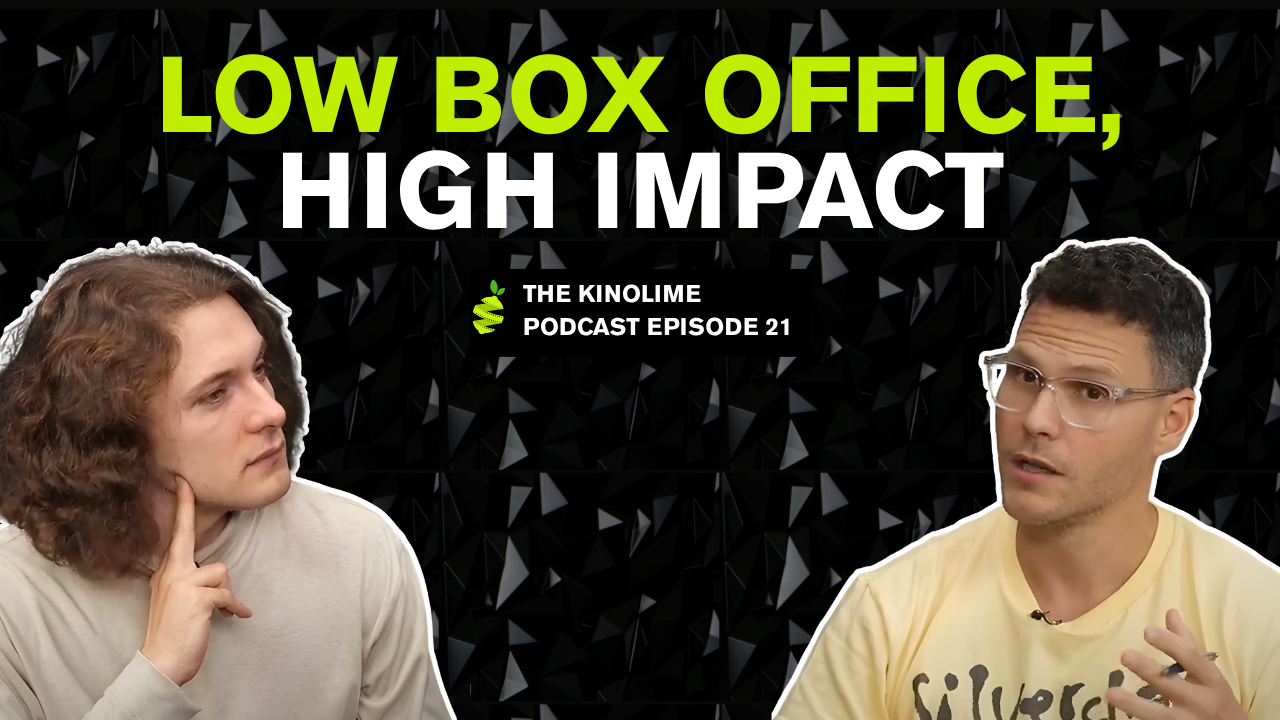
Leo, PTA, and the Battle for Meaning in Modern Cinema | Kinolime Podcast Episode 21
DM
Hosted byDanny Murray, John Schramm
Review on your platform
00:0000:00
Show Notes
This video features a debate between John Shramm, Head of Development at KinoLime, and CEO Danny Murray regarding the film One Battle After Another.The Debate: Is it a "Defining Film"?1
Danny's "Hot Take": Danny argues that One Battle After Another is the "defining Hollywood film of the 21st century."2
John's Counter-Argument: While John "really loved" the movie, he believes it is too early in the century to call it defining. He argues that other films, such as No Country for Old Men or The Dark Knight, are more deserving of that title.34
Critique of the Film
Strengths:
Writing: The film effectively utilizes "intention and obstacle" throughout, particularly in the second half.5
Performances: The speakers praised performances by Sean Penn, Teyana Taylor, and Chase Sui Wonders (transcribed as Chase Infinity).6
Weaknesses:
Leonardo DiCaprio’s Performance: John felt DiCaprio’s portrayal of an "anxious middle-aged" man was repetitive of his previous roles in films like The Wolf of Wall Street and Don't Look Up.7
Story and Themes: John found the story "vacant" and felt it missed opportunities to explore "hot topics" or deeper thematic elements.8
Third Act Climax: John felt the climax was "flat" and "half-baked," specifically criticizing the sudden character arc of "the tracker" and the lack of a final confrontation between the protagonist and antagonist.9
Thematic Interpretations
Revolutionary Spirit: Danny argues the film is about the "spark" of a revolutionary spirit being passed from a failed father (DiCaprio) to his daughter.10
Power and Ideology: Danny views the antagonists as "stupid fascists" and "powerful men... drunk on power and lust," representing the unrelenting forces that control the world.
Full Transcript
[00:00]
Who's your protagonist?
[00:01]
The protagonist of the film is like a bumbley,
[00:06]
you know, a vlog loser.
Read Full TranscriptCollapse Transcript
[00:07]
It's Leo.
[00:08]
Okay.
[00:09]
Right inside.
[00:10]
Leo's your protagonist.
[00:11]
Who's your antagonist?
[00:12]
I mean, look, like, no, yeah, it's, but who,
[00:15]
no, who's your antagonist?
[00:16]
You know, it's, it's Sean Penn, but hold on, just hold on.
[00:20]
Yeah.
[00:21]
Hold on for a second.
[00:22]
The point of it is, there is no need to don't like it
[00:23]
because like these characters, I said,
[00:25]
no, but it's dude.
[00:30]
I need a weapon, man, and all you got is goddamn known chucks here.
[00:43]
That was my Leo impression from one battle after another.
[00:46]
Welcome everybody.
[00:48]
Today, we are going to battle about one battle here at KenoLime Studios about the most
[00:54]
talked about film.
[00:56]
I don't know.
[00:57]
As Danny's about to say ever.
[00:59]
I'm John Schram, I'm at a development here.
[01:01]
I wish.
[01:02]
Danny Murray, our star CEO here.
[01:05]
Well, we have many star CEOs.
[01:06]
Actually, we have two CEOs and they're both stars.
[01:08]
Yeah.
[01:09]
We love you.
[01:10]
We're here today to talk about everything one battle after another.
[01:14]
Man, I just, if you're involved in film, know about film, love film, or just a casual
[01:18]
movie or you can't expect not to talk about this movie.
[01:24]
And I saw it last night in IMAX at Kipps Bay here in the lower in the east side.
[01:28]
I got John Tickets, Dead Center.
[01:31]
I don't know.
[01:32]
He's amazing.
[01:33]
He came through last minute.
[01:34]
So we're going to have a little chat because Danny here believes and I'll let him say
[01:39]
his hot take statement about one battle.
[01:43]
And I don't know.
[01:44]
We're just going to like we're to brawl.
[01:46]
Yeah.
[01:47]
Like I saw it.
[01:48]
Hit your take.
[01:49]
Well, I'll give it a quick prologue.
[01:53]
Not 40 minutes.
[01:54]
Yes, going to be a 45 minute ramble before I get to it.
[01:57]
But I saw the film opening night, 70 mil IMAX Lincoln Center.
[02:04]
And when the lights went up, the worst review of the film, and to be fair, it's 70
[02:10]
mil IMAX Lincoln Center.
[02:11]
So I'm sure that it's mostly, you know, a whole bunch of like bearded dudes with those
[02:16]
A24 hats that like laugh at the wrong moments, you know, the light go up.
[02:21]
The worst review I heard is that's the best movie I've seen this year.
[02:26]
The average review I heard was that's the best movie I've ever seen in a theater.
[02:32]
I kind of fell somewhere in the middle ground where I'm like, that is the defining Hollywood
[02:37]
film of the 21st century.
[02:38]
And there's nothing else coming close to that.
[02:41]
I'm going to talk about because I have some pushback.
[02:43]
So anyway, that's an amazing take.
[02:45]
I did not take that's your, I love that statement.
[02:49]
It just made me so happy.
[02:51]
It's hard to battle this movie because I got to be honest, I really, really loved it.
[02:55]
It's great.
[02:56]
It's really, really liked it.
[02:57]
I love it.
[02:58]
I love it.
[02:59]
I love it in there too.
[03:00]
Love it in there too, for sure.
[03:01]
I really loved it.
[03:02]
There's so many great things to talk about.
[03:03]
But I want to get into, I want to just start pushing back, dude, on the defining 20th,
[03:09]
you know, well, let's just go into some of the issues I have with the film.
[03:13]
Sure.
[03:14]
And then we'll go into maybe films that were more defining of the 21st century.
[03:17]
It's a little tough, a little early to call it defining because.
[03:20]
It's a quarter.
[03:21]
You know, I mean, yeah, dude, you're like, we got a lot of the first drive.
[03:24]
They touch down on the first drive, you know, but like, we don't know what's going to happen
[03:28]
yet.
[03:29]
So, where do I begin?
[03:31]
Well, first, I'll point out some positives.
[03:33]
What this story does really well from a writing perspective is give you intention and obstacle
[03:39]
throughout the whole film.
[03:40]
There are intentions, especially in the second half of the film, where characters have motivations
[03:46]
or goals, and there are things in the way getting to them.
[03:48]
It does a stellar job of having that.
[03:51]
And like, it's just, you know, the Leo trying to save his daughter in this one battle after
[03:55]
another, blah, blah, blah, blah, blah, blah, blah, blah, blah, blah, blah, blah, blah,
[03:58]
and it works really well from a writing perspective.
[04:02]
I think that the performances were incredible.
[04:05]
Sean Penn was, you know, top notch.
[04:08]
I did have, and, you know, Tiana Taylor.
[04:12]
And is it Chase Infidia?
[04:13]
Infiniti.
[04:14]
Infinity.
[04:15]
She was incredible all around.
[04:17]
I had an issue with Leo.
[04:18]
I got to be honest.
[04:19]
What's your, you're not liking this, like in the 2020s, Leo just playing like anxious, middle
[04:26]
age, you know, I feel like I love it.
[04:29]
Why his performance, maybe his performance, him being in the film, hurts the film, because
[04:34]
again, there was some box office, the film didn't do that great this past weekend.
[04:38]
I got to be honest, like, 20-something mill for the most talked about film around.
[04:42]
Like, I was a little shocked.
[04:44]
Like 50 mill.
[04:45]
And at the end of the day, this isn't worldwide.
[04:47]
But domestically, why were American audiences not showing up to, and essentially this
[04:52]
is an action film, this is an action movie.
[04:55]
I think the answer, without spoiling anything is the trailers were very ambiguous because
[05:01]
the opening scene of the film, you're like, okay, I understand why they didn't want to
[05:06]
publicize, you know, what's happening here.
[05:09]
If you're trying to market this to the entire...
[05:11]
Wink, wink, immigration, wink, wink.
[05:13]
It immediately takes you into like Obama era detention facilities.
[05:21]
But yeah, like...
[05:23]
But I felt like his performance, his choices, everything were fine.
[05:27]
But we've seen it before.
[05:29]
And I think that if you had a different actor who was, because this role is so, it is
[05:34]
meaty that there's some great scenes.
[05:36]
I mean, the phone scene with him and that guy was...
[05:39]
Comar Josh.
[05:40]
I literally tingled myself in the film.
[05:43]
It was so funny.
[05:44]
It was so funny.
[05:45]
But what makes actors...
[05:51]
I guess the push of a film that's put in the stratosphere is you want to see actors
[05:56]
take a turn from the norm.
[05:58]
I think personal opinion.
[05:59]
You want to see an actor who may be played straight up until recently, now takes on the
[06:04]
neurotic crazy role.
[06:06]
We've seen Leo do this countless times already.
[06:09]
I got a little bored of his antics because I've seen it.
[06:12]
I've seen it from Wolf of Wall Street to Don't Look Up, a little bit of killer flower
[06:16]
moon.
[06:17]
I'm kind of over it.
[06:18]
I felt like he pulled me out.
[06:19]
Sean Penn was incredible.
[06:20]
I was glued to him every scene.
[06:22]
Tehran Taylor, Chase, they were phenomenal.
[06:25]
He pulled me out.
[06:26]
He was excellent in execution.
[06:28]
But there was something about I just seen it before with him.
[06:31]
And I would love to...
[06:32]
I just almost...
[06:33]
If you're PTA, you have Carbel on to any actor you want.
[06:35]
Why not?
[06:36]
I don't know who you didn't go after.
[06:37]
Who would be that get?
[06:40]
But I felt for Leo.
[06:42]
Maybe that's a reason why.
[06:43]
But we're not here to talk about why the film.
[06:44]
This is my personal opinion.
[06:46]
But I will say the one knock I have on this and this is why I don't think it's the defining
[06:51]
film of the 21st century is I felt that the story was vacant.
[06:54]
I've really...
[06:55]
I did.
[06:56]
I felt like...
[06:57]
How?
[06:58]
I'm gonna...
[06:59]
I know.
[07:00]
Look at his face.
[07:01]
Look at that face.
[07:02]
It's such a simple, endearing story.
[07:05]
It is, but it's finding Nemo.
[07:06]
I don't think that he had...
[07:09]
There's not a real theme to the story that I felt like, you know, who's changing really
[07:15]
at the end?
[07:16]
I guess what Leo's like a maybe a little bit of a better dad.
[07:18]
I don't know.
[07:19]
I felt that there was so many chances to talk about hot topics and, you know, what it's
[07:26]
like to be a failure revolutionary and etc.
[07:28]
That it just...
[07:29]
It felt vacant to me at the end.
[07:31]
Like I left...
[07:32]
And again, I love the film.
[07:33]
I just left feeling like, what was it really about?
[07:35]
Well, if I could touch on that.
[07:36]
Like there is...
[07:37]
Again, I'm trying to do this without spoiling anything.
[07:40]
There's one, something fascinating about the Leo character in which like, you know, he's
[07:48]
not really...
[07:49]
I mean, there's a line after their first, you know, heist there, you know, the first
[07:56]
big action we shoot them in.
[07:58]
Operation, there you go.
[08:00]
Where they kind of ask him, you know, the whole prologue is like this...
[08:05]
Every relationship between every character is about race and power.
[08:10]
And there's a scene where Tiana Taylor, like where he's essentially falling in love with
[08:14]
her.
[08:15]
And she's like, I think this guy likes black girl.
[08:18]
It's something like that.
[08:19]
And he says like, I believe he says something like, like, that's why I'm here almost.
[08:26]
Did he say that?
[08:27]
Is that the car scene when they left the house?
[08:28]
The car scene where...
[08:29]
Yeah.
[08:30]
Yeah.
[08:31]
And like, it's this weird thing where like, you know,
[08:35]
throughout the film, I think like there's a great juxtaposition between like the sensei
[08:40]
character, right?
[08:41]
A guy who is a revolutionary out of necessity, right?
[08:46]
Compared to someone like Leo when the cards aren't in his favor and his world blows up,
[08:52]
he sits on the couch smoking weed and watching movies about this stuff for 16 years, right?
[08:58]
Like, there was this...
[09:00]
But you spent so much time with him in the beginning being an effective revolutionary,
[09:04]
right?
[09:05]
It's not like, you don't want to say like...
[09:07]
To some degree, I mean, it's like...
[09:09]
There's a debate there too between the Benicio character and Leo, like, he says, you
[09:14]
failed, man.
[09:15]
Like, you know, there isn't...
[09:16]
That's what I'm saying.
[09:17]
Well, a PTA circle, then maybe it was so much to take on because it's like an epic.
[09:21]
This is defined as an epic.
[09:22]
Yeah.
[09:23]
You know?
[09:24]
But the...
[09:25]
I felt like he didn't get into his hands and the dirt of like real thematic, you know?
[09:30]
I would disagree because like, I mean, at least for me, the underlying theme of
[09:34]
the film right is like, I thought a lot about...
[09:38]
After I watched it, where most people that spent their life trying to affect massive structural
[09:43]
change in the world, historically, those people die thinking that they failed.
[09:49]
There's very few people, right?
[09:51]
I mean, there is hundreds of years of history in this country of people trying to enslavery
[09:57]
who either died enslaved or they died thinking they had lost.
[10:02]
But, you know, their actions inspired people to continue that fight.
[10:09]
And I guess for me, and I think Leo's character is a kind of bad example.
[10:13]
And I think that him as an actor is kind of perfect for it because he is that guy for
[10:19]
climate change.
[10:20]
He is a guy that talks a big game and then flies private jets, right?
[10:25]
Like he is in that way, I think kind of like masquerading is something.
[10:29]
The same way his character is in this film.
[10:34]
But I guess for me, it's like you see that spark in this daughter, right?
[10:38]
You see his failure and him kind of receding and becoming anxious and losing the spirit.
[10:44]
If there ever really was one outside of just lust that brought him in to the French 75,
[10:51]
you see a real kind of like...
[10:54]
Like the strongest parts of his passions by the end kind of affect his daughter, right?
[10:59]
And keep that spirit alive.
[11:01]
I don't know.
[11:05]
There was a lot of really big, you know, I guess like motifs and themes and challenges.
[11:12]
But...
[11:13]
I don't think it was fully...
[11:14]
Again, I think that's the issue.
[11:15]
He's tackling too much.
[11:16]
And I think he didn't have a singular vision of like thematically on the page.
[11:21]
Like again, I felt that spoiler alert, you know, his daughter's arc.
[11:28]
She didn't care about any revolutionary stuff.
[11:30]
She goes to the nunnery for a hot second and then now is a little sudden going to follow
[11:34]
her mom's footsteps.
[11:35]
Like that felt very rushed to me at the end.
[11:39]
I will also say, and this is a big issue from a story perspective, because the whole
[11:46]
crux of your third act, one of your crux of third act, is when she's chained and about
[11:53]
to maybe be killed at that 1776 roadhouse side street.
[11:59]
Why is the tracker having a massive arc and Leo isn't?
[12:04]
Like we spend no time with this hunter in the white Dodge Charger.
[12:09]
He for some reason decides to let her go, which I don't understand why there's no connection
[12:15]
between them.
[12:16]
And I think like PTA wrote himself into a corner.
[12:18]
Didn't know how to figure to get himself out.
[12:20]
Maybe if somebody, a character that has no any real screen time or backstory in arc,
[12:26]
and she's a lot of escape.
[12:28]
I didn't feel that it was half baked at all.
[12:33]
It's a guy.
[12:34]
We see any of his backstory.
[12:37]
He's a coyote who essentially, his job is just to kidnap and traffic people across borders.
[12:43]
And he's to find people.
[12:45]
No, but he has a code.
[12:46]
He has a strict code that's laid out like twice.
[12:49]
He's like, no kids.
[12:52]
And now you put him in a position where you're forced to.
[12:55]
He will take her because he did.
[12:56]
No, he will, but the point is is, and I thought it was pretty clear, is that he does not work
[13:02]
in the business of killing children.
[13:06]
And simple enough, it's like, again, I'm not even necessarily sure it plays out as a,
[13:12]
oh, this guy came to his morals after 40 years of being a trafficking coyote.
[13:18]
But very clearly, his moral ground is, I don't work in the business of killing children.
[13:25]
And he drops off baby Charlene.
[13:29]
And yeah, like now he's in the business of killing children.
[13:33]
And as a bit of, so he stops.
[13:35]
It's a bit of a stretch.
[13:36]
I don't think it is at all.
[13:37]
I mean, you might not have liked it, but it's not a stretch.
[13:39]
I understand why you might have, why you needed that out, but either he was out on the
[13:45]
cutting floor.
[13:46]
His maybe had more scenes or more backstory.
[13:48]
Maybe they couldn't fit it in.
[13:49]
It just felt like you can one shot of him in the car contemplating and then he's going
[13:52]
to kill himself over a kid.
[13:54]
He didn't kill himself.
[13:56]
He knew he was going to die.
[13:58]
Like it doesn't make, it didn't make a lot of sense to me.
[14:00]
Like killing one person, like if it was just the one guy that was watching her, I get
[14:04]
that, but like he knew that there was people in the house.
[14:07]
Like he's essentially a suicide mission.
[14:09]
And that's a, that's oh, no case, stands to have as a character.
[14:12]
Like I'm at my would send.
[14:13]
I'm going to just die for a cause, but it just felt very like rushed to me.
[14:18]
I felt the third act was a little flat towards the end, but like I don't want to put
[14:22]
poo in the movie.
[14:23]
What part of the third act?
[14:24]
I felt, well first of all, let's talk about the brilliance of that, you know, that
[14:28]
shot of him going over the hills.
[14:29]
That was amazing.
[14:31]
I can't hit the heat, right?
[14:33]
Heat's an epic.
[14:35]
Heat's dramatic has action.
[14:37]
No, no, but you have a lot.
[14:38]
You have like, I mean, I love heat.
[14:39]
Who doesn't love heat?
[14:41]
And, but when you're going to your third act and you have your antagonist and pro
[14:44]
tags and you're at pins and needles to see their confrontation, that to me is an effective
[14:50]
third act.
[14:51]
Like it's climaxing to something that you can't wait for.
[14:54]
I felt that this third act didn't have that same bone.
[14:59]
Like I killing Sean Penn through that guy and the Mustang, whatever it was fine choice
[15:05]
or attempting to kill him.
[15:07]
But then after that, there was no real danger.
[15:10]
Like you knew, they just felt flat to me.
[15:14]
Okay.
[15:15]
Like you think that the daughter is going to shoot him, I don't know, like that's what
[15:18]
you're really.
[15:19]
Who, Sean Penn or the guy she shot?
[15:21]
No.
[15:22]
When Sean Penn's upside down, dead, Leo sees him and he's going with the gun and his daughter's
[15:27]
hiding in the bush.
[15:28]
Yeah.
[15:29]
Like that's your climax or your film.
[15:31]
Because that's the choice.
[15:33]
If she pulls the trigger, she kills her.
[15:34]
You know, that's what I'm trying to say is it felt flat to me because you like knew
[15:39]
she wasn't going to shoot her father and you knew she wasn't going to, you know, it was,
[15:44]
it just felt a bit flat.
[15:45]
I kind of felt like the climax of the film was like the car's crashing like the end to
[15:52]
the chase, right?
[15:53]
Mm-hmm.
[15:54]
But then what the, everything's a denouement?
[15:57]
Like that's your climax.
[15:58]
I'm telling you, that is your climax.
[15:59]
Okay, sure.
[16:00]
The gun.
[16:01]
Well, it's automatically what?
[16:02]
I think the reason it's not working for you is because this guy isn't supposed to be
[16:06]
like an all knowing evil villain.
[16:08]
Like all the villains in this movie are stupid fascists.
[16:12]
Oh, Sean Penn is.
[16:13]
Sean Penn, the guy that shoots him, they're idiots.
[16:15]
I will.
[16:16]
There's no way Sean Penn is an idiot.
[16:19]
Look at what he has.
[16:20]
No, no, no, no, no.
[16:21]
I'm saying in the film, the point of it is is that these are all powerful men that are
[16:26]
lonely, fascist idiots that are in a race to the bottom until there is one guy trapped
[16:34]
in that little Dr. Strangelove room who is the ultimate Christmas adventure.
[16:39]
The whole point of the film is it's a guy that deals in misery and death and-
[16:47]
Who's your protagonist?
[16:48]
Anything to state.
[16:49]
Who's your protagonist?
[16:50]
The protagonist of the film is like a bumbly, you know, flawed loser.
[16:57]
It's Leo.
[16:58]
Yeah.
[16:59]
Right inside.
[17:00]
Leo is your protagonist.
[17:01]
Who's your antagonist?
[17:02]
I mean, look, like, no, yeah, it's, but-
[17:04]
No, who is your antagonist?
[17:05]
You know it's Sean Penn, but-
[17:07]
So, hold on, just hold on.
[17:09]
Hold on for a second.
[17:11]
The point of it is there is no need to like it because like these characters-
[17:13]
I said one, I said-
[17:14]
No, but it's dude.
[17:17]
The whole point of the film is there's not one likeable character in this film other than
[17:20]
the-
[17:21]
Doesn't have to be like-
[17:22]
I guess Virginia Hall.
[17:23]
No, the point is every single person in the film is a-
[17:28]
Essentially on- at one point of the film, drunk on power, drunk on power and-
[17:35]
and lust and essentially like-
[17:41]
Once we get past the prologue, bumbling around-
[17:46]
I get it.
[17:47]
I want-
[17:48]
Let's try and define their meaning.
[17:49]
Like your protagonist is Leo, Sean Penn is your antagonist.
[17:52]
Okay.
[17:53]
What are some defining films in the history of cinema to you?
[17:58]
Just go.
[17:59]
What are some defining films?
[18:00]
I get-
[18:01]
You know, one that's very much like this would be Star Wars.
[18:03]
Okay.
[18:04]
My point is your antagonist and protagonist, that's the point is you climax to that.
[18:10]
It's like forces of evil, there's forces of good-
[18:13]
Sometimes, yeah.
[18:14]
Again, like you're talking about defining film.
[18:16]
And I'm not-
[18:17]
Again, I love the film.
[18:18]
I'm just saying it felt flat to me because you've eliminated Sean Penn in a cool way-
[18:24]
Or at least-
[18:25]
Put him off to the side.
[18:27]
Then your- your fight, your protagonist and antagonist are supposed to fight over the heart, the soul-
[18:33]
They can, they don't have to.
[18:35]
They don't have to.
[18:36]
But if you're talking about defining films, there is that battle.
[18:39]
Sometimes, I agree.
[18:41]
Okay, for the-
[18:42]
The film you mentioned as a defining film has that exact same thing, right?
[18:45]
Yeah.
[18:47]
Okay, we can agree on that.
[18:49]
Right?
[18:50]
Yeah.
[18:51]
No, I mean, we can.
[18:52]
It's just, I think that like-
[18:54]
Because Sean Penn and like Leonardo DiCaprio aren't like battling in the whole lights, they're-
[19:00]
They don't need that, but I don't think-
[19:01]
They also could be a battle of ideology.
[19:03]
It could be a battle of the soul.
[19:05]
It doesn't have to be that.
[19:07]
Yeah.
[19:08]
But when you're climax, when you have effectively diffused the audience and robbing of any true
[19:15]
like climax from your protagonist perspective, it's like, to me it felt like, was it Dave
[19:23]
Smokina, like from God to machine, where in like-
[19:27]
I don't know if I'm saying this correctly, but it's like there was a writing process that
[19:31]
the Greeks did, where at the end of their plays, the gods would come in and fix everything.
[19:36]
Right?
[19:37]
Sure.
[19:38]
Leo didn't have that moment, right, where he's like-
[19:42]
Where he's facing off, like he's chasing, which is fine.
[19:45]
I just felt like the climax felt a little flat.
[19:48]
Well, I think that battle of the solar spirit, the whole point of it is that in the context
[19:54]
of the film is that the journey we've been on is contingent, right?
[20:00]
That spirit and that fight continuing is contingent on Leo and I, you know, spoiler, I guess
[20:08]
Sean Penn's daughter continuing that fight.
[20:13]
So the conflict and the big battle at the end is, will she die or will she live on to
[20:20]
carry that fight, right?
[20:22]
But at that point, we just-
[20:23]
That's the kind of evolutionary at that point.
[20:25]
That's not- it's not about her being- no one in this film is really a revolutionary.
[20:29]
Or an attempted-
[20:30]
No, because she's a kid.
[20:32]
The whole point is that she is going to, from this journey, take the best parts of the
[20:39]
spirit of her father and her mother for that, you know, and continue that fight.
[20:46]
I don't think that's not-
[20:47]
You won't win.
[20:48]
No one wins.
[20:49]
The world stays the exact same throughout the film in a lot of ways over like almost 20
[20:54]
year period gets worse.
[20:56]
But the point is is that we keep going.
[21:00]
We don't give up.
[21:01]
I think-
[21:02]
And her, like, her living and her getting that, you know, that passion, that spark igniting
[21:08]
in her, you know, at the end, it's funny because at the end Leo is still loser.
[21:12]
Like he's still sitting on the couch doing the same thing.
[21:16]
But he's passed on that spark to his daughter who is no longer afraid, right?
[21:22]
Of like essentially just this anxious, like, huddled hermit life they've lived for the
[21:27]
last six years.
[21:28]
I don't think it's there in the climax.
[21:29]
We can agree to disagree.
[21:30]
Okay, we can, but it is, but I agree to disagree.
[21:33]
I mean, you have a protagonist in Leo and an antagonist in fighting over their daughter,
[21:37]
yeah.
[21:38]
There isn't a fight, I really, at the climax, like there is nothing being tested for even
[21:42]
if Leo's a protagonist.
[21:44]
But again, you can have dual protagonist.
[21:45]
I think if you're going to compare it to like a heat, a no country for old men, which
[21:49]
I could argue is maybe more defining than this film.
[21:52]
There's a similar scene, right?
[21:54]
Like the coin flip scene is- I felt very much like- it's something Stephen actually brought
[21:59]
up to me.
[22:00]
It's very much like that DNA testing in a lot of ways.
[22:07]
In a way, I mean, that coin flip scene is really showing, revealing more of the antagonists
[22:13]
like makeup, mental makeup.
[22:16]
This DNA scene was wrapped in pot.
[22:19]
But I mean, if you were to show, and again, that's an interesting thing is your protagonist
[22:23]
in no country for old men, Josh Brolin dies, spoiler, before-
[22:29]
Yeah, but-
[22:30]
The third act climax.
[22:31]
The third act.
[22:32]
At the third act climax, but that is more thematically rich.
[22:35]
It's based on a better novel.
[22:38]
Sure.
[22:39]
Which is a better source material, comic or theme, one of the best living, right?
[22:43]
Well, I think he died last year, but RIP.
[22:48]
That was a battle of thematic posing forces, right?
[22:53]
That climax is more potent to me in no country, and I think more defining.
[22:59]
I mean, I think I'm putting more emphasis on the story, which is a re-disagree, but
[23:03]
one battle on author was great.
[23:04]
I just want to move on, because we're going to now quickly debate about defining film,
[23:08]
and I feel like I'll make two arguments against one battle after another.
[23:13]
And again, everyone goes to this movie because it's really great.
[23:15]
No, there's two instantly classic characters.
[23:19]
No question.
[23:20]
One of the best scenes you'll ever see on a big format, there's got to travel like thousands
[23:25]
of miles to see the 9x.
[23:26]
Go do that.
[23:27]
We'll say that two films that are more defining than this.
[23:31]
One century.
[23:32]
One you're going to hate.
[23:33]
What is it?
[23:34]
And one...
[23:35]
Well, I'll go...
[23:36]
You give me the heat things.
[23:37]
That's 1995.
[23:38]
No, no, we're going to go with the one you're going to hate first.
[23:41]
I would say the dark night is more defining.
[23:45]
Defining than this.
[23:47]
No, that's like...
[23:49]
I'm not going to get into it, but just in terms of theme, it's like...
[23:54]
That director is...
[23:56]
He changed the superhero genre.
[24:00]
It was a Shakespearean story, what he did visually.
[24:05]
I mean, I could say I can go toe to toe, but I will give you the...
[24:09]
In an arm wrestling match, the one that's going to beat one battle.
[24:12]
No country world men is the more defining film of the 21st century.
[24:15]
Well, the thing about...
[24:17]
I mean, I love no country world men.
[24:20]
I think about that film all the time next to there will be blood,
[24:23]
which I think is...
[24:26]
I guess, however you define it, but...
[24:28]
There will be blood to me as a better, more important film.
[24:34]
I just couldn't give PTA two of the defining.
[24:37]
I can't fight against himself.
[24:38]
But the dark night, I think, just in terms of...
[24:42]
You know, the tone of the film is like...
[24:45]
I think there are some...
[24:47]
That was more of a joke.
[24:48]
That was more of a joke.
[24:49]
Okay, yeah, because that's a bit of...
[24:52]
It was a bit...
[24:53]
I don't even know if I want to put this take out there.
[24:55]
I don't think I will.
[24:56]
No, no, do it.
[24:57]
It's a bit...
[24:59]
You know, fascistic in a lot of ways, right?
[25:02]
Like, I hope that's not too defining.
[25:05]
Yeah, I'm interested.
[25:07]
I think it's a bit vacant in a lot of it.
[25:10]
At the end of the day, we know Danny loves this movie.
[25:12]
Yeah.
[25:13]
I find one battle an amazing action drama.
[25:18]
It is a film about, you know, not giving up against the unstoppable, unrelenting, stupid
[25:28]
idiots that control our world and want to destroy us.
[25:32]
In that sense, like, I don't know if there's been as big of a film that plays with these
[25:39]
themes, you know, like...
[25:40]
I think it's a little simpler than that.
[25:43]
I don't think it's that overarching.
[25:44]
I mean, to me, it's just like...
[25:46]
How does it sound?
[25:47]
Some crazy Tarantino-like antagonists that didn't feel...
[25:52]
Some of the scenes there, especially in that weird dungeon basement when they were
[25:55]
talking about...
[25:56]
Yeah, it's like the...
[25:57]
It's just strange love.
[25:58]
Yes, but not as smart and felt a little flat in those scenes, but great, great villain,
[26:03]
great bad guys.
[26:04]
But at the end of the day, it's just, you know, a guy trying to find his daughter, the
[26:08]
battles that come in front of you.
[26:10]
That's why I think it's an amazing movie.
[26:11]
I don't think it's a defining film of the 21st century, but who cares what we think?
[26:15]
We want to hear what you think.
[26:16]
So anyone that has seen one battle after another, please go to Kenalim.com, go on our
[26:21]
Instagram, Facebook, you know...
[26:23]
My space.
[26:24]
Twitter.
[26:25]
But we...
[26:26]
Oh my god.
[26:27]
Twitter, I can't believe it.
[26:28]
Oh my god.
[26:29]
Any of our social media platforms like, hit us up.
[26:31]
Like, let us know what you think.
[26:32]
Message us on our website, you know, we got...
[26:34]
Send us a hell of a...
[26:35]
Yoni, take in...
[26:36]
Yoni, take in messages.
[26:38]
We love to hear from you why you think or do not think this is the defining film of
[26:43]
the 21st century.
[26:44]
And if you don't agree that it's such a defining film like me, I'd love to know what you
[26:50]
think is the defining film of the 21st century.
[26:52]
But Danny, it's always a pleasure.
[26:53]
I've never seen him get heated.
[26:55]
We have it on camera, Ron, when you edit this, we're going to zoom in on Danny's face.
[26:59]
Yeah, I can.
[27:00]
I started that climax.
[27:01]
I agree.
[27:02]
Danny, that was a nice chat, buddy.
[27:03]
You're the best.
[27:04]
Thank you so much.
[27:05]
I'm everyone here at Kenalim.
[27:06]
Wow, we love you.
[27:08]
Goodbye.
[27:09]
Do you want to make a short film?
[27:11]
Because if you're at Kenalim, we're giving you the keys to the kingdom.
[27:13]
Right now, we're in our top 26 selection process from you, the audience, where you get to
[27:17]
vote on 26 amazing short screenplays and vote into the top 10, which eventually will
[27:22]
go on in the winter.
[27:23]
We'll get their screenplay funded for a short film here by Kenalim.
[27:27]
So go to Kenalim.com, read, vote, and let's make a short film together.