
Masculinity, Shame, and the Search for Truth in COME with Kole Lee | Kinolime Podcast Episode 22
DM
Hosted byDanny Murray, Meara Owen-Griffiths
KL
With guestKole Lee
Review on your platform
00:0000:00
Show Notes
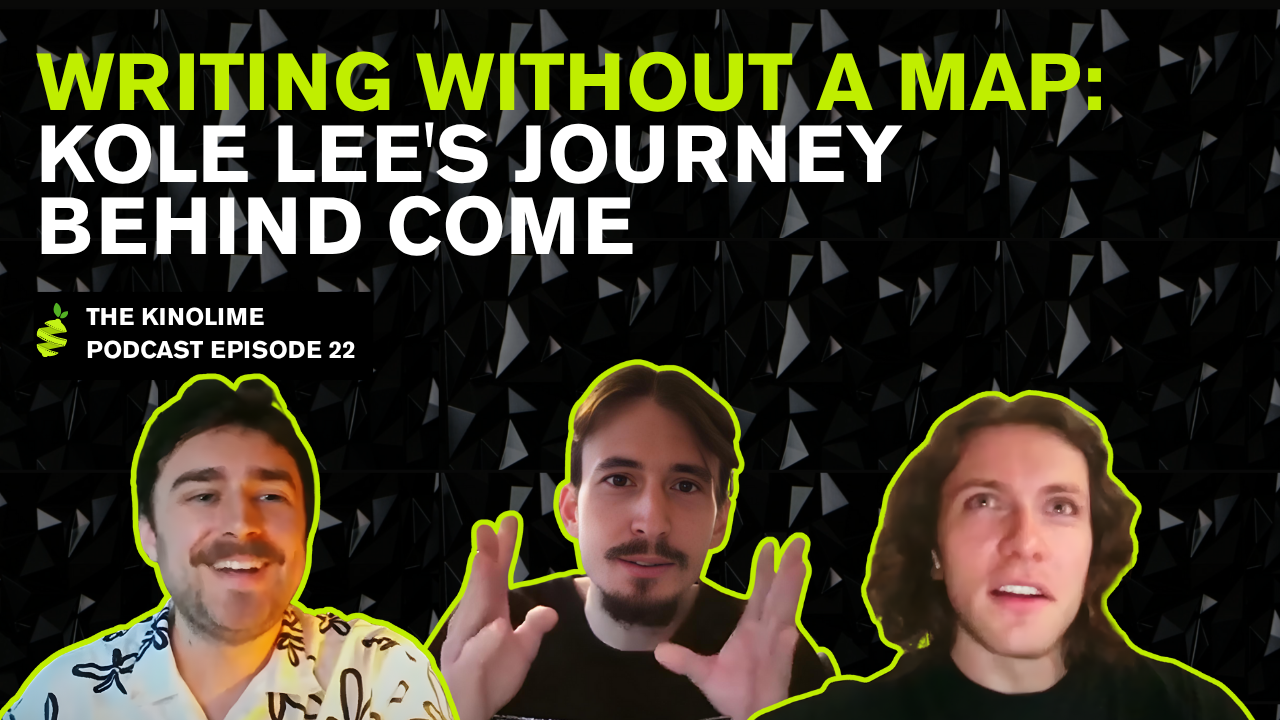
This video features a discussion between Meera Owen-Griffiths, Danny Murray, and Kole Lee regarding Kole's short script titled "Come".1
Background and Discovery: The script was submitted anonymously to a company short film competition and was ranked among the top 26 entries before the author's identity as Kole Lee, the company's social media manager, was revealed.2
Creative Process: Inspired by filmmaker David Lynch, Kole describes his writing process as an experiment in letting a single idea consume him and following his subconscious rather than overthinking or outlining.3
Thematic Content: Kole describes the script as an exploration of shame and guilt in a young man struggling with relationship issues and addiction.4
Narrative Style: The participants characterize the screenplay as "Lynchian," experimental, and surreal, noting that it straddles the line between a traditional narrative and a completely experimental film.5
Interpretations of Imagery: The group discusses various interpretations of specific scenes, such as the appearance of older characters who Kole views as archetypal figures representing judging forces or a potential future self.6
Personal Connection: Kole notes that one particularly impactful scene involving a child in a wheelchair was influenced by his personal experiences as a parent of a special needs daughter.7
Future Plans: Encouraged by the positive feedback from his colleagues, Kole expresses a newfound motivation to bring the script to life by filming it.
Full Transcript
[00:00]
David Lynch was, for me, one of the most motivational filmmakers.
[00:04]
His whole process was about the idea, just like he would say, it's all about the idea.
[00:10]
You go fishing for an idea, just meditate on that one idea and you let it consume you,
Read Full TranscriptCollapse Transcript
[00:16]
you try to feel it, and then you just let that lead you through every single step of the
[00:20]
process.
[00:21]
I get an idea and I start overthinking.
[00:23]
I start out online really little things, thinking about every plot point, doing character
[00:27]
backstory, like just corrupting the idea in a way.
[00:30]
So this script was like my attempt of taking Lynch's advice to heart and having an idea
[00:36]
and then not really doing anything else except letting that idea consume me and then just
[00:42]
writing.
[00:43]
Hello, Keno Limer's, me, we're here and I'm joined today by Mr. Danny Mori.
[00:56]
Mori, over in New York and Sir Cole Lee, over in LA.
[01:02]
Good evening to you from Ireland.
[01:03]
We managed to sync up all three time zones to get everyone here together on this call.
[01:09]
Welcome guys, how are we all doing today?
[01:11]
Great.
[01:12]
You're incredible.
[01:13]
I'm going to touch on all the eyes.
[01:17]
Nice.
[01:18]
Nice.
[01:19]
How are you, Cole?
[01:20]
I'm good.
[01:21]
Yeah, I'm just using finally the 99 degree heat every day in LA.
[01:25]
I'm really proud of you.
[01:26]
It's like perfect.
[01:27]
It looks great right now.
[01:28]
Amazing.
[01:29]
We work in Celsius over here.
[01:31]
So I have no idea what that means, but it sounds bad.
[01:33]
Yeah, it's hot.
[01:34]
It's like really hot here.
[01:37]
Guys, today we're here.
[01:39]
We're going to talk about a short script that came through in our short competition this
[01:44]
year, all of which is anonymized.
[01:47]
So we do not get to know who wrote the script until we're kind of vetting right at the last
[01:52]
stage just to make sure that we don't let any Woody Allen's in or anything like that.
[01:57]
Now we did that this year and we found that there was a slight conflict of interest because
[02:02]
one of the top 26 that we were going to push through was written by Cole our very own.
[02:09]
And today we just wanted to get together and briefly talk about this script.
[02:14]
Cole, you can say the name of it because I don't want anyone clipping me saying it.
[02:19]
I'll come.
[02:20]
That's the name of it.
[02:22]
That's the name of the screen.
[02:24]
CSC OME.
[02:25]
That's correct.
[02:26]
And that's how I'll refer to it from here on out.
[02:28]
But yeah, Cole, we wanted to have you on basically just to talk a little bit about your script
[02:33]
because we loved it so much and it really kind of just goes to show how many great screen
[02:38]
writers we have attached to this company and out because kind of whether they're creative
[02:42]
execs, head of development.
[02:45]
What's your official title?
[02:46]
You run all of the social medias?
[02:48]
What's your handle?
[02:50]
Social media manager, I would say.
[02:52]
Awesome.
[02:53]
Well, yeah, guys, we really have so many great screenwriters here at all levels.
[02:58]
So we wanted to discuss Cole's script and dissect it a little bit.
[03:01]
Don't forget to mention yourself and the great screenwriters attached.
[03:04]
Give over.
[03:05]
You're going to make me be a good person.
[03:07]
Both are, I guess, technically, John too.
[03:10]
It's something that a lot of people know.
[03:11]
But John got introduced to the company before is really conceptualized because there was,
[03:17]
this is maybe like 2022, there was a pilot run before the company was founded to see how
[03:24]
a competition would work.
[03:26]
And John's script, Temple of the Dog, had the highest score.
[03:31]
So you three are actually our little perfect triangle of people that have ranked very highly
[03:44]
in the competition.
[03:45]
I think that says a lot about this company because it attracts people that aren't talented.
[03:50]
That's why I was so passionate about getting involved in GinoLon in the first place.
[03:55]
And it shows to anybody at home.
[03:56]
If you've got a script up there, you too can be sitting on a Zoom with a bunch of guys next
[04:01]
year if you want to submit to our competition.
[04:05]
Yeah, please be our guest.
[04:07]
So guys, we'll have a fair for any further ado.
[04:10]
Let's talk about your screenplay, COME.
[04:14]
So we've congratulated you and we've talked a little bit about, I mean, can you give us
[04:18]
kind of a brief, a log line or synopsis about what this screenplay is?
[04:23]
Because I mean, while Danny and I are huge fans, it's extremely hard to put a finger on
[04:28]
the pulse of what this screenplay is.
[04:31]
It's weird, it's lynchy and it's a little bit experimental.
[04:35]
Kind of got a yotterouski kind of vibe at times maybe.
[04:39]
When you tell us kind of in your own words what this screenplay is in your own mind.
[04:45]
Oh, this is the worst fear.
[04:47]
This is like the question I was hoping you wouldn't ask.
[04:49]
I don't have a log line for it.
[04:51]
I really can't summarize it myself either.
[04:54]
To me, I can't give it a log line really.
[04:57]
Like a standard kind of clean log line.
[05:00]
But to me, it's just about, I would say that this is like an exploration of a young man,
[05:07]
struggling with shame and guilt while dealing with a relationship.
[05:11]
That's the best that I could say to it.
[05:14]
For me, what the script is about.
[05:16]
That's all I can say.
[05:17]
I really couldn't give it a log line.
[05:18]
I'm sure I could come up with a log line if I sat here and thought about it a lot.
[05:22]
But that was part of the whole process with writing it was like, I didn't think about
[05:27]
a log line.
[05:28]
I didn't think about an outline of summary or anything.
[05:31]
But yeah, I'm sorry, I can't give it a log line.
[05:33]
Maybe throw it in the chat GPT and let it generate a log line.
[05:37]
I don't know.
[05:38]
I find it very fascinating that you're one of like social media's top kind of screenwriting,
[05:46]
educational and inspirational posters.
[05:50]
Was there any sort of advice, writing tips or filmmakers that you were, I mean, obviously
[05:59]
Lynch, but like directly inspired by to kind of get the story rolling?
[06:04]
It was Lynch.
[06:05]
I mean, that was it at the end of the day.
[06:07]
And it was like, I mean, you and I have talked about Lynch before Danny a lot.
[06:11]
He's my favorite filmmaker.
[06:13]
Like, he's just, I think he's the best filmmaker.
[06:15]
It's subjective, but he's my favorite filmmaker.
[06:18]
His films, I feel like, affect me the most when I watch his movies.
[06:21]
Mahal and Drive is my favorite movie of all time.
[06:24]
And this script is kind of born out.
[06:26]
I mean, honestly, when Lynch passed away, that was like, it really made me want to start
[06:31]
revisiting all of his work.
[06:33]
And at the time that I wrote this script, I kind of haven't been writing for years, really.
[06:38]
I mean, like, I kind of had stepped away from like seriously working on anything.
[06:42]
And I've written a lot of stuff.
[06:44]
And I was working on a feature and I kind of was writing on working on it for a few months,
[06:49]
stepping away, working on it for a little bit.
[06:52]
And I kind of had stepped away from writing for a long time and just doing other things
[06:55]
and focusing on other things.
[06:57]
And then Lynch passed away.
[06:59]
And it's like, you know, just, you know, affected all of us, all of us that love his work.
[07:03]
So I just started like rewatching all of this stuff and rewatching all of his interviews,
[07:08]
his masterclass, all of it.
[07:10]
And just got inspired, you know, I just, the whole thing, the idea of this script, this
[07:15]
script really is like just a experiment.
[07:17]
It was like an experiment for you because I've never written something like this at all.
[07:22]
Everything I've written has kind of been more clean cut narrative, beginning, middle,
[07:27]
end, plot points that you can kind of, you know, see what they are.
[07:31]
And rewatching Lynch's work and more specifically like his interviews.
[07:35]
I don't know if you all delve down the whole of like watching, you know, like he, it's
[07:41]
funny.
[07:42]
It's funny because it wouldn't seem like it.
[07:44]
But David Lynch was like, for me, one of the most motivational filmmakers.
[07:49]
I don't mean like Tony Robbins, raw, raw motivation.
[07:53]
But it's fun.
[07:54]
Like all of his interviews would kind of somehow turn into him giving advice and talking about
[07:59]
creativity and ideas and meditation, obviously.
[08:03]
And like you really watch his interviews and listen to what he says.
[08:07]
You learn so much about his process.
[08:10]
And at the end of the day, I think his own words, he would say this, but also just my interpretation.
[08:15]
Like his whole process was about the idea, just that, you know, like he would say, it's
[08:20]
all about the idea.
[08:21]
You go fishing for an idea and you just get that one idea.
[08:26]
And then you just meditate on that one idea and you let it consume you.
[08:31]
You try to feel it.
[08:33]
And then you just let that lead you through every single step of the process.
[08:36]
And it sounds like, okay, yeah, that's common sense.
[08:38]
That's how you write a script.
[08:39]
But that's not the case for me.
[08:40]
Like I'm an overthinker.
[08:41]
Like everything I've ever written has been, I get an idea and I start overthinking.
[08:46]
I start out online.
[08:47]
I find real little things thinking about every plot point doing character backstory, like
[08:51]
just corrupting the idea in a way to the point where like by the time I got to a place
[08:56]
where I felt like I wanted to start writing, it's almost like I wasn't connected to that
[08:59]
initial idea anymore.
[09:02]
So this script was like my attempt of taking Lynch's advice to heart and having an idea
[09:07]
and then not really doing anything else except letting that idea consume me and then
[09:13]
just writing without even thinking about what is the outline?
[09:17]
I didn't even know when I started writing a scene, I had no idea what the next scene
[09:22]
was going to be at all.
[09:23]
It just poured out of me in a way.
[09:26]
So I don't know if that's actually probably not even good advice or anything, but that was
[09:29]
the process for me.
[09:30]
It was like trying something I've never done before and really just letting an idea in
[09:35]
my emotions lead me to write this thing.
[09:39]
And it was my funnest and best experience I've ever had writing a screenplay because
[09:43]
I struggle a lot with writing.
[09:45]
I kind of procrastinate.
[09:46]
That's a really, really interesting call and all the advice that you have about, I
[09:53]
mean I see a lot of Lynch on the social media, your screenwriting and LA page as well as
[09:58]
the keynote line stuff.
[09:59]
Lynch obviously means a lot to you.
[10:01]
And when we met up earlier this year in New York and some kind of gluten free bakery
[10:07]
that we were dragged to, I'm sure.
[10:09]
And I think that we kind of got on to Bull Holland Drive in like a very, very short amount
[10:13]
of time.
[10:15]
And without kind of saying like this is like a lynchian sort of story.
[10:20]
Like there is kind of a similarity in that kind of fugue state, this kind of like sense
[10:24]
of nightmareish is NUE, the right word, I don't even know, but it sounds cool.
[10:32]
But you know, at the same time, I don't think this feels like it's trying to emulate
[10:37]
Lynch.
[10:38]
It doesn't feel like a Lynch project.
[10:40]
I can see those inspirations there.
[10:42]
But when this came across our desks and again, Danny and I read a lot of these, you know,
[10:47]
when we have a chat that we talk about kind of, you know, entrance and oh, you check out
[10:51]
the submission, there are the submissions great and I'd recommend this one and so forth.
[10:55]
We did kind of, you know, it felt like this, this weird kind of, it was so different from
[10:59]
anything else.
[11:00]
It really straddles the line between having a narrative and being like a completely
[11:05]
experimental sort of film.
[11:07]
So I mean, it really feels, you know, completely like its own thing.
[11:12]
One of the comments I had to Danny and to John was that, you know, this right here,
[11:18]
because again, we didn't know that this was cold behind this screenplay.
[11:21]
It really feels like they opened this tap, this faucet and they kind of, they didn't know
[11:25]
what it was going to mean from from one scene to the next, but it ended up kind of meaning
[11:30]
a lot.
[11:32]
But also I don't know what that, you know, actually looks like when I try to quantify it.
[11:38]
So I mean, yeah, it's really, really fascinating to hear it because I can, I could definitely
[11:41]
interpret that you didn't write this with an outline, but to hear you say that you kind
[11:46]
of didn't know kind of what the next scene would look like is fascinating and I'd love
[11:49]
you to share, you know, how much kind of editing did you do on this?
[11:54]
Did you go back and say, well, this scene actually needs to go after or did you kind of, you
[11:58]
know, sit down, write it, bang it out in one, any refinements or how many drafts have
[12:02]
you been through?
[12:03]
Kind of what's your, your experience been like since you, you know, initially kind of
[12:06]
said, here's my, here's my first draft, my vomit draft.
[12:10]
Where do you go from there?
[12:11]
The first stop.
[12:12]
Thank you.
[12:13]
Like I appreciate everything you're saying.
[12:15]
And I wasn't like listen, I love Lynch and it would, it would be, it's an honor just
[12:20]
for you to say like, you know, I can feel the inspiration of Lynch.
[12:24]
I wasn't trying to like emulate or copy Lynch, but like it really was, it was like, I
[12:29]
had no plan to like do anything with this script again.
[12:32]
It was like, I hadn't been writing for a long time and stepped away.
[12:35]
And it's like, I wanted to just do something I've never done before to hopefully kind of
[12:41]
motivate myself to like get back into the process of writing.
[12:44]
And like I was saying a second ago, like I'm, I struggle with writing.
[12:48]
Like I'm, I love it.
[12:49]
And when it's going well and maybe Mira, you can attest to this.
[12:52]
To me, you seem like a prolific writer.
[12:54]
Like the blog posts you write and like your scripts are amazing.
[12:57]
But like I really struggle with it when it's going well, I feel like I'm high and then
[13:02]
book pretty much every other minute.
[13:03]
It just feels like, like I'm overthinking.
[13:05]
I'm procrastinating.
[13:07]
And so I wanted to try out doing something where there was no limitations, like no limitations
[13:13]
really, no restraints on what I'm going to do.
[13:16]
And so I guess my process, like the process was, so I got an idea.
[13:21]
And again, I guess now that looking back, it's like, what was my initial idea with him?
[13:25]
But I think it was just like exploring what shame and guilt around addiction, maybe porn
[13:31]
addiction feels like while you're in a relationship and you feel guilty to leave, you don't want
[13:37]
to leave.
[13:38]
You're lusting over other women, but you love the person you're with.
[13:41]
Like it was like all those kind of ideas crumbled together into into one idea.
[13:45]
And then I just like meditated on that idea.
[13:47]
And rather than what I do, what most people do, which isn't even a bad thing, but for
[13:52]
anyone maybe listening, it's an experiment.
[13:55]
Like it's a way to kind of experiment, try something new.
[13:58]
Instead of me starting to think about, okay, I have this idea now, how can I turn it into
[14:01]
a story?
[14:02]
How can I turn it into a structure of, you know, beginning, middle, end, the enticing
[14:06]
incident.
[14:07]
Instead of that, I just like meditated on it and started thinking about like visuals.
[14:12]
Like, what do I see when I feel this idea or what emotions do I feel?
[14:16]
How can I, instead of how can I tell an narrative?
[14:19]
I was like thinking, how can I make other people feel when I'm feeling when I think of this
[14:25]
idea?
[14:26]
Like what visuals can I write that will maybe make other people feel this, like, you
[14:31]
know, instead of like listen to the story or whatever.
[14:34]
And so then I just started out having all these like images.
[14:37]
And then that's where that's kind of when I started writing, honestly, was I had that
[14:41]
first scene of like a woman laying in a field with all these scribbles looking like
[14:46]
her, you know, private parts.
[14:48]
And I just started writing that scene and then to answer your question about like, how
[14:52]
many drafts and stuff I wrote, I think I wrote this in a matter of like probably like
[14:57]
four hours, but it was spread out between a couple of days.
[15:00]
So I just sat down, wrote that first scene and as soon as that first scene was done, instead
[15:04]
of thinking about what happens next logically, I just, whatever fucking idea came to think,
[15:10]
I just like wrote it down on paper.
[15:12]
Like I just wrote down whatever the next thing was.
[15:15]
And I think, and this sounds pretentious, whatever, it's going to sound pretentious,
[15:19]
but I do think it's like leading with your subconscious rather than your intellect.
[15:25]
Like instead of letting your intellect tell you logically what makes sense to happen
[15:28]
next, I just let whatever my subconscious fed me be the next thing that I wrote.
[15:34]
And then of course, I would take that and kind of flesh it out into something that kind
[15:39]
of makes sense.
[15:40]
And then that was the whole process with it, like just doing that.
[15:44]
And I wrote like maybe the first half in a couple of hours and then the next day went
[15:47]
back to my favorite coffee shop and like wrote the second half and I never re-wrote it
[15:52]
or anything.
[15:53]
I mean, I blessed it out a little bit here and there, but I never like did a second draft.
[15:57]
I never like added more scenes.
[15:58]
It was just literally that first thing that like came to mind.
[16:02]
And when I wrote it again, it was like an experiment.
[16:04]
It was like, I don't want to limit myself with anything with this.
[16:08]
I don't want to think about narrative.
[16:09]
I want to like like just almost like what a painter does when they're just painting
[16:14]
something that's coming to their mind.
[16:16]
I just wanted to like capture whatever this feeling is that's making me feel something
[16:21]
so much.
[16:22]
Like how can I just capture this like in this moment?
[16:25]
And then that was really it.
[16:26]
Like that was the whole process.
[16:27]
That is so crazy to hear, especially is for me, I do so much pre-planning on my work
[16:33]
this year.
[16:34]
A 170 page vomit draft of a screenplay which I then had to whittle down to 120 and it
[16:41]
took forever.
[16:42]
So the fact that you've managed to make something so polished kind of without an outline in
[16:47]
such a short amount of time is crazy to me.
[16:49]
So congratulations and anything that you kind of want to throw at Colwell, we've got him
[16:52]
here on the hotspot.
[16:54]
My first read through, I kind of interpreted the story as like the kind of suffocating
[17:00]
feeling of like wanting to approach someone that maybe you know you're not good enough
[17:06]
for like they're like kind of creating an entire pair of social relationship with someone
[17:11]
that you won't ever actually plan on pursuing.
[17:16]
And then my second read was entirely different.
[17:21]
My second read it almost felt like a man kind of like not to bring it back to Lynch but
[17:25]
like an eraser head story of someone who's just like suffocating in their kind of like
[17:31]
confined life.
[17:33]
And then, potentially what I'm passionate about.
[17:39]
Understanding from your perspective is like where did these two elder characters play
[17:45]
into the story for you?
[17:46]
Like what was your motivation for adding them?
[17:50]
I haven't cracked them at all.
[17:52]
I think it was like well first off, I appreciate like I appreciate everything you're saying.
[17:57]
And just to touch on one thing because you said like your first read it was this, your
[18:01]
second read it was this, when I finished writing it, the first thing I did, which Stephen
[18:06]
Fingleton talked about this actually on the re on his like recent podcast episode, which
[18:09]
you also go anyone who hears this goal is amazing.
[18:13]
Nice, nice, close goal.
[18:14]
Well, he was, he was, I love this podcast.
[18:17]
It's an honor to even be on here because this really is a great podcast.
[18:20]
He was talking about how like one of the best tips you can do when you're writing is kind
[18:24]
of like talk to other people about it.
[18:26]
Send, send your ideas around, talk with friends about it, maybe send an outline around it,
[18:31]
just kind of bounce it off with people.
[18:33]
So like the first thing I did when I wrote it was, you know, I've connected with a lot
[18:37]
of amazing people on social media through my account.
[18:39]
So I sent my script to like 10 or 15 people that like I've just kind of become friends
[18:44]
with and said, Hey, would love your feedback on this more importantly, what's your interpretation?
[18:49]
Like what do you, like what does this make you feel like?
[18:51]
What do you think in every single person had a different interpretation?
[18:54]
There are common, common things like everyone just had their own interpretation, which
[18:58]
again, like again, this is probably going to sound like dumb or sound pretentious, but
[19:02]
that was a part of my attention with writing.
[19:04]
This was like, that's what I love about cinema so much.
[19:09]
It's like it's so subjective in every film, every single person sitting in the theater is
[19:13]
probably going to interpret it in a different way.
[19:15]
And it's all valid.
[19:17]
Everyone's kind of interpretation is valid.
[19:19]
That's the beauty of it for me.
[19:21]
So I did write this really intentionally wanting to like write something that everyone
[19:26]
might feel and see in a different way.
[19:29]
Like depending on where you're at in life, you might like the elder people might connect
[19:32]
to you more.
[19:33]
Like if you're in a certain place in life or like, you know, the woman in the field might
[19:36]
connect you more.
[19:37]
So anyway, the women in the field are the elder, the elder people, I don't know.
[19:42]
I mean, again, I think it was like on the surface, what comes to mind for me when I was writing
[19:47]
that first scene where the elder guy was introduced was I think it's just maybe a metaphor
[19:53]
for the young man's future self, like where he could end up in the future if he doesn't
[19:59]
change his ways or he doesn't do what he wants to do or he doesn't reach out to that
[20:04]
girl that he's crushing on in the park or whatever it is.
[20:07]
I think it was kind of like just like the archetypal kind of like future self, you
[20:12]
know, there to kind of remind the young man where you're going to end up, you know, or
[20:17]
maybe what's important.
[20:19]
You know, I think that's all it really was to me.
[20:21]
And the woman, the elder woman, which I think she's in the scene where he's standing in
[20:26]
the line if I'm remembering correctly, I think she was like an interpretation of like
[20:32]
maybe just the archetypal feminine, like the feminine nature, you know, because she's
[20:36]
the one that like calls out the young man and says you can't be here.
[20:39]
Like, and so I think she was kind of like the archetypal like this feeling that a
[20:44]
lot of young men feel when you don't feel good enough, when you feel like you're being
[20:47]
judged by women, when you don't feel like good enough to go on dates or go ask someone
[20:52]
out, I think she was kind of that judging force of the feminine, but I don't know.
[20:56]
That's just what comes I can't do I can't interpret this shit any better than anyone else
[20:59]
honestly.
[21:00]
That's the best that I can come up with.
[21:03]
What what chance do we have or anyone at home have then call it so I just want to finish
[21:11]
on yet another congratulations call.
[21:13]
I'm sure that you'll find a home for this in some shape or form.
[21:15]
I'd love you to see you you shoot it yourself.
[21:18]
Possibly, you know, I don't know if that's something you're interested in, but you know,
[21:21]
this definitely has a future and we all wish you the best look.
[21:25]
Let us know if there's anything that we can do to help you kind of, you know, actualize
[21:29]
this.
[21:30]
And I'll finish on just a couple of things that really stayed with me from the screenplay.
[21:35]
The shot where the child is being wheeled backwards out of the out of the apartment room
[21:41]
really like stuck with me kind of long after I first read it, it was kind of the, you
[21:46]
know, the one image that was, you know, burned into my brain, I guess.
[21:52]
And also when the elder man says, you know, something on the lines of, you know, like don't
[21:57]
worry, you've still got a lot of time or something like that.
[22:00]
And those were kind of the two moments that, you know, I think you put those on kind of
[22:06]
like your little Oscars, like short, you know, short list clip when you get there.
[22:11]
And yeah, you know, what's your favorite moment from the screenplay then, I guess, both,
[22:16]
you know, to you, Danny and to you, cool.
[22:19]
Danny, you go first.
[22:21]
I'm curious.
[22:22]
I think for me, there's something about just like the opening scene of seeing just this
[22:33]
world, world, there's something about a character where you don't need a lot of description,
[22:43]
but in like the one or two lines you receive, you're instantly hooked into whatever the
[22:47]
story is.
[22:48]
And I feel like just seeing this person laying on grass with squiggly kind of like erotic
[22:54]
drawings all over them was enough for me to just kind of be hooked in it.
[23:01]
It's meant to me what the story is, which is like, I love this.
[23:06]
I don't know what it means.
[23:10]
So like that to me is just a lot of hope.
[23:14]
Me and from the jump.
[23:16]
And I love hearing this from you all.
[23:18]
I'm serious.
[23:19]
It's like, I said this before with John and everything, but it's very motivating.
[23:23]
Like hearing what everyone thought of this is like submitted it on a win.
[23:27]
Like, and by the way, just to kind of plug the competition and stuff, like I wasn't
[23:32]
100% certain if employees like could submit or not submit.
[23:36]
And so I kind of just submitted maybe hoping it would fly under the radar, but also just
[23:41]
to be back just to see what people would say.
[23:44]
And so when you called me Danny to like just personally saying, man, I loved your script
[23:49]
and meant a lot to me.
[23:50]
Like it really, it makes me want to shoot it.
[23:52]
You know, I made a couple of short films with my iPhone, but like this makes me want
[23:56]
to like actually take that next step to try to bring it to life.
[23:59]
But I appreciate it.
[24:00]
And my favorite scene probably like, honestly, you said it, Mira, I do think the the
[24:06]
the kid in the wheelchair, like I have a special needs daughter.
[24:11]
So clearly it kind of came out of struggles that I've had in my life with my relationships
[24:16]
and my daughter.
[24:17]
And so that scene, that moment like you said it perfectly, like willing him out backwards
[24:22]
in the young man, just seeing the kid.
[24:25]
And is it his kid?
[24:26]
Again, you can interpret it however you want, but seeing this kid kind of means wheel
[24:30]
down with all this shame and guilt surrounding it.
[24:32]
Like that scene probably was for me to like the kind of very impactful thing that I felt
[24:36]
a lot when I was riding it, you know.
[24:39]
All right.
[24:40]
Well, that wraps things up guys.
[24:41]
Thanks so much for joining us today.
[24:43]
As you can see behind me, it's getting dark here.
[24:45]
So yeah, we better get going.
[24:47]
Thanks.
[24:47]
It's been a pleasure to discuss this with you.
[24:49]
And yeah, once again, congratulations, Cole.
[24:52]
Danny, thank you for joining us today.
[24:54]
And everybody at home, check out Cole's screenplay.
[24:56]
I'm sure we'll have it linked down below someplace.
[25:00]
Maybe you should have read it before you listen to this discussion.
[25:03]
I don't know.
[25:04]
Maybe that was probably the better way to do it.
[25:06]
But we're here now.
[25:07]
So because it's so surreal and ambiguous
[25:11]
not for interpretation, no matter what you heard,
[25:14]
it's probably wrong.
[25:15]
Read it yourself.
[25:17]
100%.
[25:18]
All right, guys.
[25:19]
Well, yeah, thanks so much.
[25:20]
And I'll see you all soon.
[25:22]
Thanks, Yankele and best of luck.
[25:24]
Thank you so much.