
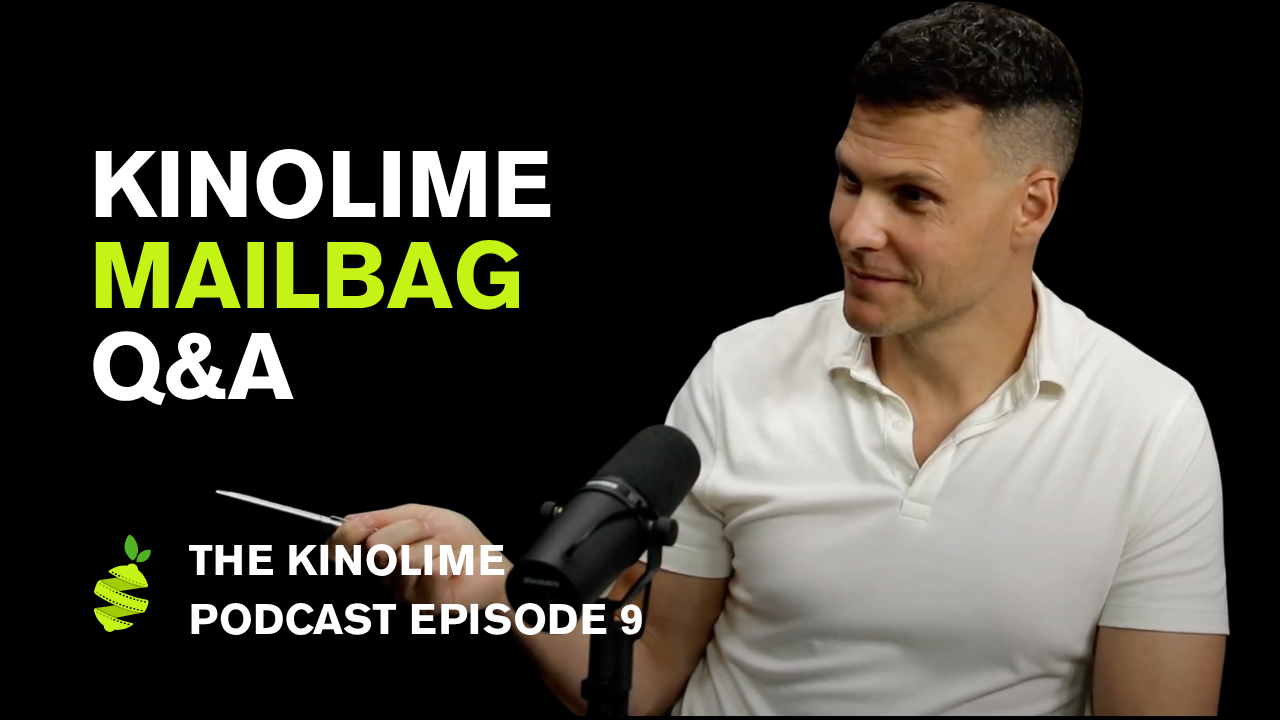
Q&A: Breaking into Hollywood, Divisive Films, & What’s Killing Theaters | Kinolime Podcast Episode 9
DM
Hosted byDanny Murray, John Schramm
Review on your platform
00:0000:00
Show Notes
The video features a discussion covering various topics related to the film industry, specifically focusing on career entry, creative preferences, and current industry trends.Breaking into the Industry
The participants debated whether it is necessary to live in Los Angeles to build a career in film.
The speakers acknowledged that while networking via tools like Zoom has made it easier to connect remotely, living where the industry is concentrated still offers traditional advantages.
While creating content independently is more accessible than ever, building a sustainable career is described as being increasingly difficult, especially for those without pre-existing connections.
Creative Philosophies
When asked if they would prefer creating a divisive film adored by a dedicated group or a mildly appreciated film with broad appeal, the speakers expressed a strong preference for the former.
They noted that films with passionate, niche fanbases—citing the example of director Zack Snyder—can be more fulfilling to create.
Trends and Challenges in Cinema
The conversation shifted to negative trends dominating modern cinema and potential solutions for the industry's decline.
Visual Trends: A dislike for the "Netflix look," characterized by flat lighting and digital processing that the speakers felt cheapened the final product.
Creative Choices: Concerns regarding a lack of thoughtful plot twists, the reliance on formulaic subplots, and a perceived lack of passion from some younger actors.
Marketing: The speakers critiqued the practice of revealing too much information in movie trailers, which they believe spoils the viewing experience.
Theater Experience: To address declining attendance, the speakers suggested:
Reducing ticket costs or offering incentives like free concessions to drive traffic.
Renovating aging theater infrastructure to improve the quality of the viewing experience outside of major media hubs.
Expanding the use of subscription services (such as A-List) to make frequent movie-going more affordable and routine.
Increasing investment in screenplay development to ensure higher quality content is produced.
Full Transcript
[00:00]
I think we're seeing this now get pushed back against.
[00:02]
Thank God, but it is young movie stars
[00:07]
not really caring about movies.
Read Full TranscriptCollapse Transcript
[00:09]
All right, we got a fun rapid round of the Keenalai Malabag,
[00:22]
which I love to do.
[00:24]
So Danny, you got some questions
[00:26]
that came in through the social media channels.
[00:28]
Why don't we wrap it fire?
[00:29]
Cool.
[00:30]
Okay, so the first one we have, does being outside
[00:33]
the Hollywood bubble make it harder to break in?
[00:36]
Or is that less of an issue than it used to be?
[00:40]
What do you think?
[00:41]
In my experience, I think it's easier to break in now.
[00:44]
As a writer, easier now.
[00:47]
So when I moved out to LA in 2012 to pursue film,
[00:51]
this is like, presume, you know, COVID,
[00:54]
it was, you had to get out there like, you know,
[00:58]
get the mail.
[00:59]
You got to like someone a DEA agent once told me,
[01:01]
like if you want to hunt, you know, elephant,
[01:03]
you got to go where elephants roam, you know,
[01:06]
so I got a big sense.
[01:07]
So you go to LA.
[01:08]
Nowadays, I don't know.
[01:09]
I think like you can network.
[01:11]
It's much easier, I feel with the Zoom.
[01:14]
Everyone's taking meetings remotely.
[01:16]
We're doing this remotely.
[01:17]
You're not even next to me.
[01:18]
No, this is, yeah.
[01:19]
But you know what I mean?
[01:20]
I do it on my own.
[01:21]
It's real.
[01:21]
I think it's easier, but at the end of the day,
[01:23]
you still got to write a good screenplay.
[01:24]
So you see in order to get the meeting,
[01:26]
you need to still write the great screenplay.
[01:28]
But I do think it's easier to network
[01:30]
and kind of break in.
[01:31]
But I would still say if you can,
[01:34]
it's always good to still go with the elephant roam.
[01:36]
Yeah.
[01:37]
For those reasons, what about you?
[01:38]
I think it's, I mean, I think it's easier
[01:40]
to make stuff yourself.
[01:43]
But I think in order to, you know, have a career,
[01:48]
especially in writing or in DEV, or, you know,
[01:52]
yeah, it's probably much, much harder than ever,
[01:56]
if you don't have connections.
[01:58]
You know, like we just saw last year,
[01:59]
like there's a 25% reduction WGA writing jobs.
[02:04]
Like that hits even harder when it comes to writing assistance,
[02:07]
when it comes to people in mail rooms.
[02:10]
But there's also more writing.
[02:12]
So there's 25% reduction in what we have.
[02:14]
But don't forget the last several years has been an increase
[02:16]
because of the, big streamer boom.
[02:18]
The meeting of content.
[02:19]
So yeah, evens out.
[02:21]
But I don't know, like I think at the end of the day,
[02:25]
if you, you know, need to write and you desperately need
[02:30]
to get your phone made, you can do it now
[02:33]
in a way you've never been able to.
[02:36]
But I think in order to really kind of put yourself
[02:40]
into a career that can hopefully pay you
[02:43]
and you could build your way up.
[02:45]
I don't think it's that much harder.
[02:46]
Could we compromise and say, move to the San Bernard
[02:49]
of Valley and just go on to week and zoom the rest?
[02:52]
I think that's a great idea.
[02:53]
Okay.
[02:54]
Yeah.
[02:55]
Okay.
[02:57]
Would you rather, I mean, I think that this one's
[03:00]
gonna be fairly obvious, but would you rather make a film
[03:03]
that's divisive but adored by 50% of people
[03:06]
or a film that's mildly appreciated by everybody?
[03:11]
Device in that it's not a, it's debated whether it's
[03:14]
a good film or not or the topic.
[03:16]
Yeah.
[03:17]
Would you rather make, you know, salt burner F1?
[03:21]
I neither.
[03:24]
No, I would rather make a film that gets,
[03:27]
I'd rather first tell the best story that's in my heart
[03:30]
and if it's divisive and half the people get it
[03:34]
or appreciate it, I'd rather have that than be adored.
[03:38]
I don't wanna be the McDonald's factory there.
[03:41]
No, totally, it's way better to.
[03:43]
What about you?
[03:44]
Oh my God, yeah.
[03:45]
Who wouldn't wanna make a movie that, you know,
[03:48]
you have like your own mini convention for
[03:50]
and then if you walk down the street, people are screaming.
[03:52]
I would love to be screamed at.
[03:54]
Being Zack Snyder seems so fun, you know,
[03:56]
I think his movies, I don't like his movies,
[03:59]
but there are people that would die.
[04:01]
There's a small minority that really love the Snyder Sots.
[04:04]
Yeah, it's incredible.
[04:05]
Like that seems so fun.
[04:07]
And I think it's good.
[04:08]
Like if you ever actually hear him talk,
[04:10]
he seems just like the best guy.
[04:12]
It's like, it's really doing something
[04:15]
having, it's like the perfect equilibrium.
[04:17]
Yeah.
[04:17]
I would do that.
[04:18]
Where we got next up.
[04:19]
Are there any trends you see dominating
[04:22]
cinema today that you're actively pushing back?
[04:25]
All right, so this is something I am
[04:26]
feel very passionate about.
[04:27]
And it's like not thing new,
[04:28]
but it's like the Netflix look dude.
[04:30]
Like digital flatness.
[04:31]
It's like, it looks like everything was shot with, you know,
[04:34]
a ring light through an iPhone.
[04:35]
Yeah.
[04:36]
There's like this flat lighting, this plastic skin tone.
[04:40]
You cannot stand it.
[04:41]
It cheapens the film, the movie.
[04:43]
And you just instantly know like this is gonna be mediocre,
[04:47]
you know, content.
[04:48]
And I use the word content purposely for that.
[04:50]
What about you?
[04:52]
And I have two more, but let's go to you.
[04:53]
Yeah, I think, and I think we're seeing this now
[04:56]
get pushed back against.
[04:57]
Thank God, but it is a young movie stars
[05:02]
not really caring about movies, you know,
[05:04]
like there is like this.
[05:05]
It's so awesome.
[05:06]
You're so right.
[05:07]
And I really, it's kind of disgusting to me
[05:11]
when anyone gets the opportunity to like work
[05:15]
in the coolest creative field in the world
[05:17]
and get compensated well for it.
[05:19]
And it's just kind of a thing they do.
[05:22]
That really makes me feel icky.
[05:24]
And I think in the last few years, you know,
[05:28]
like all of the movie stars coming out,
[05:30]
I think there's kind of been such a pushback to that,
[05:32]
like, General Ortega.
[05:33]
So one thing even like, Retro Spectal,
[05:35]
we look back and say, maybe I shouldn't have made that movie.
[05:38]
But to me in the moment, like a few years after success
[05:40]
would be a lot of success.
[05:41]
I should have never done this movie.
[05:42]
Well, how did you, you got this movie
[05:44]
which launched your career, you know, you can't really kind of.
[05:46]
Or I don't watch movies, which is another gross.
[05:48]
That's funny, yep.
[05:49]
But yeah, so that would be fun.
[05:51]
I have two quick ones on the writing side.
[05:52]
One, a lack of good thoughtful twists.
[05:55]
I watched Primal Fear the other day.
[05:57]
Just again, it's like, you know, the twists,
[05:59]
obviously incredible.
[06:00]
Like movies don't have the great twists anymore.
[06:03]
And a lack of a really compelling subplot.
[06:05]
I think films, stories are structured
[06:08]
just to get like to go quickly into the plot
[06:11]
and the story engine.
[06:12]
And they have to throw in a love subplot or whatever.
[06:15]
And it's just painted by numbers.
[06:16]
But the compelling subplots I find are missing.
[06:20]
I just thought that was something that I would like to see.
[06:23]
You know, I had never seen a Michael Hancky film
[06:25]
until it was my birthday a couple of days ago.
[06:27]
And I've always heard amazing things
[06:30]
about the piano teacher.
[06:31]
And I came in totally blind.
[06:33]
And I didn't really know what I was getting into.
[06:37]
And that's a film that, yeah,
[06:40]
just kind of creeps and creeps along with like,
[06:43]
the underbelly of its subplot
[06:44]
until you get into something so dark and...
[06:47]
Yeah, I know, yeah, yeah, yeah.
[06:49]
That just gets more and more grim
[06:51]
until the film ends, spoiler alert
[06:55]
with your main character stabbing yourself in the heart.
[06:58]
Yeah.
[06:59]
Walking away from her career pretty much.
[07:02]
Not a great birthday movie.
[07:04]
No.
[07:04]
But it's a great example.
[07:05]
And you had a rough birthday to begin with.
[07:06]
You just were going ahead.
[07:07]
I had the most adult birthday ever.
[07:09]
It was just a complete nightmare.
[07:11]
He turned 25 and literally life just came on
[07:14]
with that.
[07:15]
Everything that he needed to do adulting.
[07:17]
Walking every doctor's appointment before you know.
[07:20]
I just can't do that until I hopefully get Medicare
[07:23]
in my 60s.
[07:26]
But yeah, that was...
[07:28]
That's a great, but he's a great filmmaker.
[07:29]
Yeah, God, I've got to start more next.
[07:31]
What else we got up?
[07:32]
Anything else?
[07:33]
Yeah.
[07:34]
What do you think are the three biggest problems
[07:36]
in Hollywood causing decline?
[07:38]
The general decline.
[07:39]
On the sposter.
[07:41]
I think lack of quality screenplays that are being made.
[07:48]
I think that cinemas need to do more to get people in the theater.
[07:58]
I think they're charging probably too much.
[08:00]
You know, I do.
[08:01]
Like if people are going to spend $18 or more on a movie ticket just for one plus pop
[08:06]
or whatever, you know, it's going to cost you, like if you bring a date.
[08:10]
Oh, yeah.
[08:11]
So $100 to go see a movie that you're not going to probably like.
[08:14]
Like why would you spend $100?
[08:16]
Like you can go $100 and get like a really amazing meal at a restaurant that you know
[08:20]
you're going to like.
[08:21]
So I think they got to bring the cost down and do something to drive an incentive
[08:25]
to get people in the theater.
[08:26]
I thought of something really interesting and please no one take this.
[08:29]
But I'm like, why don't movie theaters just give away free popcorn?
[08:32]
Think about it.
[08:33]
Causing nothing.
[08:34]
Like literally nothing.
[08:35]
Like corn is so cheap.
[08:36]
Like the soda guns.
[08:37]
Like that's just like syrup and water.
[08:40]
Give away like one free soda and a free popcorn.
[08:43]
I think that would drive it up.
[08:45]
The third thing, I feel that films give away too much in the in the trailers.
[08:52]
Like you know everything in a movie.
[08:54]
No more red band trailers.
[08:55]
Like seriously, like they tell you everything.
[08:58]
Like I miss the days of where you just got a little snippet.
[09:00]
I just watched the new Ryan Dozzling trailer that just came out.
[09:03]
Hail Mary.
[09:04]
And like the trailer was really dope up until the point where he meets the alien.
[09:09]
And I'm like, why introduce the alien now?
[09:10]
Like you had me at the guys going to try and save the world and it there.
[09:14]
Yeah.
[09:15]
Go to the theater and then he's like, oh, he meets be friends in alien, like fly to the navigator.
[09:18]
Mm-hmm.
[09:19]
Like that's that why you telling me now there's an alien.
[09:21]
I was like so shocked they gave that away.
[09:23]
So shocked.
[09:24]
Yeah, I remember it's one of my favorite trailers ever is the breaking bad film, El Camino.
[09:32]
Oh, yeah.
[09:33]
It doesn't tell you anything.
[09:34]
You don't know anything about it.
[09:35]
I know.
[09:36]
It was awesome.
[09:37]
So it's a great trailer.
[09:38]
Everyone should check it out.
[09:39]
What are you three?
[09:40]
This is going to be hard.
[09:41]
I think I took the three top.
[09:43]
Well, I mean, I think that they fall towards the same general underlying things, which is
[09:49]
like, I would like to see studios invest more in development.
[09:52]
And I would like to see, you know, screenplays be nitpicked and fostered in a way that they
[10:01]
probably haven't been in my entire life.
[10:03]
Yeah.
[10:04]
Right.
[10:05]
Yeah.
[10:06]
And then I would go into redirection towards story.
[10:09]
Another thing that I think I've never really gotten a chance to fully understand until
[10:14]
I traveled the country more because I've only ever really lived in Los Angeles and New
[10:18]
York.
[10:19]
I've always had incredible theaters at my disposal.
[10:21]
Yeah.
[10:22]
And there's renovated and there's people in them constantly and there's a vibrant, really
[10:27]
curious community.
[10:29]
And the time you step into a theater, you have art house theaters everywhere.
[10:33]
I know you.
[10:34]
You have people talking about movies.
[10:36]
You've great places to watch and hang out with friends.
[10:39]
When you travel the most of the country, you have a big box theater that hasn't been renovated
[10:44]
since like, you know, when you talk about the glory days of like, when, you know, like
[10:49]
the 2000s, it's the same.
[10:51]
The ugly carpets, like half the screens, you know, like, don't work or you're here
[10:57]
and calibrating.
[10:58]
Yeah.
[10:59]
And it just, it's like, why are you paying for this?
[11:02]
Like it is, it's what people always say is like, why wouldn't I just watch at my house?
[11:07]
And what I always think is like, well, because the grandiose of the movie theater, they
[11:12]
don't, like most people don't get that in this country.
[11:15]
I'd love to see like, you know, instead of like, communities having like one 30 screen
[11:21]
theater that sucks, that hasn't been renovated.
[11:23]
Like, maybe make, have a couple like, you know, more vibrant theaters that are a bit smaller,
[11:31]
better programming.
[11:32]
All right.
[11:33]
So that's your second one.
[11:34]
Yeah.
[11:35]
So renovate theaters.
[11:36]
Screenplay about some story.
[11:40]
And I think that it's probably another one, but like, we need to do something to get more
[11:47]
people into like yearly kind of like a list as subscriptions that get people constantly
[11:52]
in the theater.
[11:53]
Pass and all that.
[11:54]
Sure.
[11:55]
The amount of friends I have that never really cared about movies that now go through
[11:57]
it's a week with like a list.
[11:59]
That goes to the cost factor, right?
[12:01]
I think like if they were going to go once a week, they would never go once a week if
[12:04]
they were paying full freight, but they have like access to a plan that can get them in.
[12:10]
I completely agree.
[12:11]
Yeah.
[12:12]
I think we got to somehow like libraries now like my library, I can get the hoopla app
[12:16]
can't be, you know, can't be, but like we should they should do something like cinema.
[12:20]
Migrate.
[12:21]
Yeah.
[12:22]
We need to give people an affordable option to invest in theaters and make theater going
[12:28]
on a routine.
[12:29]
Sure.
[12:30]
Right?
[12:31]
Thank you for your questions.
[12:32]
These were amazing.
[12:33]
And anymore, subitxanelab.com.
[12:34]
And we'll do it on the grab back soon.
[12:36]
Yeah.
[12:37]
John.
[12:38]
Danny.
[12:39]
Bye.
[12:40]
See you later.