
The Writing Process That Won a Screenplay Competition | Kinolime Podcast Ep 53
JS
Hosted byJohn Schramm
KZ
With guestKathryn Zizek
Review on your platform
00:0000:00
Show Notes
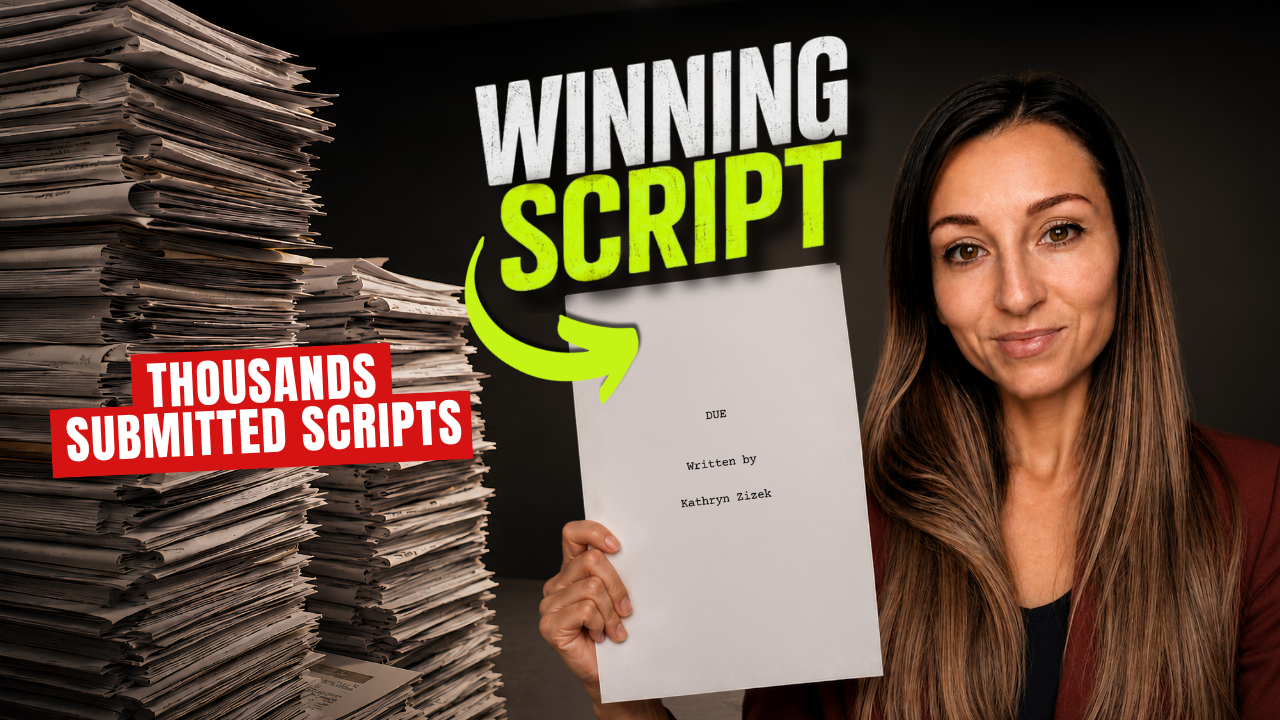
Kathryn Zizek had never written a screenplay before. Then her debut script, DUE, won Kinolime's 2026 Script-to-Screen Competition. Now it's being made into a film!
In this episode, John Schramm sits down with Kathryn to unpack exactly how she wrote an award-winning screenplay on her very first attempt. From finding the initial idea to building memorable characters and meaningful arcs, Kathryn walks through the writing process that helped her script rise above thousands of submissions.
Together, they discuss how she learned screenwriting, how she developed the story for DUE, why she builds characters by working backward from their destination, and the biggest challenges she faced while writing her first screenplay. Kathryn also shares practical advice for aspiring screenwriters who are just starting out and wondering if they're "good enough" to write a script.
Whether you're outlining your first screenplay, trying to create stronger character arcs, or looking for insight into what makes a screenplay stand out in a competition, this conversation is packed with actionable writing advice you can apply to your own work.
Full Transcript
[00:00]
What's a piece of writing advice
[00:01]
that you would give first time writers?
[00:04]
I think just to get something finished,
Read Full TranscriptCollapse Transcript
[00:07]
that is the first step,
[00:08]
because if you can just get a first draft
[00:11]
I've heard this somewhere, but you've got the clay.
[00:13]
Yeah, and you're ready to talk about the clay.
[00:15]
Jordan Peel always talks about
[00:17]
shoveling sand in the sandbox.
[00:19]
And I love that, that's one of my favorites,
[00:21]
because it does, it's shoveling sand,
[00:22]
just get in the sandbox,
[00:23]
and we'll make a castle later out of it.
[00:26]
Hey everybody, welcome to the Kinelein podcast.
[00:29]
I'm John Schram.
[00:30]
Guys, I don't want to spoil it,
[00:32]
but we have our script to screen.
[00:34]
Kinelein winner with us today.
[00:36]
Kinelein is a studio essentially that operates
[00:39]
in a way through a screenplay competition.
[00:41]
So from screenwriters all around the world,
[00:43]
you can submit your screenplay in English.
[00:45]
And it goes through a variety of voting rounds
[00:47]
where the audience gets to vote.
[00:48]
45,000 and growing community members, they voted.
[00:51]
The winner doesn't get a trophy,
[00:53]
they get a director, as well as up to $15 million
[00:57]
in production financing.
[00:58]
We have our script to screen.
[01:00]
Kinelein winner with us today.
[01:02]
Katherine, how are you?
[01:03]
I'm just squeezed right now.
[01:05]
I'm just squeezed in and out.
[01:07]
The script is only being made
[01:09]
because of everyone who came out and voted for it.
[01:12]
How has life been since winning the script to screen competition?
[01:16]
It has been incredible.
[01:18]
I think that I didn't really know what to do.
[01:21]
I think that I didn't realize that the start
[01:24]
what just could come from this.
[01:26]
I'm so glad that I entered, obviously,
[01:29]
but I feel like it was just...
[01:31]
Yeah, sorry.
[01:33]
I'm like a little too nervous.
[01:35]
I'm just going to score.
[01:36]
This is great.
[01:37]
You're doing fantastic.
[01:39]
My phone was running hot the morning of the competition.
[01:42]
I'm sure it was.
[01:43]
We've been contacted by more people in my life.
[01:45]
So your friends and family just checking it out
[01:47]
and helping like seeing what happened?
[01:49]
Yes, yeah.
[01:50]
So many people just saying congratulations.
[01:53]
And even strangers online,
[01:56]
obviously, like, contacting me on Instagram.
[01:58]
Yeah, everything.
[01:59]
Everything club now.
[02:00]
I mean, this is a big deal.
[02:01]
Yes.
[02:02]
That's a true testament to your writing.
[02:03]
Sometimes I just forget that I won.
[02:06]
And I'll just have this moment in the day
[02:08]
where it pops into my head.
[02:09]
And I just find myself sort of smiling.
[02:11]
And nobody really knows why.
[02:13]
It's been really nice.
[02:14]
It's not the kids, it's not the husband.
[02:16]
It's not the great weather.
[02:18]
It's the fact that you're going to have a movie made.
[02:20]
That's huge.
[02:21]
Yeah.
[02:22]
And what's also incredible is like,
[02:24]
you know, this is the first time you wrote a screenplay.
[02:27]
Like, you are a Diablo Cody, you know, with Juno,
[02:32]
writing her first screenplay,
[02:33]
getting produced and winning an Oscar.
[02:35]
I mean, that's a big deal.
[02:36]
It's huge.
[02:37]
It's, I just, this is maybe my greatest achievement
[02:41]
outside of my personal life.
[02:42]
Yeah.
[02:43]
It's just, it's come so quickly.
[02:44]
It's, it's, it's, it's indescribable.
[02:47]
Well, let's talk about things you can describe.
[02:50]
First of all, how did you come up with this idea of the do?
[02:55]
I can pinpoint the exact moment that inspired you.
[02:58]
So it was an intrusive thought or an image that came into my mind.
[03:04]
I was up in the middle of the night breastfeeding my son.
[03:09]
And it was dark.
[03:11]
I was alone.
[03:12]
And I just thought to myself,
[03:14]
how terrifying it would be if I just looked down and instead of my son,
[03:21]
I saw a man latch to my breast.
[03:25]
And that was just,
[03:27]
at the first look was actually, I would watch that movie.
[03:31]
Oh, okay.
[03:32]
So you like horror, horror is something that you're into.
[03:37]
Yeah, totally super into horror.
[03:39]
So I just thought it was something that I was going to say.
[03:43]
Something that could be something bigger and be more.
[03:48]
So then my next thought was,
[03:51]
well, who would that be?
[03:54]
Who would that have the most effect on?
[03:57]
Who would that person be that it would be the most horrifying to?
[04:01]
And the answer wasn't just a mother.
[04:04]
It was someone who had experienced a major violation before
[04:09]
and thought they had sort of escaped that.
[04:12]
It's a really scary thought to, obviously,
[04:16]
because the thing that makes it so scary,
[04:18]
it's not a physical harm in such,
[04:21]
it's that it's a violation.
[04:24]
And yeah, I think I just really dove really deep into that
[04:30]
and what made it scary.
[04:32]
And then I just, I saw that there was the bones for a horror film there.
[04:38]
So was that, was that on the same moment that you answered these questions?
[04:43]
Was this over the course of days or, you know, all these things of the character?
[04:48]
I would say over the course of the next few days.
[04:51]
So at first I just had that image and I knew it could shake it.
[04:55]
Yeah, yeah, yeah, you could shake it.
[04:57]
I get it.
[04:58]
And so then when did you decide,
[05:00]
because were you screenwriting at the time or?
[05:03]
No, I was not screenwriting.
[05:05]
I've been a writer sort of casually through my life.
[05:09]
So, but screenwriting I had never touched it.
[05:12]
So you're a full-time mom, two kids,
[05:14]
and then boom, you get this idea.
[05:16]
So what made you take that step into deciding to write your first screenplay?
[05:20]
Part of it was that I needed,
[05:22]
I needed something like, as I just said,
[05:24]
I wasn't employed and I just needed something that was mine,
[05:28]
that I could do that was about me,
[05:31]
because being a mom,
[05:33]
you don't get a lot of time to yourself.
[05:35]
And when you do,
[05:36]
so many things have been stripped away,
[05:38]
that you're not even sure what to do with yourself anymore
[05:40]
when you've got that moment.
[05:42]
And writing was something I loved,
[05:45]
that I had abandoned in a way,
[05:48]
and I just wanted to go back there.
[05:50]
So I thought that I would do it.
[05:51]
And I never wrote the screenplay thinking I would show it to anyone.
[05:55]
I just was something that I wanted to do for myself.
[05:58]
I wanted to finish something.
[06:00]
And really, the goal was just to finish a screenplay.
[06:04]
What was day one like,
[06:06]
did you start outlining?
[06:07]
Did you, like, how did you, as a first-time writer,
[06:09]
did you read any books on screenwriting?
[06:11]
Like, how did you know what to start?
[06:13]
Yeah, so I started by researching the rules,
[06:16]
like finding out.
[06:17]
Right, a screenwriting, yeah.
[06:18]
Yeah, yeah, screenwriting.
[06:20]
I needed to know, like, obviously, all the formatting,
[06:23]
but as well, I just,
[06:25]
I was watching videos on YouTube,
[06:28]
but I was signing up to every newsletter,
[06:31]
just really trying to absorb as much as I could about the craft
[06:35]
before I started,
[06:37]
because I really just didn't have any idea what was involved.
[06:41]
So was there a book,
[06:43]
a YouTube channel,
[06:44]
like, what was something that, you know,
[06:46]
really helped you in this early stage?
[06:50]
I found Tom Vaughn pretty early.
[06:54]
I don't know if you've heard of him,
[06:56]
but he's got some, like, incredible tips.
[06:59]
Some of the, that was, like,
[07:02]
maybe that's more about the refining than the formatting.
[07:06]
Okay.
[07:07]
The formatting, I mean,
[07:08]
a lot of it was just whatever,
[07:10]
that was the first Google search result, you know?
[07:13]
When did you start getting into, like, the story?
[07:15]
Did you start with,
[07:17]
I got to create my protagonist,
[07:19]
like, what were you starting to think of,
[07:20]
scenes?
[07:21]
Like, how did you start in very, very early days,
[07:23]
this, you know, building out, do?
[07:25]
I knew that whatever I wrote,
[07:28]
had to lead to that scene.
[07:31]
So, and it had to earn that scene.
[07:34]
So I actually, from that,
[07:36]
from the scene, the breastfeeding scene,
[07:39]
I worked out who my character needed to be,
[07:42]
who my protagonist needed to be,
[07:44]
and from knowing who she needed to be,
[07:48]
I then could see what her arc needed to be.
[07:52]
And once I knew that she needed to go from victim
[07:55]
to fierce protector,
[07:58]
and that she needed that emotional transformation,
[08:02]
then I decided what sort of antagonist
[08:07]
could push her there.
[08:09]
Okay.
[08:10]
So it actually, yeah,
[08:12]
it's sad as we did, like, a little reverse engineering.
[08:13]
Like, you knew,
[08:14]
I wouldn't say the ending,
[08:15]
because it's not the ending,
[08:16]
but you knew a point in the,
[08:19]
the forest of the screenplay,
[08:21]
you knew that you wanted to get to,
[08:23]
and then you want,
[08:24]
but you had to build to there.
[08:25]
That's interesting.
[08:26]
I love that.
[08:27]
You just had this scene that inspired you,
[08:29]
and you just reversed engineered there.
[08:31]
I think that's great.
[08:32]
You need all the time,
[08:33]
writers having an ending in mind,
[08:34]
and then building a home movie around that,
[08:35]
but you, this wasn't the ending.
[08:36]
This was probably around the midpoint, Ish, right?
[08:39]
So...
[08:40]
It's not my run the middle.
[08:41]
And it really could have got cut.
[08:43]
It just was like,
[08:44]
it just, was the DNA,
[08:46]
and...
[08:47]
The inspiration.
[08:48]
That's what you needed, the spark.
[08:50]
So if everyone home, I want to,
[08:51]
zero in on this, the spark park.
[08:52]
Because I think for a lot of writers,
[08:54]
and I can speak, you know,
[08:56]
to myself, is,
[08:57]
there's a spark that gets me going every day
[08:59]
to get my ass in the chair,
[09:00]
and put in the hours.
[09:01]
Catherine same thing.
[09:02]
She had the spark of the scene,
[09:03]
and she needed to get there,
[09:05]
and fierce like your character,
[09:07]
you were relentless in getting there,
[09:09]
and you did masterfully.
[09:11]
So, now the question is,
[09:14]
once you got to that scene,
[09:16]
and you've satisfied that spark,
[09:18]
so to speak,
[09:19]
what kept you going?
[09:20]
I felt like I really had something.
[09:21]
Okay, so you knew at this point,
[09:23]
you had a movie,
[09:24]
and a screenplay,
[09:25]
yeah, I got it.
[09:26]
I got it.
[09:27]
Yeah, and it just felt like,
[09:29]
good enough that
[09:31]
it wasn't just for me anymore.
[09:33]
I think that...
[09:34]
So like that.
[09:35]
And I love that it wasn't for you.
[09:36]
It was like, you were,
[09:37]
and I look at this metaphor,
[09:38]
you were birthing something,
[09:40]
so to speak,
[09:41]
right, this entity of a story.
[09:44]
But like, what was,
[09:45]
as you were writing it,
[09:47]
like, was there, like,
[09:48]
what were you latching on to that,
[09:50]
besides getting to that scene,
[09:52]
that really,
[09:53]
you kept wanting to go?
[09:55]
Was there, was it a character,
[09:57]
you just always wanted to revisit every day,
[09:58]
was it that you wanted to write more
[10:00]
of the crazy freaky shit that was in there?
[10:02]
What was it that,
[10:03]
you know, you couldn't wait,
[10:05]
couldn't wait to get back to the computer the next day?
[10:07]
I had these,
[10:08]
just these ideas that would come to me,
[10:10]
and sometimes it would be in the middle of the night,
[10:13]
and I just had to get them on paper,
[10:15]
and it was,
[10:18]
and, you know,
[10:21]
I mean,
[10:24]
there was some of it was,
[10:26]
the freaky stuff,
[10:28]
some of it was,
[10:29]
just connecting something that wasn't connected before,
[10:32]
and realizing that,
[10:34]
that would be a big payoff,
[10:36]
and that kind of thing really,
[10:38]
was exciting,
[10:40]
that it was,
[10:41]
it was just like,
[10:43]
writing is a muscle. It's, you know, as Aaron Sorkin says, it's the only profession you can get better with with age, you know?
[10:49]
So it's something that you're gonna put the hours into learn and like, you know, when you get to Reddler's block
[10:53]
kind of overcome this, but it's your first time writing fucking screenplays.
[10:56]
So like, like, what were some of your challenges when you were writing that you were like, you know,
[11:01]
fuck, this is hard and like, what do I do? Like tell us, you know, for all those first-time writers out there, like,
[11:07]
like tell us your experience with that.
[11:09]
I think if you love doing it, it doesn't even, it doesn't even feel like that. Like, I just, I was having so much fun with it that I would just come in with the energy and I would just keep going.
[11:21]
And I feel like another thing is that it was obviously my personal time, my time to myself. So it was just, it actually didn't feel difficult even when I hit like a point where I didn't know
[11:34]
where to go with it. I would just sometimes I would write a different scene that I knew was coming up and I would leave that scene.
[11:42]
And then later on I would come back and fill that gap. So I always just kept going. I didn't stop. There wasn't like a big period where I wasn't writing and I just left it alone.
[11:54]
I really just went from like nothing to first draft in three months.
[12:00]
Wow, it was three months. Okay, but that's that's that's a very solid. I mean, it gets a very good timeline to get it done.
[12:07]
What a when you were in those moments though, how did you get so you you had the neck you just did another another scene to just rejig it.
[12:17]
Did you outline? Did you know what scenes like did you have something on paper that you knew you were following or?
[12:23]
Sometimes I had no idea what was coming next. I did not write an outline at the start of what the end would be. I obviously I knew that scene I was working towards with the breastfeeding, but I didn't know how I was going to get there.
[12:36]
I had it all just was instinct and I feel like I was drawing from what I thought it would look like as a movie. So I just I would imagine what would come after this.
[12:49]
If I was watching this, if I was sitting in the cinema, what would I expect to come after this and or what would I expect these people to say if I was watching this as a scene.
[12:59]
And you know, whether let's focus on your characters, right? So you created this Nina character sort of you know when you were talking about the genesis of the idea.
[13:11]
Now has she evolved at all from like your first draft to the draft we read like what has changed in your early drafts to now.
[13:20]
Originally I wrote Nina a little harsher than she is in regards to her substance abuse.
[13:29]
I had ideas that you know she would be well addicted and I kind of wound up back a little and had her just have a lingering issue with substance abuse.
[13:41]
I just felt like it was a little it. I think sometimes extremes feel less real. So I think I had to wind her back a little bit.
[13:50]
Sure.
[13:51]
What was your particular scene that you had trouble with writing just like individual that your stick stands out like man I couldn't crack it like it just was what do I do here.
[14:02]
Yeah. So the most difficult scenes to write were the ones where there was some healing happening.
[14:10]
So when Nina was talking with her mother and when her mother sort of says that she believes her that scene the dialogue in that scene was really hard to nail without you know being too obvious to one the knows and just knowing what what they would authentically do in that moment.
[14:31]
And the other one was the scene on the pier at the end where she's facing her father.
[14:38]
I think that that was obviously it's the moment that matters the most. So that was quick break from the episode.
[14:46]
Everything that we talk about on this podcast character story funding your own films all of it is geared towards you actually putting it into practice.
[14:54]
So here's your big chance.
[14:56]
KinoLimes 2026 frame by frame shorts competition opens for submission July 27th put it in your calendars and then the 2026 NXT national high school screenplay scholarship program returns this fall.
[15:09]
KinoLime exists for one reason only not just to talk about these films but actually help you make them.
[15:15]
So whether you're a veteran this is your 100th screenplay or you're writing your very first we want to hear your stories go to kinoLime.com slash competitions.
[15:23]
Check the link below. Thanks for your time. Let's get back to the episode.
[15:27]
Did you write a theme like did when did theme for you sort of emerge?
[15:31]
I think it was early I feel like it's so much about the because it's so much about Nina's emotional art.
[15:39]
Yeah. Yeah.
[15:41]
I feel like the theme was just it just came along for the ride it was there from the beginning it really it unapends everything and even the
[15:49]
littleest decisions seemed to still echo.
[15:51]
Still yeah reverberate for sure.
[15:54]
Now when you had your first draft in three months did you have people read it like did we get feedback at that time?
[16:00]
My husband was my first reader.
[16:03]
Okay.
[16:04]
And I really trust his opinion.
[16:06]
I mean I trust his movie instincts like we both enjoyed the same movies will both talk about them after they finish and.
[16:15]
So I knew that he would give me an honest and sort of valuable feedback so yeah my husband was the first reader and then I just started editing like crazy after he gave me his notes.
[16:27]
Did you have any other people read it or just him?
[16:30]
Yeah. Yeah. So I had a couple of friends who I trust.
[16:35]
My cousins and after I had him breathed the script and I give me his notes and so I reached out to a couple of people but maybe three mats and that was all the people in my life that really even
[16:44]
knew that I had written a screenplay.
[16:46]
I kept it kept it on the down blow and it was a bit like my like little secret.
[16:51]
So this competition actually made me just like blow it wide open.
[16:55]
I had to tell everybody's now and that was great.
[16:58]
And we've gotten some from other people to would write to us saying thank you for the competition because it forced me to get people to look at my material and there's
[17:06]
something about getting it out there.
[17:08]
Which I think it's important for every writer to kind of go through.
[17:11]
But going back to the first pass so you know was there a note that you got that dramatically maybe altered your subsequent passes like was there something that someone said like oh yeah that's
[17:23]
amazing and then it kind of like helped you even further improve the screenplay.
[17:29]
Yes so I think a lot of things weren't very clear in that first draft and there was there was major clarity issues things that where I thought it came across and it didn't
[17:40]
come across definitely sort of the rules, the rules of the antagonist and that sort of thing it didn't come across enough.
[17:50]
So the first big revision that I did was to just make sure that what I wanted to come across came across.
[17:59]
Sure and you know you're based in Australia right so was Australia an influence or to you in this in this story as you were crafting it or do you feel like this can kind of be anywhere.
[18:16]
I do think it could be anywhere but I definitely picked locations that I had in my head everything that I wrote I could see in my head and so I I don't feel like
[18:28]
I was creating this fictional environment I was taking Nina to places that I've been sure yeah so but and actually first when I first started writing the script I was writing it as if it was an Australian suburban house and I was writing it with Australia in line.
[18:46]
Because Australia I mean they have some amazing cinema was there any like Australian horror influences that you had potentially for this.
[18:56]
Oh the Baba Duke yeah oh yeah huge once yeah yeah that's the main one I'd say from Australia yeah what about worldwide obviously hereditary sure just was another big one and Rosemary's baby I was about to say you had a mention Rosemary's baby you're missing you miss it.
[19:19]
Did you consciously let try to avoid kind of what they did in their films to to make yours stand out a bit or not kind of fall into the same.
[19:29]
I hate these word tropes but choices that they made in their stories.
[19:34]
I think the whole time that I was writing I was trying to avoid doing anything that had been overdone.
[19:42]
But not specifically trying to avoid anything in those movies.
[19:47]
Because I was writing it for myself I was just staying really true to what I thought should happen and I I wasn't sort of trying to engineer it so that it would sell it was just like how can I make this story cool how can I make this land and you know that was the main goal.
[20:06]
I love it and it does it does come out especially in the imagery the fly and all that stuff you were definitely I could tell focusing on visual cues and image which I think was great because it is a set in eerie sense throughout the whole read.
[20:21]
Which I think you did a marvelous job of if you had to film one scene from your screenplay tomorrow and show it to the world to get them on the do bandwagon what scene would it be.
[20:39]
Oh that's difficult I feel like the breastfeeding scene is jumping in to do it.
[20:45]
Let's get it right away let's just show them why not maybe maybe it's I don't know people like that kind of thing like they like that they're going to see something that's going to shop.
[20:55]
Yeah yeah confronting but maybe it wouldn't be that scene maybe maybe just one of the real uncanny valley moments I like the jam scene where Casey has it in her teeth.
[21:10]
Yeah yeah that's a moment that jumps to mind.
[21:15]
Yeah that's very that made me very uncomfortable reading that by the way.
[21:19]
What's a piece of writing advice that you would give first time writers.
[21:24]
I think just to get something finished that is the first step because if you can get it if you can just get a first draft then you've got I've heard this somewhere but you've got the clay.
[21:37]
Yeah and you're writing talk about the clay Jordan peel always talks about shoveling sand in the sandbox on the first draft just shoveling sand and shoveling sand and don't worry about it.
[21:46]
Shut and I love that that's one of my favorites because it does it's shoveling sand just get in the sandbox and we'll make a castle later out of it but right now just get it in the sandbox.
[21:55]
Yeah and I think there's a lot of things that can discourage you.
[21:59]
There's a lot of a lot of talk on social media about how hard it is and when I started because I had no idea how hard it was to get a movie made but also I didn't care because I was just writing this thing.
[22:12]
You're ready for fun you just where this was your own personal time this was great you know and I think if I had seen some of that I would have maybe not even done it because I think that it was.
[22:22]
Yeah that's so James Cameron you know one of the biggest directors ever he said if I knew this the stats of making it he said I was so ignorant starting out that you know if I knew today the probability I probably would never try to because it's like one million or more you know so you're right I think it's good ignorance is bliss as they say and it's good that you just and you also were we're not.
[22:43]
Trying to maybe subconsciously or make consciously make it a career you just like I want to write a cool story do it my spare time and let's see what happens and I think that's nice to approach it in that fun way it's less pressure I think so many writers put so much pressure on themselves to.
[22:57]
Try and get it made and I need to be successful it's just like do write a story you know get it out there you have a you know crazy image when you're breastfeeding right that movie you know I think it's great that's so true and when you when you've got it in your head that you're planning to sell it I think that you sometimes make.
[23:12]
Creative choices.
[23:14]
Oh yeah you try and play.
[23:16]
You try to play the market or what's hot now blah blah blah blah you should always write what's into what moves you what's that spark.
[23:23]
Alright we're going to do a little speed round this is going to be quick quick and painless.
[23:27]
I'm going to ask you a number of series of questions the goal is to answer as quickly as possible I don't want you to think as much just I'm going to see gut reaction alright first question bing bing bing what's your top three movies go.
[23:39]
The shining 28 days later and six cents.
[23:44]
Oh okay speaking of 28 day 28 days later did you see 28 years in the bone temple.
[23:50]
I did what you think those.
[23:53]
Yeah good I'm like I don't think anything will ever be the original.
[23:58]
No but there we go I enjoyed it.
[24:02]
Alright screenwriting advice that you disagree with.
[24:06]
Oh okay show don't tell but not like I think you can definitely tell a little.
[24:16]
I think that's I think tell a little I like that.
[24:19]
Well like that but you disagree with that I can't I agree I think a lot of people tend to be quick to dismiss any sort of exposition or telling and everything's got to be visual I you know I agree with you on that.
[24:32]
Alright what's a movie that you'd wish you'd written and nothing that you've mentioned so far on this podcast movie you wish you wrote.
[24:40]
Interstellar oh my god someone else kind of mentioned that's it and just else coming up a lot.
[24:45]
I love that movie.
[24:47]
I love that movie that is my favorite what your favorite scene in that movie.
[24:51]
When he's watching the video.
[24:54]
Oh he's crying oh yeah that gets me every time.
[24:57]
I would cry now about it.
[24:59]
Chris Nolan I love love you Chris Nolan and Jonathan Nolan.
[25:03]
What's a habit that made you a better writer.
[25:07]
This isn't really a planned habit but I wake up in the middle of the night and then instead of wasting the time just laying there.
[25:16]
I use that time and I just am like okay this is my working time and then I get to it in my head of.
[25:23]
Looking through my scenes and seeing if I can tweak them but just all in my head in the dark but I used to just waste that time laying there trying to get back to sleep now.
[25:32]
Now you put it to work every minute counts especially if you're a mother of two.
[25:37]
You don't get many moments by yourself so it's good that you take advantage of the moments when you can't go back to sleep.
[25:44]
Catherine any parting advice.
[25:46]
Just to believe that it can happen.
[25:49]
Believe it.
[25:51]
Believe that it can happen to you.
[25:53]
Why not you there's no reason why it can't be you.
[25:58]
Don't let the negative in.
[26:02]
That's right we don't want bad entities entering the house.
[26:08]
Katherine, thank you so much. You're a pleasure as always. And by the way, we cannot wait to get going on your movie. So
[26:15]
You know for everyone we're gonna keep you posted on updates
[26:19]
regarding due and the process once we get everything going so but Katherine
[26:23]
You're an amazing screenplay. Thank you for trusting keen on with your story
[26:27]
And we'll see you soon
[26:29]
Thank you. All right, if you got something out of today's podcast
[26:32]
Please share it with your filmmaking and screen running community and hit subscribe
[26:36]
It genuinely helps us keep making these we need them and we'll see you in the next one