
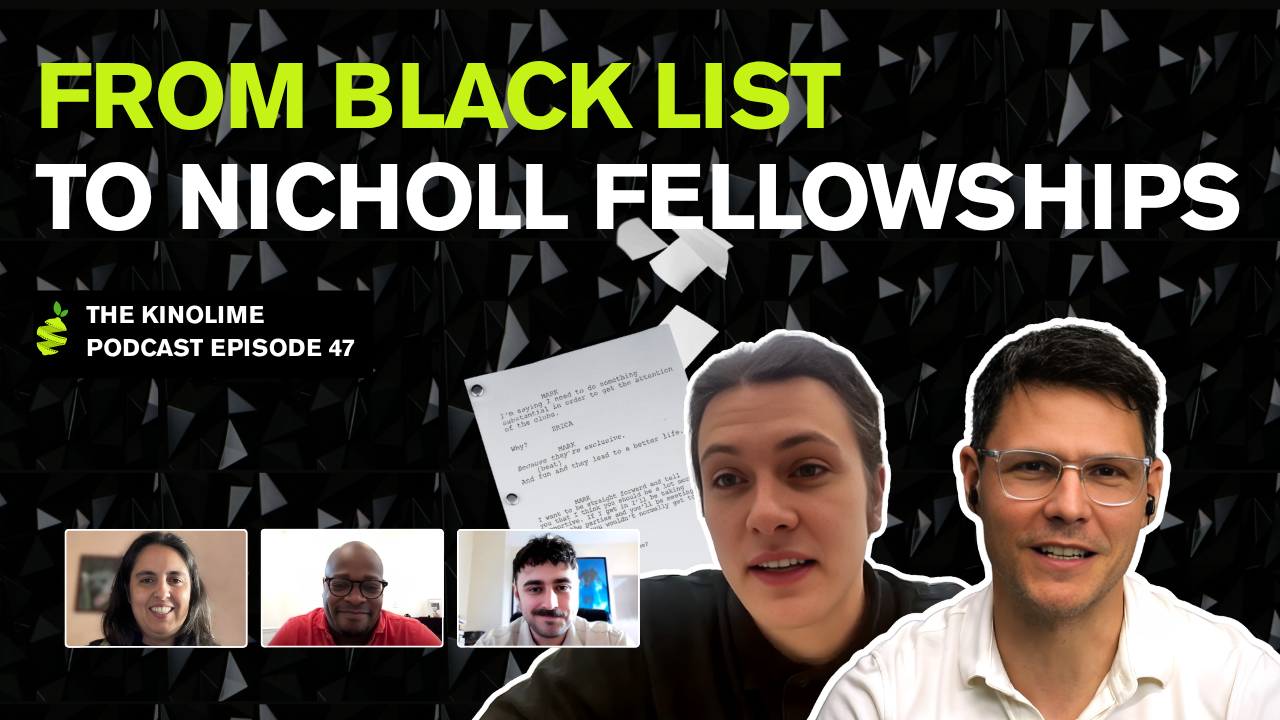
What Black List & Nicholl Readers Look For In Screenwriting Competitions | Kinolime Podcast Ep 47
DM
Hosted byDanny Murray, Meara Owen-Griffiths
GC
With guestGiulia Corda, Shom Shamapande
Review on your platform
00:0000:00
Show Notes
🎬 Episode Highlights
Meet the Readers: Discover the diverse origin stories of our panel, from prestigious MFA programs and UN speechwriting to navigating the grueling Hollywood assistant desk.
The 12-Page Test: Why those opening pages are critical, and the non-negotiable elements (like impeccable formatting!) that keep a reader turning the page and fully invested in your story world.
Character vs. Concept: A deep dive into why an active, decision-making protagonist facing impossible choices will almost always beat out a flashy but hollow premise.
The "Magic" of a Recommend: What elevates a script to the top 1%? The panel explains why it’s all about evoking genuine emotion, crafting inevitable twists, and exploring deeply rooted human questions.
✍️ Crucial Mistakes to Avoid
The Logline Trap: Why your logline must encompass the entire emotional and narrative journey, not just a 20-page action stretch in Act Two.
Convoluted Chaos: The danger of mistaking confusion for mystery. Learn why mastering "simple storytelling" is a writer's greatest superpower.
Chasing the Zeitgeist: Why writing to current trends (like the sudden influx of AI scripts) usually fails, and the immense value of writing what feels personally true and authentic to you.
Painting by Numbers: Why blindly following a rigid screenwriting formula will make your story feel robotic, and how to let structure happen naturally.
💡 Pro-Tips for Writers & Readers
For Writers: Focus on the fundamentals—Character, Conflict, and Desire. Stop worrying about exact page counts or hitting structural beats on specific pages, and start focusing on making the audience feel something profound.
For Readers: Always judge a script based on what it is aiming to be. If it's meant to be a popcorn blockbuster, evaluate it on those merits, regardless of your own personal genre preferences.
Listen in to find the fire for your next draft, master the fundamentals of character growth, and learn how to navigate the script coverage process like a Hollywood pro!
Full Transcript
[00:00]
Welcome everyone to the Keena Line Podcast.
[00:12]
I'm John Schram, Sans Danny Murray, but Danny Murray is on the feed today just in another
[00:18]
part of the office.
Read Full TranscriptCollapse Transcript
[00:19]
I'll be taking solo.
[00:21]
This has been a podcast that I kind of been waiting for for a long time because this
[00:25]
is when you're starting out as a screenwriter, how do you break into the business?
[00:30]
What is it that you need to do?
[00:31]
I need agents to read.
[00:32]
But who are the first people that actually read your screenplay?
[00:36]
That's what I think the myths of the infamous readers are.
[00:39]
That's what we're going to have today.
[00:40]
We have four amazing readers on.
[00:42]
We're going to have a discussion.
[00:43]
You're going to learn everything from about how they gatekeep, how they got started, what
[00:46]
they look for when they're reading your screenplay, whether it's a competition for an agency,
[00:50]
production company, et cetera.
[00:51]
So I just want to say, please, thank you so much for everyone joining today.
[00:55]
We have Danny Murray, who, like I said, it's not next to me, but on the other side of
[01:00]
the office, Danny, how you doing, buddy?
[01:02]
I'm amazing, man.
[01:03]
This is, I'm so excited to ramble.
[01:05]
Great.
[01:06]
A different part of the office towards it.
[01:08]
It's great.
[01:09]
Coming in from Rome, we have Julia Corda.
[01:12]
How are you, Julia?
[01:13]
Ciao everyone.
[01:14]
I'm doing very well.
[01:15]
All right.
[01:16]
I'm excited about the podcast.
[01:18]
Great.
[01:19]
The next guest is Sean, Shama Pandey.
[01:22]
I hope I pronounced that right, Sean, but thank you for joining.
[01:25]
Thank you.
[01:26]
Excited to talk to you.
[01:27]
All right.
[01:28]
And then last but not least, the infamous Swiss Army knife of Keenalheim, mirror Owen Griffiths.
[01:34]
How you doing, mirror?
[01:35]
Hello, hello, doing very well.
[01:36]
Thank you.
[01:37]
I'm excited to talk about, yeah, gatekeeping movies.
[01:40]
Great.
[01:41]
That tone really got me excited.
[01:43]
Okay.
[01:44]
So we're going to hop into it.
[01:45]
So for everyone at home, again, there's the myth of the reader that I kind of want to
[01:48]
talk about and like, you know, these people read your script.
[01:51]
So we'll start with Julia.
[01:52]
Julia, how did you get into becoming a reader and tell us a little bit about who you
[01:58]
read for if you're able to and what you read for.
[02:00]
But we'd love to know more about you and your history as a reader.
[02:04]
So I'm a screen writer and story analyst and reader.
[02:11]
And I have a master's and MFA in screen writing.
[02:17]
While I was at USC, that's where I studied.
[02:23]
The classes were workshops where you had to give notes.
[02:28]
And I have to be honest, I was really struggling because writing in my second language and
[02:35]
being able to give compelling notes.
[02:39]
And I promised myself I would be better at this one day.
[02:44]
And then I became an intern at an agency and I started reading.
[02:49]
I had more time.
[02:52]
And my, my agent, the agent I was working for really, really liked my, my analysis.
[03:02]
And then I actually, my first real gig, paid gig was reading for the Sundance writing
[03:12]
labs for something called the Asian American Fellowship, which I believe doesn't exist anymore.
[03:19]
But that was an incredible experience.
[03:23]
And I also, in terms of competitions, I also read for the Nichols twice.
[03:31]
And, and then during the pandemic, I started reading for the Blacklist, which is where I'm
[03:39]
still reading.
[03:41]
And I also have, I've been a reader for a couple of production companies, but my longest
[03:49]
gig has been this one at the Blacklist.
[03:52]
So you've checked off like every major from the screen writing competition.
[03:56]
I love it.
[03:57]
Now we just got to get you to Keenaliam and read for us.
[03:59]
Shome, tell us a little bit about your journey on the reading side.
[04:04]
Well, I'll start.
[04:05]
I start in, I start my career, I'm not classically trained educationally.
[04:10]
I actually was a speech writer for a long time.
[04:12]
I was a speech writer at United Nations.
[04:14]
I used to write for Manlin Albright when she had a condition at the United Nations.
[04:18]
And for other members of the United Nations, I've always been a writer, and I thought,
[04:23]
but when I, early in my career, I just didn't know how I made career out of this, right?
[04:27]
So I took the writing in that professional space, wrote speeches, worked for Obama campaign,
[04:33]
did all that kind of stuff early in my career.
[04:37]
But always for writing and start off an advertising agency, similarly.
[04:42]
Robert Simlier, which was brought up by Ogreville and all that.
[04:46]
So I started off with there and it moved over.
[04:50]
And then when I got closer to academia, we'll teach you to go into school of the arts and
[04:55]
how university, I got more and more opportunities to be a reader.
[05:00]
I was told not to talk about something in place.
[05:03]
But major award shows and in the past at least, I did write a reread for the nickels in
[05:10]
the past at least.
[05:11]
I don't know if I do it anymore, but I in the past I did.
[05:15]
So I was kind of just recruited.
[05:17]
I didn't really know how it happened.
[05:19]
The people reached out to me and I said, we really would like you to give analysis on this.
[05:23]
Can we do that?
[05:24]
And that's how it happened.
[05:26]
And the other part I say is like, with reading, to me, much of that starts off with just
[05:30]
known how to do basic script coverage.
[05:32]
That's true.
[05:33]
Right.
[05:34]
And that's kind of what I meant to climb myself and do it when analyzing scripts.
[05:37]
Okay.
[05:38]
Great.
[05:39]
Mira, how did you get involved on the reading side?
[05:42]
On the reading side, yeah.
[05:43]
I did go to film school and when I came out of that, I was in London and I was just running
[05:49]
for companies trying to get like any foot in the door and really struggling to do that.
[05:53]
So I'd be basically like bringing cups of coffee and whatever and occasionally I'd get
[05:57]
something to read for like 15 minutes or whatever.
[05:59]
And it was super unfulfilling.
[06:03]
So I actually ended up just going like freelance then eventually just kind of of my own accord.
[06:07]
I started finding people who wanted to exchange stuff on Reddit and kind of built up like
[06:12]
a database of kind of clients and was just giving coverage.
[06:16]
I don't know how great it was to begin with, but I was charging like nothing for it and
[06:21]
kind of worked my way up eventually.
[06:23]
Then I was kind of like whatever the reading equivalent of ghost writing is.
[06:26]
So people who read for competitions but didn't want to actually do the reading would be like
[06:32]
read this, tell me if it's like a seven or better and then they'd read those ones.
[06:38]
So I kind of worked up from there.
[06:40]
Yeah.
[06:41]
So I went freelance originally, which is kind of a typical approach to it and then I
[06:47]
ended my screenplay into the first keynote.
[06:49]
I'm script screen competition.
[06:51]
I got second place, this close.
[06:54]
And then I've been reading for keynote for the past two years as well as kind of doing
[07:00]
continuing to do freelance kind of coverage and what have you on top of that.
[07:05]
And I just have to say to give a little prop to me and this is why having a good reader helps
[07:08]
is me or I'm not going to name the name of the screenplay, but help a writer on the black
[07:13]
list get I think at eight or nine they sold the screenplay.
[07:16]
I mean, you were really I think integral in helping that writer develop their screenplay
[07:20]
to the best of the potential.
[07:22]
Yeah.
[07:23]
One of my buds who was like the literature, the first person I ever I ever kind of provided
[07:28]
notes for on Reddit just sold two of his screenplays in a package like two weeks ago as well.
[07:33]
So yeah, we're on the up the value of the reader plays to me.
[07:37]
But Danny, you have a really cool reader origin story that I think a very apropos to
[07:42]
more more and everything, but maybe tell us a little about your reading adventures when
[07:45]
you were teenager.
[07:46]
Oh, yeah.
[07:47]
I mean, I come from a pretty funny.
[07:50]
I guess my first time actually getting any money to read anything was I have an uncle
[07:57]
who's a professional screenwriter who is dyslexic.
[08:02]
My brother was older.
[08:03]
So he got most of this work, but he would essentially as almost a summer job, pay us some money
[08:08]
until I copyright and make sure there were any spelling mistakes in his submissions.
[08:13]
So that was kind of like my first step.
[08:14]
I went to film school and immediately out of film school, I got an internship.
[08:20]
For a WGA writer wrote on some really cool shows.
[08:25]
She wanted to start her own production company and start selling her own pilots.
[08:29]
So the first, I guess, gig I had out of film school is she gave me these pilots and she
[08:36]
said, can you give me like, please just give some coverage, some notes on these stories.
[08:45]
And again, it was her work and I really didn't like them.
[08:49]
And I gave blistering coverage that within about an hour of sending it back, I had been asked
[08:56]
not to return to the internship.
[09:00]
And then yeah, so then from there, like, okay, what do I do now?
[09:05]
I paid.
[09:06]
I did pretty much every assistant gig you can get, trying to get back into story.
[09:15]
I got a gig as a producer's assistant where I got to do reading and then found my way into
[09:22]
KinoLime where I got to, again, do as much reading as I could possibly imagine.
[09:28]
We give you as much as you want.
[09:30]
Yep, which is exactly where I want to be.
[09:33]
So Julia, I want to, because for everyone at home, you know, they, y'all as readers are
[09:39]
the people that really could make a great career.
[09:41]
This is where your script liver died in like a sentence.
[09:45]
How would you define what does a script reader do for those who don't know what a script reader is?
[09:49]
Well, a script reader, he's supposed to read a full script and in case of the blacklist,
[10:00]
which is what I'm reading for you provide and analysis of the script that, so for instance,
[10:09]
this is different from what I was doing for an agent because I don't provide a synopsis.
[10:17]
And I have a template that I, I have to follow and in my analysis, I highlight the strengths
[10:31]
of the script, the weaknesses of the script.
[10:35]
And I also analyze what the commercial prospects are.
[10:42]
And ultimately we, as readers at the blacklist, we give an overall score that is divided
[10:51]
also into sections.
[10:53]
Although the final score is not like the average of the other sections.
[10:59]
So you are, as a reader, you read an analysis script and provide feedback that goes toward
[11:12]
trying to make the script better and give mostly in terms of the weaknesses you, you try
[11:20]
to give actionable notes.
[11:23]
And you also emphasize the strengths, the great qualities of that script.
[11:31]
And for everyone at home, so script readers, agents require a different sort of form out
[11:35]
of how they want their readers to analyze, screenplay competitions have their own.
[11:40]
So you're going to hear different terms, but it doesn't mean that if you're a script reader,
[11:44]
it's the same blanket template that you're doing every time.
[11:46]
For example, what Julie was saying, that in the blacklist, if you haven't tried the black
[11:50]
list, you get strengths, weaknesses, commercial viability, et cetera.
[11:54]
For an agent, they may not want the weaknesses they want to know, like just overall synopsis
[11:58]
of the screenplay so they can review it pretty quickly.
[12:01]
And if something in there speaks to them, they'll probably read it themselves.
[12:06]
So every script reader does a different task.
[12:08]
Sean, can you walk us through a little bit of your process when you get a screenplay
[12:12]
in for the competitions or any sort of submission?
[12:15]
What's your process like?
[12:18]
Can we take us through step by step when you're reading a screenplay for the first time
[12:21]
in that setting?
[12:22]
I had jumped in first.
[12:23]
I really think about how I'd get to the first 12 pages, right?
[12:28]
I'm trying to get to the end of the first act right away.
[12:30]
And I want to look at it immediately.
[12:32]
Did it engage me?
[12:33]
Right?
[12:34]
Did I want to keep turning the pages?
[12:37]
Was I lost at all?
[12:38]
Was I followed in the story of the way it was designed?
[12:41]
And I'm taking notes on that.
[12:42]
That's how that's where I start.
[12:44]
That whole plastic idea in Hollywood about if you're the first 10 pages don't work, it's
[12:48]
not going to work.
[12:50]
I kind of do go there.
[12:51]
I kind of keep about 12 or so pages.
[12:53]
I try to get to the inciting incident at least, right?
[12:56]
Get through all of that.
[12:57]
To see whether or not it's really engaging me, one of the things I mean, for anyone that
[13:03]
a young person wants to get a screenwriting, format has to be impeccable.
[13:07]
We don't have that conversation cannot be had, right?
[13:10]
You're formatting it all that.
[13:12]
You're going to nail it.
[13:13]
Like that.
[13:14]
That's just done.
[13:15]
Could have been battling the format.
[13:17]
Oh, I'm turned off immediately and the screen.
[13:19]
Right?
[13:20]
Of course.
[13:21]
Yeah, it's funny because Spielberg said that he prefer, and this is Spielberg, that give
[13:25]
me a messy idea on an napkin.
[13:26]
I don't care about if it's spelling and formatting, if the story works, it works.
[13:31]
Which I understand, but as a reader, when you're reading so many, you want the format to
[13:36]
be right.
[13:37]
I mean, Mira Danny, we talk about this all the time.
[13:38]
If it's poorly formatted, whether the story is great or not, it just subconsciously pulls
[13:43]
us out and you're going behind the eight ball.
[13:46]
So like for everyone at home, first tip, get your format down.
[13:49]
Get it right.
[13:50]
Right.
[13:51]
I think that's my word my students are on teaching.
[13:53]
I don't want to have a conversation about format.
[13:55]
Good.
[13:56]
I like that.
[13:57]
It's not difficult.
[13:58]
Get it.
[13:59]
Right.
[14:00]
I agree with the point that, I mean, the other part is I agree with the idea that to the
[14:04]
Spielberg's point, a good story that's poorly formatted is better than a good record.
[14:12]
And what if we formatted the terrible story?
[14:14]
Yeah.
[14:15]
Exactly.
[14:16]
A vapid, nothingness.
[14:17]
Yeah.
[14:18]
Yeah.
[14:19]
A lot.
[14:20]
Yeah.
[14:21]
Good format, terrible story.
[14:22]
That's not working.
[14:23]
Now, I got a question because you brought up the 12 pages, which we're going to get into a
[14:24]
little bit deeper.
[14:25]
But how long do you wait until you form an opinion of the story?
[14:31]
So you read the 12.
[14:32]
Like, is that your, are you, are you pretty accurate?
[14:35]
Because Sid Field says why he developed a system of the acts and how he would analyze
[14:40]
screenplays.
[14:41]
He gave it 30 pages the first act and he would know whether by 30 it was working.
[14:45]
So when do you know you have an opinion on a screenplay?
[14:48]
Do you give it to 30, 25?
[14:51]
You know, what's your opinion?
[14:52]
I'm trying to get to the first act.
[14:54]
So get to the first act because then you have your opinion.
[14:56]
Because at this point, in the first act, I need to be like, okay, what's going to happen
[15:00]
next?
[15:01]
If I don't feel that.
[15:02]
Yeah.
[15:03]
But not going, then it's not working.
[15:04]
But I do consciously think about the first 10 to 12 pages.
[15:08]
Yeah.
[15:09]
And you should be a note.
[15:10]
Imagine by, I get to page 25 and I love it.
[15:12]
Yeah.
[15:13]
And I didn't like the first 10.
[15:14]
Well, that's a note now.
[15:15]
Yeah.
[15:16]
Yeah.
[15:17]
I get it.
[15:18]
Really like the story.
[15:19]
You didn't hook me at the beginning.
[15:20]
But I like where you took us.
[15:22]
We ever wrong where you read the first 20, 25 and it was met.
[15:26]
But then later, really picked up.
[15:28]
Or is it more consistent that the first 25 if they're met, the story is going to be met.
[15:32]
First 25 is met.
[15:33]
The story is going to be met.
[15:34]
Okay.
[15:35]
So that's accurate.
[15:36]
Yeah.
[15:37]
Julia, I would love to know.
[15:39]
Your process as a script reader, when you get a screenplay, what's your methodology like?
[15:45]
Before that, I just wanted to follow up on that because I think just as Shum said, you
[15:52]
have a sense, probably especially if you love a script that you love it almost from the
[15:59]
get go from the first 5, 10 pages.
[16:03]
But I would say to really have a clear definitive opinion, maybe I'll wait until midpoint.
[16:13]
I have in my mind a script that I read and I thought it was so amazing.
[16:18]
And then it really disappointed me after I think it was midpoint.
[16:24]
So it does happen that sometimes a script has an amazing, because on average, first
[16:33]
thoughts are slightly easier to write.
[16:40]
At least I have in this, in my mind, this particular script that I was like, oh, I love
[16:44]
it.
[16:45]
And then I was so disappointed.
[16:48]
And yeah.
[16:49]
But you don't I think about that too.
[16:51]
But if I get to that second, I get to the first out, I enjoyed it.
[16:55]
Then it disappoints me.
[16:56]
I generally at that point have a lot better notes.
[16:59]
This is a really good beginning.
[17:00]
I think what you lost me was here here.
[17:03]
But I almost feel like my mindset has changed too.
[17:07]
Oh my God, you have such a great beginning.
[17:09]
We could have made this amazing.
[17:10]
And then I have more notes for the first time.
[17:14]
No, you're right.
[17:15]
It's the first act is just bad.
[17:16]
I'm just like, oh, no.
[17:17]
I don't have anything else you want.
[17:19]
And something lets you down.
[17:20]
I think it's easier to be diagnostic about what you want to happen than if it was kind
[17:23]
of like very neutral territory the whole way.
[17:26]
You're like, I don't know where this is going or what I wanted to do.
[17:29]
So yeah, you're absolutely right on that.
[17:31]
Yeah, we had a screenplay in the current competition where the first 30 were incredible.
[17:36]
I think like Danny, we were all like, I'm not going to name this action screenplay.
[17:40]
But we're like, this is this is going to win the screenplay competition.
[17:43]
This is the best thing we ever read after 30 fell off a cliff.
[17:46]
So we totally emphasize empathize with that.
[17:48]
But Julie, what are you looking for in the first, let's say the first act.
[17:52]
Are you looking for like a clear protagonist, a Hulk?
[17:55]
Like what is it that when you're reading that first act that maybe it's conscious or subconscious,
[18:01]
like that you're really looking out for that you want to progress past that personally?
[18:07]
Personally, I'm a character driven screenwriter as probably every screenwriter.
[18:15]
But I really care about a compelling protagonist that is in captivating, fascinating predicament
[18:26]
that they have to solve.
[18:29]
And I have to say if there's an element of freshness and originality, something unique, it's always
[18:39]
better.
[18:42]
But yeah, to me, I think character is a little above premise, although catchy premise is
[18:53]
obviously has its way too.
[18:57]
And I was also reading something interesting in the in the substep that the blacklist has
[19:05]
where there is an analysis of statistically on how those different aspects impact the scoring
[19:15]
that the score that the reader gives.
[19:18]
So for me, and ultimately premise is, sorry, the plot part is the most important on average
[19:29]
for the blacklist readers, but I would say for me it's slightly more character, like
[19:35]
predominist and how relatable they are and how effectively characterised they are.
[19:46]
I love that because again, the premise to me is like part of that engine, which you always need,
[19:52]
but is it the character that really gets you through Miro?
[19:55]
The premise is a combination of both.
[19:56]
What is it that you're looking out for when you're reading?
[19:59]
Yeah, I'm pretty character heavy.
[20:01]
I agree with a lot of Julius points, but I'd say that, yeah, kind of motivation and contradiction,
[20:07]
or usually the things that I look for in my act one that I think are really kind of tell me if
[20:12]
the story's going to have legs, if it's going to carry itself on like a human level throughout
[20:15]
kind of whatever wacky things are going on in the story.
[20:19]
Characters always probably the my kind of like guiding light, my north star when it comes to
[20:25]
analyzing a screenplay.
[20:28]
I wanted to touch on just kind of the application of the log line, right?
[20:33]
Because the log line obviously when you're reading something, it's usually the first impression
[20:37]
you get of the screenplay. You might get title, which can only tell you so much,
[20:40]
log line, which should tell you kind of as much as you need to know.
[20:44]
And then you get into the screenplay, but I mean, I find so many screenplays,
[20:48]
the log line really is describing kind of maybe a 2030 page stretch that happens in act two.
[20:53]
You know, I get to the end of act one. We've not jumped into any of what's what the log line's
[20:59]
actually about. And maybe we've not even really set it up very much. That's usually kind of like a
[21:04]
big red flag. That's a great, great point. So Danny, with character and premise, you know,
[21:09]
what are you seeing when you're reading in the current sort of zeitgeist of writers?
[21:15]
Yeah, it's tough. Like I think my most common recurring note when I read something with an
[21:21]
incredible premise that just doesn't grit me is I'm just finding a protagonist that isn't making
[21:28]
decisions. It's something that I am, you know, when I'm kind of having my brief on things, I feel
[21:35]
like I write that more than anything. Yeah, it's just this kind of perfect combination that I,
[21:42]
like when I have an incredible premise, and when I have characters that again are constantly forced
[21:49]
to make tough decisions, that is usually what kind of guides me into what I'm looking for as a reader,
[21:55]
which is a, again, like I want to kind of forget that I'm reading, like all the scripts that I
[22:01]
recommend, I feel like, again, I almost read them like a novel where I see the movie. I'm so engrossed,
[22:07]
time flies by, and I, you know, I fully see it in my head. And it feels like something I just need
[22:15]
to give to someone else. Some combination of a strong premise that, you know, I haven't seen
[22:20]
before, or some birding, you know, genre in an interesting way, with characters struggling with
[22:26]
tough decisions. Yeah, I'll just piggyback on that and say, well, when I, like on the executive side,
[22:31]
when we're getting a screenplays in here, we're analyzing whether we should move forward in some sort
[22:35]
of co-production, production, investment capacity. I love a good premise. Danny, I think Miran know
[22:40]
that very much, but I find that in today's market, for whatever reason, people are not writing
[22:47]
character well. They come up with a great idea, a great plot, a great engine, but then they,
[22:51]
there's something about the character. Sure, I wanted to throw it back to you for a quick second
[22:57]
in regards to a protagonist where Danny just brought up about being more indecisive, more passive.
[23:02]
Does that sway you? Are you looking for a protagonist that's really clearly making decisions?
[23:07]
Are you more forgiving in that? Let's see if this character is, you know, a bit passive to start
[23:13]
and then unfurls. What's your process on the protagonist side? My three things are, character conflict
[23:19]
desire. All right. I need to know the characters, I need to understand them, I need to understand
[23:25]
the conflicts they're going to be dealing with, and I need to know their clear desire. I'm one of
[23:29]
those people really believe that stories are just about, I'm going to get character to want something
[23:33]
and after those that prevent them to get it. Let's just do that. That's what we're doing.
[23:37]
Which is therefore asked the question that I think often young writers don't think enough
[23:41]
about. They love their protagonist, but they don't spend any time thinking about the antagonists.
[23:46]
And the important is, yeah, character is going to face throughout the story.
[23:50]
What would be another thing that I think is important that I'm noticing in the first
[23:54]
10 to 15 pages, the story world. Where are we going to be for this story? This is a big deal
[24:01]
when you're going to fantasy and we leave the world living. But to me, the very tangible thing,
[24:06]
I'm checking off in my notes. What are we going to be for this story? The story world matters to me.
[24:14]
Because that's where it's going to produce the conflict for the content for our protagonist.
[24:17]
The antagonist is going to produce the conflict. In the first 15 to 20 pages, you create all of that.
[24:23]
I should be able to get to the end of the first act. Oh, this is going to be interesting. I
[24:28]
could see what we're going for this. Yeah. That kind of where I'm looking for.
[24:32]
Okay. So as much I think that the character, the main character is driving,
[24:38]
but I've started to see the swings and arrows that are going to be thrown at them throughout the story
[24:43]
to get that thing. Love it. No, that's perfect. I mean, Aaron Sorgen talks about that all the time,
[24:48]
right? Intention and obstacle. He talks about getting, you know, your cat up the tree and then
[24:53]
went through a rock set, not the cat, your protagonist up in a tree through a rock set in the
[24:56]
second act and the third act they come down. Julia, what are you thinking about when you're
[25:00]
reading specifically for a protagonist? For a protagonist, I have to say, again, a good
[25:10]
a good problem for him to or her or them to face. And I also wanted to point out that
[25:21]
I read for a company that has a very clear former, we need to hit some specific mandate.
[25:34]
Yeah. But then I also think in all these evaluations we give that there's something that is not
[25:43]
tangible. Like I remember when I was reading for the Nichols and this is you can find it online
[25:53]
on their page where they list their criteria that one specific field was meeting and magic. Like,
[26:03]
is there something unexplainable about this script that still moves you and you cannot tell exactly
[26:13]
what it is, but the script stays with you after you finish it. So even if I'm a very rational person,
[26:23]
I have to say that when I read a script that gets an eight, there is something about them that it's
[26:30]
not even, you cannot really explain it in a way, but it just resonates with you. And again,
[26:37]
there are scripts, and I read really thousands of them. I still remember.
[26:43]
We talk about that all the time here at Keenal, I'm with the first competition. We're like,
[26:47]
oh, whatever happened to that script because there's something that stays with you, but with
[26:51]
something that stays with you, obviously you're going to give it a recommend or a high score.
[26:53]
What makes you actually say recommend or give it a high score?
[26:58]
I want to say that the scripts that really maybe surprise me and there is something about some
[27:07]
script that you think, oh, I really didn't see this coming. And then at the same time, you think
[27:14]
it's inevitable. Like, oh, and you didn't think about it, but the writer took you on that journey.
[27:22]
So there's an element, let's say a very good twist. That is, some twists are just,
[27:30]
you know, give it, but some of them you really don't see them coming. And at the same time,
[27:36]
you say, wait, that was the only thing that could happen to this character. So if a writer can
[27:43]
surprise you with something like that, I think it's really what gives the extra.
[27:50]
I love that. And we talk all the time about ziggin and zagging. So one of the first things that I
[27:56]
some screenwriting advice I got that really stuck with me was, zigg, when you want the audience to
[28:01]
zag. So that's sort of what Julia, I think, is saying about the twist. It doesn't have to be a twist
[28:05]
like, oh, they're the killer or it was the mother all along, but it could be an emotional twist,
[28:10]
an internal twist of a character, making a choice that you didn't see coming that I think gets
[28:16]
a reader on their toes like, wait, wait, but they were going to go that way. But now they chose
[28:19]
that path. So that's, that's, that's fascinating. Mira, what is something that makes you say recommend?
[28:26]
Like, you know, Julia was mentioning about a twist that really stays with her. What is the thing that,
[28:30]
you know, when you get a screenplay that's really like, this is, this got to move forward?
[28:33]
Well, kind of building on top of what we've been talking about about character and intention.
[28:37]
And then also twists kind of coming to the end of act one. I really like to be able to look at
[28:44]
the character and tension and kind of be able to fill it in my head. Like, this is how the second
[28:47]
act is going to go. Because if you've written a really clear anti or protagonist for your act one,
[28:53]
I should have like a really good idea of that trajectory kind of like formulated my head just
[28:58]
from, you know, general media literacy and, you know, you really don't know if you kind of, you
[29:03]
learn those patterns that becomes like a language to you. But any twists that you get on top of
[29:08]
that then are great because, you know, it, it disarms you when you think that you know how something's
[29:13]
going to go. It doesn't, you know, so act one, I think it's all about setting expectations,
[29:18]
act two is all about kind of conforming to them where it's satisfying and defying them where
[29:23]
it's satisfying as well. And really the best like the screenplays with the, you know, the special
[29:30]
sauce, the june seco, that we're going to recommend or we're going to push through there, the ones
[29:36]
that kind of mentioned, take both of those boxes. And it's really funny, Julia, that you mentioned
[29:40]
about this intangible that, you know, you're asked to make tangible to give like a rating on like,
[29:46]
you know, this magic like, yeah, but if you had to give it an out of 10, you know, it's like a,
[29:50]
it's really funny. But I do feel about all of the screenplays that we read that I love the most
[29:57]
are ones that I have to kind of defend a little bit because I'm like, look, it does do this, which
[30:02]
is a little bit out there. It's a little bit wacky, but, you know, just hear me out on this.
[30:07]
So yeah, that all comes down to character, intention, and then kind of, you know, twist during
[30:13]
the, the meeting potatoes of your story in act two. Danny, what's the thing that, that, I mean,
[30:18]
I know what really gets you going on a, on a recommend, but maybe what's the thing that,
[30:24]
that you love to say, to read that, you know, you know, you're like, we got to push this, you know,
[30:28]
forward in the competition. I think just to build on what everyone's been saying so far, it's the
[30:35]
thing like, I feel like there's, you know, steam coming out of me, I'm so excited to answer this.
[30:40]
I've read for other competitions where, like Julia and like Mira are saying, they asked me to kind
[30:46]
of itemize out of 10, everything dialogue, concept, character, and then like something I appreciate so
[30:54]
much about how we kind of read an analyze screenplays at the core of everything is the question of how
[31:01]
does this make me feel? That's a great one. Love it. What always sticks with me more than anything.
[31:08]
I find like the scripts that I, again, I cry when I finish or I jump around, well, when I'm reading.
[31:16]
I know. Again, regardless of genre, it is a piercing dramatic argument that I don't have an answer
[31:24]
to and that I feel like I need to read the scripts to like come to some sort of new
[31:31]
understanding of how I see the world. Like I think, you know, it's always something that you can
[31:37]
kind of make for yourself. It's not giving it to you, but you know, just a question that,
[31:43]
you know, just rips you apart. Like, you know, how am I, how can I be a good person when the world
[31:48]
won't let me? You know, like, just like these kind of inditing questions that you can make a
[31:53]
comedy, you can make a drama, but at the core, it's just something maybe that is universal
[32:01]
and that we're afraid to talk about or, you know, we all argue about when a character and a story
[32:09]
and the pacing and the theme and all these kind of one-out attends are kind of, you know,
[32:15]
into woven, into a real question that the author is, you know, searching for. I always find that
[32:23]
those really stick with me, even when they have hiccups and dialogue or, you know, pacing or whatever.
[32:29]
Like, I want to be on that journey. Sean, what is the thing that gets you to say recommend?
[32:35]
A couple of things, we say about dialogue and all that, we can fix that. That's not a few of
[32:39]
our dialogue on the set. We can fix it later, right? It's important, but we can fix it, but I'm
[32:45]
going to piggyback on Danny's point. Make me feel something. Make me feel something. That is the role
[32:52]
of the artist. I don't mean just scream right, I mean a painter, I mean a musician, I mean an artist.
[32:58]
We show up because art is going to make us feel something. So those movies, those stories,
[33:04]
it's just like to Julie's point, that stick with you when you're done reading them,
[33:07]
but I just finished the biography about the Wright Brothers. They're in Postbook.
[33:13]
And I was, it's flying off the shelves.
[33:21]
One of those books, when you finish a book and you're sad to finish the book because you're
[33:25]
going to hang out with these characters any longer. Yeah, feeling. That's powerful.
[33:32]
And then there's a feeling that I have sometimes you read a really good script,
[33:35]
as a script that I was read about two and a half years ago. And remember the opening line
[33:38]
of movie was in the script was this is the story of how almost became a billionaire.
[33:42]
I was like, I was like, I'm like, I'm like, I'm like, I'm just, yeah, I'm like,
[33:47]
and you pop me immediately. That's an interesting way to begin a story. I was hooked.
[33:52]
I'm not supposed to read it for a production company. I was like, I'll give it to you,
[33:56]
but I'll give it to you. I was like, you gave it to me. I got a sat in that. I said at the bar,
[33:59]
reading the whole thing. Yeah, I read the whole thing. I was, I was.
[34:03]
When you get that screenplay that you just can't put down, but I just want to highlight what
[34:07]
you're saying, Sean, because it's really important. And Mira's obviously mentioned this as well as
[34:11]
about feel. I think what I find with a lot of writers, screenwriters specifically are they're writing
[34:17]
almost to try and be too cinematic. They're trying to wow or in a way or or build something that I
[34:25]
think doesn't have the heartbeat, the blood in it that's pumping through the veins. And I think
[34:30]
if you can write from feels, now it could also be action if your action is your genre, but make
[34:35]
you feel like the best action sequence ever made or really put your character in danger or drama,
[34:40]
whatever. Great thrillers have feels. It's not it's a different type of feeling, but they still make
[34:45]
you feel. You have in comedy, like one of the things I was wrestling with, something I'm working right
[34:48]
now is the whole concept every time we have meetings about writing about young brother, I'm going to say,
[34:53]
it's a comedy would have sold. Yeah. The comedy has that was sold. It can't just be funny.
[34:58]
It's got to be going on here too. And I think like you said, that's the thing. I don't know
[35:04]
when you teach it exactly. Yeah, you can't it. It's just is. It just is.
[35:09]
My brother one time we wrote a scene and I read it after he wrote it and I was like, what
[35:14]
are you going for? And I see any because I've gone for. Oh, yeah. That's how you can describe
[35:22]
the scene you wrote as I was going for. Oh, that's it. That's great. That's great. And I think
[35:29]
a therapist said once that I was listening to was like, you know, don't think about what you want,
[35:35]
think about how you want to feel in your life, which I was like, wow, that kind of blew my mind.
[35:39]
Like, yeah, like I want, I want this. I want that. But no, it's not a checklist. How do you want to
[35:43]
feel? And I think the same thing when you're reading or writing, how do you want the audience to feel?
[35:47]
Julia, what do you think separates the top five 1% of screenplays from the rest? Like what is that
[35:55]
top top percentile? What is it that you find that you see as a common theme or threat or,
[36:01]
you know, denominator that separates them from the rest? I have to say is this magic
[36:07]
blend of everything we've been saying. So I would say out of this premise again is maybe the least
[36:16]
important to me because great execution can make up for it. But it still needs to attract you
[36:26]
in a way. So this blend of all the elements premise and a relatable character that has to face
[36:36]
something difficult and that you see change probably it's those are the stories that
[36:44]
are more compelling to me. And yeah, and it's if there's something
[36:53]
unique about them, something that I didn't see coming, that twist element we were saying.
[36:59]
What are the common mistakes that you see that hurt the writer when you're reading? As someone who
[37:05]
reads a lot, I'm a fan of clarity and this this creeps that are two abs throughs for no reason or
[37:15]
I always think of one of the first lessons in Miami Fade at USC and this professor was like
[37:25]
drawing on the on the board a sort of gauge between ambiguity and confusion and he was saying how
[37:36]
the majority or many scripts fall into the confusion element thinking there being
[37:45]
mysterious or ambiguous to me maybe also because I'm a known native speaker but if it's
[37:55]
again two abs throughs for no reason it really it pulls me off as you were saying before.
[38:02]
There's a value in clarity for me and another element that can pull me off is that
[38:10]
I really don't see where the script is going for too long so that's really that's maybe also you
[38:18]
know one of the elements of reading a lot you're sort of craving that oh I know it can sound
[38:25]
contradictory because you want to be surprised too but feeling entirely lost because you don't know
[38:34]
where something is going and many times it ends that way too it's not that oh I didn't see where
[38:41]
where it was going but then it's many times it just stays that way and that's frustrating
[38:49]
for readers saving. Sean what's a common mistake that you see most writers do?
[38:54]
I'm gonna do it I'm gonna go I'm gonna steal from you again it's particularly with young writers
[39:00]
it's the terms that the more convoluted the story is the better the story is rather than I'm
[39:06]
just like I'm a real I'm one of my big obsession my students is always big simple storytelling yeah
[39:12]
amen simple storytelling you can I mean no country for old man simple I got I stole I got some
[39:19]
money people whose money it is wanted back what am I willing to do to keep this money and what
[39:24]
are you willing to do to get that's it that's what it's simple it is so hard to do as well like to do
[39:30]
to do effective simple is way harder than to do convoluted yeah and to the point I'm like
[39:36]
again silly from Julia here again is that whole you never you didn't hold my hand through this
[39:41]
process I'm confused what's going on here like as a reader I'm just confused what's going on here
[39:46]
and the story that's not a good place to be as a reader so I'm generally telling my students
[39:53]
to try to make it simpler also it's a realisation I had personally as a writer
[39:59]
there was the first story we saw just my brother and I saw the story pictures we wrote it in six
[40:04]
months and spit it out but it was boy meets girl that's it that's it oh we're writing here I
[40:09]
said the next move will be trying to write a movie a movie that was set in the past in the present
[40:14]
the police are investigating the crime and trying as we're watching the past and figuring it was
[40:18]
happening it took a seven years throughout that it wasn't difficult it is yeah yeah
[40:25]
you're right sometimes it's right simple that's it my first agent said simplicity simplicity simplicity
[40:31]
and that's another piece of advice I'd always took with me because it is it's like we try to put a
[40:35]
hat on a hat or convoluted plots we think no just keep it simple like what is it what is that what
[40:40]
is the term keep it simple stupid um near when you're reading what's the common mistake a single common
[40:46]
mistake you see yeah so I often find that you know the logline obviously is kind of the first thing
[40:51]
that you see when you receive the screenplay um then you jump into the script itself and you already
[40:58]
have an idea of what it's gonna be but so often I find that the logline is gonna be maybe like a
[41:02]
2030 page stretch that happens kind of in your act two and by the time that you've got through your
[41:08]
act one you're still not kind of at the logline yet and you feel like you've been trying water
[41:13]
kind of waiting for something to happen it's still not happened I think it's really important
[41:16]
that you manage to make your logline encompass the whole story not just kind of like a certain segment
[41:21]
of it um so that you feel like you're on a journey and you're kind of always building towards
[41:26]
something everything so all included in in what the logline is what is that journey rather than
[41:31]
like what is the the climactic scene or or something like that you you want your logline to
[41:37]
include kind of the character from where they begin to where they end up rather than just
[41:43]
you know the exciting part of that journey um I find that a lot by the time I get to the end of
[41:48]
act one I you know I'm not really sure I'm not really sure where we're going with it or
[41:55]
we've had all this build up and I'm like okay now it's logline time so I know exactly what that
[41:59]
middle section looks like yeah so um yeah I think you know as important I always talk about how
[42:05]
important it is to have like a good treatment a good Bible a good pitch deck all of those things
[42:08]
I'm like you're not finished your screenplay until you've got those things in place similarly a
[42:13]
logline if it doesn't truly encompass your story then you're not giving a correct first impression
[42:17]
and you're negatively impacting how people consume your story um so it couldn't be more important
[42:22]
to me is is that you you managed to yeah find find a way to to sum it up really effectively
[42:29]
Danny what's a common mistake you see yeah I think to kind of piggyback on Mira's point um
[42:35]
something I see a lot is really strong right in or you know I script that this clue clearly
[42:41]
gone through a lot of passes that maybe the writer is is not taking every aspect of making
[42:48]
and potentially selling this screenplay seriously like I want you to take your characters seriously
[42:53]
like Mira said I want you to take the presentation of this film seriously I was on a polyester day
[42:59]
with a director development at a you know like production company with the first look deal and
[43:05]
they were looking for just great specs and I said like what does that look like for you what they
[43:10]
said is like something that's budget friendly with you know clearly defined characters that doesn't
[43:16]
need a lot of development work to make for like three to five mil okay um right to like get your
[43:24]
movie made and I feel like sometimes you find writers that it's very clear like again uh they're
[43:31]
gonna get this thing made and like everything around the script isn't pursued of that goal um
[43:39]
again like selling your screenplay pitching your screenplay having an eight or a nine on the
[43:43]
blacklist or winning a competition is great but that's essentially like your first look to
[43:48]
talking to these people that will then ask you more questions right who will need more to take
[43:54]
you seriously and try to get your movie made take the entire process around your story around your
[44:00]
presentation and around your general pitch for what this is as seriously as the script.
[44:06]
Julia I would love to know we spent a bit of time and I'm really happy that we spent all this time
[44:12]
on what writers aren't doing because I think the best way to learn for everyone at home is to focus
[44:16]
on your I would say weaknesses as a writer to learn and you're hearing it from the readers you know
[44:21]
mouths of what they're looking for and what's the thing that they don't find helpful in your process
[44:26]
but Julia what is like what's the fastest you know that you knew something was special like was
[44:32]
there is something that comes to mind you have to give the name of the screenplay but what is this
[44:35]
like what was the fastest you knew that this screenplay was special. I think one page like I have a
[44:41]
couple of scripts in my mind where you know the setup was quick and it's also personal taste I have
[44:50]
to say that there's some thing there are some themes some actually for me I'm a history but like
[45:00]
there are some historical times that really do something for me and and something I didn't
[45:08]
mention before and that it's part of that meaning and magic part is but this is personal taste again
[45:18]
for me there's something about being genuine being authentic you know not all scripts need to be
[45:26]
you know naturalistic or pretty realistic and but there's something about the authenticity of
[45:34]
emotions that that you can see in dialogue and in character behavior that really gets me and
[45:46]
this couple of scripts I'm thinking of I could see that from the very first page so yeah
[45:55]
that's great page one Sean what about you yeah I'm a kind of similar I could see that I could
[46:01]
like I said that line this is the story of how I almost became a billionaire and that got you
[46:05]
they got me like okay okay explain this story now what's happening and you just follow that you can
[46:11]
get me the things that I'm looking the things that get me immediately also sometimes that
[46:16]
possible this is why I go to the movies right that feeling but like where are you taking us on
[46:22]
where's this journey taking us we're going to someplace I would never go the the superpower of
[46:27]
movies is the ability for us to be able to go to a world we never we never we never live in right
[46:34]
for for two hours and when I watch the movie moonlight I'm experiencing the life of a gay black man
[46:40]
and in my in my enemy in a tough neighborhood trying to navigate that it's a world I never live in
[46:45]
what I'll never be in but for those two hours I get to do that yeah you take me somewhere so that's
[46:51]
the thing when when when the writing does that to me I notice it immediately you've taken to a world
[46:57]
I would never see I'm seeing the war from a vantage point of some hidden figures I'm seeing a
[47:02]
war from a vantage point of three black women were scientists in 1960s America black woman trying
[47:08]
to figure this out okay they're taking me to a world I want to go to yeah I'm not bad but I want
[47:13]
to know when you're reading that for example page one is it like is it the pros is it more like
[47:19]
again we're taught a screenwriter's keep it very staccato and short and a lot of white on the page
[47:25]
but which which I get but is it that they're are they using the language more effectively are they
[47:30]
are they breaking some rules or is it just really the the efficient use of the words that just
[47:35]
that penetrate you I mean just they fish on use of the words okay I think it's always um
[47:41]
say less whenever you can achieve it um yeah just efficient so you're using more of your
[47:47]
imagination when reading it whereas me or I want to throw it to you because again as a writer yourself
[47:53]
uh who want maybe more classically trained than than most right so like when you're reading is it
[48:00]
the pros that kind of get you is it you know I know we're not supposed to use pros but is it the way
[48:04]
they're writing it is it the efficient use of the words like what is it that that you kind of
[48:07]
kind of grabs you early on that's the tough question yeah I mean I'm a sucker for I quite like a
[48:12]
flowery uh kind of pros like a more more novel style sometimes like I know it's not like the dumb
[48:18]
thing but you know I'm not gonna mark somebody down if it's beautiful and I love it um so yeah
[48:23]
it's tough I mean I wouldn't say I don't think I'm ever like truly truly grabbed page one I think
[48:29]
I usually have to read a little bit on from that in order to try and see like a maybe a status quo
[48:33]
and how that status quo shifts but what I am a sucker for is an old old technique uh and it's just
[48:39]
like the in-media res opening of beginning kind of in the middle or toward the end of a story um the
[48:46]
example that comes to mind is casino where you know he comes out of the diner and gets in the car
[48:51]
and the car blows up and like oh how do we get here you know um I get so effective and uh it's
[49:00]
again really hard to do well but if you can get me to engage in a story where I know kind of where
[49:06]
it's going and to still care about the journey of how it actually got there then I think that you're
[49:10]
doing a fantastic job and those are the ones that I usually gravitate towards based on the first
[49:14]
you know five six pages Danny what is one thing you wish writers would stop worrying about
[49:21]
I think like trying to get a hold of like the current zeitgeist like I've got to say like 30%
[49:28]
of the competition screenplays I'll read this year are about like an AI that seeks to be human or
[49:34]
like blurring the lines between humanity and human a machine uh again if you have a meteoric
[49:40]
accent this isn't coming out for three or four years like that probably won't be what people
[49:45]
are really keen on um don't try to write to the moment like write to what's true to you and like
[49:54]
if you do that and it's personal uh I'm sure that it will still feel that way and you're so right
[50:01]
because I don't know if anyone's watching daredevil uh which isn't probably the best written superhero
[50:07]
show ever but there was something this is a little thing that I just really bothered me king pin
[50:12]
was talking to someone in the car like have you ever heard of bitcoin and I'm like no like what are
[50:17]
we talking about bitcoin stop but but I love that Danny and I think that's a really important point
[50:23]
Julia what is like one thing that you think writers should stop worrying about you know when they're
[50:27]
writing all of us studied structure and but like worrying about this specific thing needs to happen
[50:35]
here like the paint by numbers paint by numbers yeah the story should come naturally and
[50:42]
keep those points but you you cannot force force that because uh you you think that's the right
[50:51]
exact page you need to have that thing or and yeah so everyone at home stop painting by numbers
[50:59]
stop worrying about page 10 I mean I know you kind of need goalpost but like yeah they're like I
[51:03]
think to your point there's there are two um exact about it and it comes off in authentic right
[51:09]
if I can piggyback on something that you said before about something I I like I have to say as
[51:17]
an non-native speaker there is something about the wording the if the the writer teaches me
[51:26]
something like I have a script in my mind uh I'm a sucker for words that I don't know or I'm not
[51:34]
familiar with and there was this beautiful script and I'm so happy because I sort of kept tracking
[51:40]
it and it it won competition I gave I gave it an eight I think on the blacklist and this person
[51:49]
was using and I actually didn't know that verb it I think it was the verb pulling like it was about
[51:55]
a woman of a certain age uh that starts being afraid of death she loses her and she starts thinking
[52:07]
that her her best friend called her like she I think you mean if she took her out of her life like
[52:16]
yeah it's a very specific okay almost scientific word that so this woman was making a comparison
[52:23]
between adding and calling like yeah yeah yeah moving people in your life or eliminating them because
[52:30]
after a certain point in life you know the and I thought it was fascinating it really stuck with me so
[52:39]
beautiful wording or I mean Merrow was mentioning it before I like that too.
[52:46]
Sean what is one thing you wish for artists would stop worrying about?
[52:50]
I wish they would stop thinking they can trick me they can trick us
[52:55]
I want to come over with the end of the story and no one's going to figure out
[52:59]
many of us that ever be moving you go to you know the ending yeah you sure you start really
[53:03]
to get you know the ending if the boy meets girl we know they're going to get together then
[53:06]
then 90% of the time sure it's how this happens is what we're doing it's it's I used to think
[53:13]
that when I was teaching I used to think that was not only I got that's the child of writing a
[53:17]
documentary you know I realized you know like what's your documentary about Jackie Robinson you
[53:22]
know he's good you know what's going to end is good but you still could be interesting of course
[53:26]
you know the ending and still find the journey interesting that's right no one always think you can
[53:30]
trick us again then and many writers like that thinking that's the the goal but the goalpost
[53:36]
of a great writer is I tricked everybody no one saw it coming I'm I'm I find that most many
[53:41]
handles writing lots of the beginning because it's all about the ending so not about the destination
[53:47]
the journey yeah yeah I got that's what I'm here for I'm here for the journey that's right I love it
[53:53]
one last thing that we want to say to the readers writers potential artists at home or
[54:00]
current or everybody everyone that's very that's watching and interested right now I'm going to
[54:04]
start with Mira Mira what is the one piece of advice parting advice you want to give to the writers
[54:09]
at home I'd say page count isn't as important as people make it out to be is something that I
[54:17]
feel strongly about now as a as a writer and a reader I'm kind of uniquely positioned where
[54:22]
I recognize as a writer sometimes you know you're like I need an extra five pages on this whatever
[54:29]
as a reader I see sometimes a page count I'm like that's a little shorter that's a little long
[54:34]
but you know some of my best reading experiences are super long or they're super short you know
[54:39]
sometimes it doesn't actually doesn't actually matter that much at all I've read 80 page screenplays
[54:44]
that feel like they're way too long I've read 150 pages that feel like they're too short focus
[54:49]
on making it as good as you can and people are going to have a great time with it throughout if you
[54:55]
can make it strong and I guess to the fellow readers out there give it a chance if it's a little
[55:01]
bit longer than it should conventionally be because you could be holding someone back from telling a
[55:05]
really fantastic story with that extra love that love that Danny what is a piece of advice for
[55:10]
writers and a piece of advice for the readers out there yeah I mean I I think it's something that
[55:15]
I play with with my own writing and then it's what always strikes me the most when I read
[55:22]
you know a screenplay that I love that I keep thinking about which is like try to formulate your
[55:28]
film and your characters and their motivations around I guess something I'd already kind of touched
[55:33]
on but like a deeply rooted question that you do not know the answer to that scares you again like
[55:43]
make your story complicated for you and make the answers surprise you and you will most likely
[55:50]
have a far stronger more fascinating journey that will stick with people than if there is just like
[55:57]
a really great premise or like you know a great scene you want to lead to right personal personal
[56:02]
personal what about a piece of advice for the readers out there don't try to you know box in
[56:08]
different categories of stories while you read just like be holistic and kind of the same thing
[56:16]
think about how it makes you feel think about if it's something that you know if it's a journey
[56:21]
in a film you'd want to see and try to champion things I don't know there's a lot of readers I
[56:27]
think that forget that at the core what we're doing is we're trying to find things we really love
[56:34]
and go to bat for those right what were reasons to go to bat and champion stories champion story
[56:39]
I couldn't agree more Julia piece of advice for the writers and piece of advice for the readers
[56:44]
in a way it's similar I think my my advice is to keep going because you know it's it's an industry
[56:52]
that can really make us frustrated and you you get really many many knows but then there's that one
[57:04]
yes I was on the receiving and like I remember a script that wasn't going anywhere and then
[57:11]
this reader actually reached out to me and and I want this award with that script and it's like
[57:20]
I remember also the many many many times the script didn't do anything for for the other people and
[57:29]
and for the readers is the same like it we read so much that it can get hard um but I as many of us
[57:38]
mentioned today I I see remember the scripts that make me cry that even you know change my day for
[57:48]
for you know after those three hours I don't know two hours that it took me to read them so
[57:57]
I I still love doing this because for the I do it for those scripts
[58:03]
uh particularly but also the other the not so good ones were usually as parko of something and
[58:11]
we're all most of us are I'm I also writers to begin with so we're all in the same boat
[58:18]
and I just think we don't have to lose the fire and and keep going it's hard but it's rewarding
[58:27]
keep the fire I think to that's a kormac McCarthy from the the road he talked about keep the fire
[58:33]
find the fire I love that and uh shawm I'll give it to you my fellow met's fan and you brought up
[58:37]
no country for old men which is one of my favorite movies so I'll give you the last uh the last say
[58:41]
here uh piece of advice for writers and readers but writers um whenever there's a problem with your
[58:48]
script or your resting would it go back to character conflict and desire those are three things
[58:53]
one thing we haven't touched on enough in this conversation with in the character in the
[58:57]
aerial character just think about the growth of the character um from start to finish at the beginning
[59:03]
they ill equipped to solve the problem they have to solve later but they grow that's my thing that's
[59:07]
why I go back to and I'm also amazed at this one I thought a good writer now um but even the
[59:13]
critiques I get on my work it goes back to those two little three things yeah that's it I was good
[59:17]
we stay with the fundamentals and for the readers um um I used to be a huge fan and I'm aging myself
[59:23]
here of syscone ebert when he used to review movies and what they did very well is what I think
[59:29]
we should try to do his readers is this thing I'm reading good at what it was aiming to be
[59:35]
that is just something I like so if you don't like sci-fi and read a sci-fi it'll be the conclusion
[59:41]
that this is bad maybe the wrong conclusion it may not you may not be the audience this move this
[59:45]
was for sure is it good for what it was aiming I love that love it and that's how I can
[59:51]
evaluate versus you know versus what I like the things like it's like like a joke friends like
[59:58]
I'm working on a project with a team that's have a show on Netflix right now and you ask me about
[01:00:02]
their show and my honest answer I don't like reality TV that's my real answer so you ask me to
[01:00:08]
teach something the whole category I don't like yeah but there are people who love it yeah
[01:00:16]
so I just try to evaluate things for what they're what the writer was going for did they achieve that
[01:00:21]
thing yeah right if if you don't like a song blockbuster yeah but I guess some people I want to
[01:00:28]
I see movie okay did it achieve what it was aiming to do like I constantly joke about top gun
[01:00:37]
and my friends will movie bust like you love top guns I love that if you want a solo blockbuster you
[01:00:42]
watch the solo blockbuster that's it yeah if you don't like that okay probably it did what
[01:00:49]
I was aiming to do I love it and I think it's good for important for readers yeah like it's if you
[01:00:54]
love action but you get a romance like just try and judge it for what it is because it's art and
[01:00:58]
you know really trying to focus on the crowd that's really great piece of advice um I just want to
[01:01:03]
say thank you huge thank you to everybody Julia Shom Danny Mira thank you guys thank y'all so
[01:01:09]
much for coming on this was amazing I could do this for three more hours maybe we'll do it again soon
[01:01:13]
we'll do a part two but thank you so very much for joining and all your insight for everyone at
[01:01:18]
home I mean just let's give a round of applause to the readers here to give their time they
[01:01:23]
had some amazing tips insight and hopefully you learned a couple of things to improve your screenplay
[01:01:28]
I just want to say I'm John Tram here Keenaline thank you all so much and we'll see you next time