
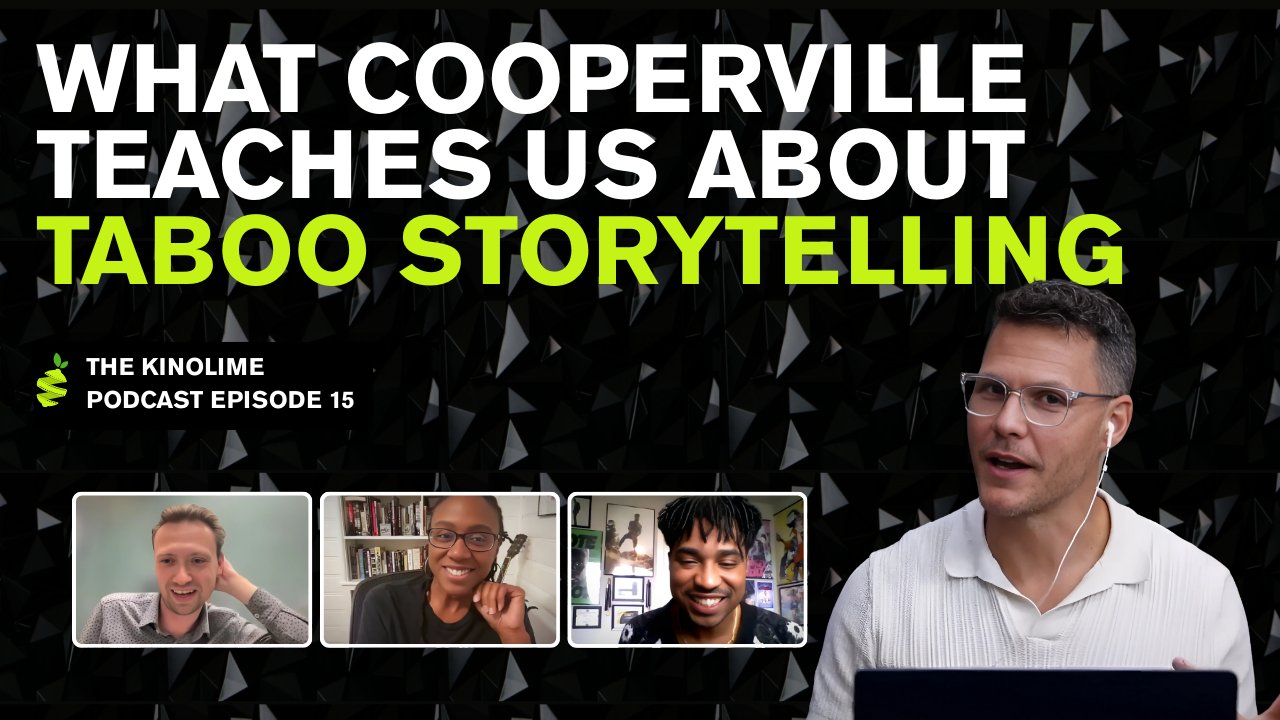
What Cooperville Teaches Us About Taboo Storytelling | Kinolime Podcast Episode 15
JS
Hosted byJohn Schramm
JJ
With guestJack Jones, Cat Street, Lee Foundation
Review on your platform
00:0000:00
Show Notes
This video features a roundtable discussion from Kino Lime regarding the screenplay Cooperville, a top finalist in their most recent competition. The participants analyze the story’s premise, characters, and structural elements, while offering constructive feedback for future revisions.Premise and Narrative Style
The panelists praise the screenplay's bold and "unapologetic" premise, which is described as being relentlessly fast-paced, moving continuously through various genres including comedy, terror, and mystery.
The moderator characterizes the script as an "outside-in" story, where a high-concept premise is established first, followed by the development of the characters and their world.
Participants note that the story serves as an entertaining vehicle for exploring deeper, serious societal issues, particularly regarding the Black experience.
Character Analysis
The Antagonist: The panelists unanimously agree that "Mosquito Man" is a standout character. The writers emphasize that a strong, well-reasoned villain is essential for compelling storytelling, comparing him to other iconic antagonists who believe their extreme actions are justified.
The Protagonists: The guests discuss the four main characters, with particular focus on Garrett and his transformation from a pacifist to a defender.
Character Development: A recurring theme in the discussion is the need for more nuanced character work to ensure the audience feels an emotional connection to the protagonists, rather than just the villain.
Constructive Criticism
Detective Development: The panelists suggest that more background information for the detective character, Thompson, would help clarify his motivations and how he deduces that people are being placed in jars.
Distinctive Voices: A critique is offered regarding the dialogue, with the suggestion that characters should have more distinct voices and cadences to help readers identify them and to better reflect diverse cultural upbringings.
Humanizing the Villain: Suggestions are made to explore moments where Mosquito Man might show empathy toward others, which could add layers of complexity to his diabolical nature.
Societal Context: There is a recommendation to further explore the societal backdrop of the missing persons storyline to provide more weight to the investigation.
Key Takeaways for Writers
Brevity and Description: The participants emphasize the importance of writing with brevity and providing precise, impactful descriptions.
Creative Formatting: One guest commends the script’s creative use of formatting to convey dialogue occurring simultaneously.
Relentlessness: The guests conclude by highlighting the value of being "relentless" with characters—challenging them with significant obstacles to push the narrative forward.
Full Transcript
[00:00]
Hello everybody, welcome to a KinoLime Roundtable.
[00:12]
Today we have three amazing guests that have decided to join us to talk about one of my
[00:17]
favorite screenplays from this year's competition, Cooperville.
Read Full TranscriptCollapse Transcript
[00:20]
So let's get right into it and hop into the chat.
[00:23]
We have, I'm just going to go based on the Zoom names, Cat Street.
[00:27]
Say hello.
[00:28]
Hello.
[00:29]
All right, we got here.
[00:31]
We got Jack Jones.
[00:32]
He's coming in from across the pond.
[00:35]
Thanks for having me.
[00:36]
I just want to say, every time I hear you speak like, you sound like you're from London.
[00:40]
I'm forgetting several other songs.
[00:42]
Like a mug of tea and everything.
[00:43]
Exactly.
[00:44]
I love it.
[00:45]
And we got Lee Foundation.
[00:48]
Lee, I don't know where you reside at the moment.
[00:50]
Right.
[00:51]
No, I live in Dallas, Texas.
[00:54]
I am from St. Louis, Missouri.
[00:57]
I moved here about almost like 12, 11 years ago getting acclimated.
[01:01]
But yes, a screenwriter and just got into that officially professionally as of last
[01:05]
year.
[01:06]
So it's been exciting.
[01:07]
So it's been exciting.
[01:08]
So it's been exciting.
[01:09]
So it's been exciting.
[01:10]
And Texas, in all places, I love Dallas.
[01:11]
Have some family that lived in McKinney.
[01:12]
Yeah, McKinney's cool.
[01:13]
All right, let's get into it.
[01:14]
We're going to talk about Cooperville.
[01:16]
And look, this is when this came in on our side during our submission period in the
[01:22]
last year's competition.
[01:24]
I mean, the premise.
[01:26]
Can we talk about the premise for a second?
[01:28]
I mean, this is like, it reminds me a lot of weapons in a way.
[01:32]
And obviously this, I read before, weapons came out in something so great and so like,
[01:37]
oh, where's this go?
[01:38]
Like, we need more bold premises like this.
[01:40]
So I just want to ask, like, what stood out to you about A, the premise and like the
[01:46]
writing?
[01:47]
You know, I'd love to hear your guys take on the screenplay as a whole, but we'll
[01:51]
start with the with cat.
[01:52]
I've known Andre since film school.
[01:56]
And that was like over 20 years ago.
[01:57]
So really, yes, a reading this.
[01:59]
I was like, this is a very Andre script in that there is a line that you don't cross.
[02:05]
And he hops over and he's like, hey, where's that line?
[02:09]
Let's go.
[02:10]
As far as the premise goes, I loved this premise because it was such an interesting, like, take
[02:18]
on the social, just the social experiment of it all.
[02:22]
And then you finally get into the why and everything that it becomes like, oh, a lot deeper.
[02:29]
But I love playing around with just like breaking down, breaking down people and seeing who
[02:36]
they really are, which is what he, with what Andre really perfectly explores in this
[02:42]
Sure.
[02:43]
In this script.
[02:44]
I didn't know you had some insight in film, Andre.
[02:45]
That's very cool.
[02:46]
Yes, yes, he was, he was like a year under me.
[02:51]
OK.
[02:52]
Jack Jones, what do you think about the premise?
[02:54]
I know as a your documentary filmmaker, but we also love movies, like tell it tells your
[02:59]
reaction to the premise.
[03:01]
Yeah, I mean, I heard about Mira, my friend who is a writer involved with KinoLime and
[03:06]
he pitched it to me and said it would be my kind of thing.
[03:11]
And it definitely was something when I when I first heard the concept, I just couldn't
[03:15]
quite picture it like what that actually meant that the shrunken world and everything and
[03:20]
how that would pay off.
[03:21]
But I think the, the writing is just so unrelenting like it just like goes from the start and it
[03:30]
never really pauses and stops and manages to be like funny and then terrifying and then
[03:38]
thrilling and a mystery and it manages to just like move through all these beats like
[03:43]
continuously and it's a really entertaining way of of talking about these wider societal
[03:52]
issues.
[03:53]
Sure.
[03:54]
Sure.
[03:55]
Lee, what were your thoughts?
[03:57]
As a writer, I believe it's important and imperative and I mentioned this early to you
[04:01]
guys, but we need to say something.
[04:03]
I love things that say things that have a message and I feel like this film does a good job
[04:08]
of really revealing a truth about what it means to be black in this country and in the
[04:14]
world in a lot of ways.
[04:16]
Lots of momentum in the premise as stated by Jack, it doesn't let up, it's relentless,
[04:20]
it's unapologetic and I think those are the best stories.
[04:23]
I mean, human experience is unapologetic and I would even go as far as to say it does
[04:28]
a good job of even, and this is me being because I'm kind of twisted, but and just my my
[04:32]
perspectives are very much so out there.
[04:34]
But I feel like it does a good job, honestly, of portraying how God feels about being
[04:39]
God to us.
[04:41]
Like I don't think like I think God is more twisted and kind of diabolical in its own,
[04:47]
I guess, own idea.
[04:48]
If you really think about life as it is, that's kind of like I feel like it does a good
[04:53]
job of portraying how God really truly sees and feels about itself and in relation to
[04:58]
us as far as what we experience as being human.
[05:01]
Just broad strokes.
[05:02]
That has a fascinating topic that we don't have three days to go into because that conversation
[05:07]
that never ends.
[05:09]
That sounds like we should be out in Palm Springs or Palm Desert, you know, Death Valley
[05:13]
chat about this.
[05:14]
I love, look, I'm a fan of great writing and I always talk about this.
[05:25]
There's two ways of, well, there's more than two ways, but you can view films as like
[05:29]
Inside Out, right, what's internal about the characters and then you build a film from
[05:33]
the Inside Out, where you have these movies that are outside in.
[05:37]
You have this great premise and then you go internal and this to me is a classic outside
[05:42]
in screenplay story where it's like you come up with the craziest premise imaginable and
[05:47]
then you build the world from outside in.
[05:49]
And like these are some of the most satisfying and like they've equated to like the bigger
[05:52]
blockbuster films, you know, that have the great hooks.
[05:55]
So Andre crushed it with this in this world.
[05:59]
I would love then to now start bringing it into the characters side.
[06:04]
What did everybody feel about the four protagonists?
[06:07]
What did you, did you latch onto anyone in particular?
[06:11]
Was there anything that stood out to you in terms of the characters?
[06:15]
Because we know how great the premise in the world is, but let's shrink it down into
[06:19]
the, you like what I did there Lee, shrink it down to the character side.
[06:23]
So we'll start with Lee this time.
[06:27]
So my favorite character, all right.
[06:29]
And this is just goes back to me as a writer too.
[06:33]
Nothing makes a movie better to me, honestly, than the bad guy to me.
[06:39]
The villain of the story is the guy that creates the story in the first place.
[06:42]
Always say like if a movie always had just heroes and everyone doing things, nothing would
[06:46]
really happen.
[06:47]
It'll be the most boring movie ever.
[06:49]
The villain is the initiator.
[06:50]
He kick starts everything.
[06:51]
You need him for life.
[06:52]
You need the devil to have God.
[06:53]
Right?
[06:54]
It goes back to that part.
[06:55]
So love the mosquito man.
[06:57]
I love the motive.
[06:59]
I love the, I love monologues.
[07:01]
I love the one of villain has some great monologues and breaks down things.
[07:04]
I, because I do that to the people who are as I explain me to people.
[07:09]
Love that.
[07:10]
Really love the mosquito man, if I'm being honest.
[07:13]
Sure.
[07:14]
And for all you writers out there, what Lee's kind of referring to is that your movie is
[07:18]
only as good as your villain as your antagonist.
[07:20]
So you need that Joker to compliment the Batman.
[07:24]
This is you need mosquito man to compliment the four characters here.
[07:29]
Cat, what did you think about the four protagonists and specifically our heroes and what did
[07:34]
you latch on to?
[07:35]
What were thoughts?
[07:36]
I was a little bit interested in Christian.
[07:39]
What a sad demise.
[07:43]
I didn't get that much info about him, but he just seemed like such a nice guy.
[07:50]
He's a big hollypate.
[07:51]
Yeah.
[07:52]
Hold on for a second.
[07:54]
Let me just double check.
[07:56]
Christian is the guy who's linked to mosquito man, right?
[08:00]
Or was it the other guy that's got the character?
[08:03]
No, Garrett.
[08:04]
That's what Garrett is going to think about.
[08:06]
Sorry.
[08:07]
Christian was the guy that got sniped by the cat.
[08:09]
Yeah, that was great.
[08:10]
That was great.
[08:11]
It was Garrett who I connected with.
[08:20]
Because there was a moment at the very end of his existence where he's just like she was
[08:26]
right.
[08:27]
And what does he mean?
[08:29]
What does he mean she's right?
[08:31]
But I like the idea of him being not really a fighter.
[08:36]
He's not one.
[08:37]
And then being put in this situation, being pushed to defend himself and to stand up for
[08:44]
himself and see what needs to happen to get somebody who's ultimately a pacifist to
[08:52]
a point where they have to start fighting.
[08:56]
And so I would have loved to see that exploration a little bit more with him.
[09:03]
So that's what made me curious.
[09:05]
But I do love mosquito man as well.
[09:07]
I know.
[09:08]
Who doesn't love mosquito man?
[09:10]
His character is a little reminiscent of anyone has seen or read Lord of the Flies.
[09:14]
I forget the character's name is a porky's, a pudge, piggy's character.
[09:20]
Same thing.
[09:21]
Jack, who's your favorite character out of everybody in Cooperville?
[09:26]
I mean, everyone has got to be mosquito man.
[09:30]
I think when I found out that mosquito man is black, it just like that moment just like
[09:37]
I just did not see that coming whatsoever.
[09:39]
And I thought that was so smart.
[09:41]
So smart.
[09:42]
And just represented just a whole different angle of the themes and the, you know, everything
[09:49]
it was talking about in a way that is just so simple.
[09:53]
But so effective.
[09:54]
Out of the guys.
[09:55]
Yeah, I mean, I really found the main protagonist like attitudes quite strong and quite, you
[10:04]
know, I kind of got their vibes from them, especially Garrett is a really like he's quite
[10:11]
a smart character.
[10:12]
And he's like, he feels like he's quite red up on everything and the issues and everything
[10:18]
that by the end towards he starts to even get broken down by this world that they're
[10:23]
put in at one point.
[10:26]
But yeah, I'd love to, you know, in photographs here more about more specifically who they
[10:32]
are and what their relationships are to each other and things.
[10:36]
Yeah, sure.
[10:37]
Yeah.
[10:38]
Yeah.
[10:39]
Yeah.
[10:40]
Yeah.
[10:41]
Can I get a second?
[10:42]
There was something that you said earlier, John, about like be going from the outside and
[10:45]
going in.
[10:46]
I think to yes and that one thing about this script that was so beautiful is that it's, yeah,
[10:53]
it's a high concept kind of thing and you go in where you kind of see what's going on
[10:58]
there.
[10:59]
I think that there, you know, that there is like a lot of like character, like a lot of
[11:04]
beefy character work in here where you do in some ways emotionally connect to maybe
[11:12]
mosquito man in some ways.
[11:14]
You hate him.
[11:15]
Sure.
[11:16]
You don't like him.
[11:18]
Maybe you understand him, which is what you're supposed to do anyway, but you know, the
[11:23]
Alex I'm looking in, but I think the thing that makes this script so great is that you
[11:29]
then after reading it, at least for me, start thinking about yourself.
[11:34]
Sure.
[11:35]
It's about like society of like, was he right?
[11:39]
You know, like thinking about like he's got a point and I think that's also what makes
[11:44]
a great villain is like somebody who like who who has maybe the right intentions.
[11:53]
Yes.
[11:54]
We're like the right intentions, but goes about it the wrong way.
[11:57]
Sure.
[11:58]
Well, that's what makes it like an activist.
[12:00]
So completely.
[12:01]
Yeah, like if he was just one degree to the left, he could have been a great like you said,
[12:05]
activist or something, but because they're one degree to the right, I always say this
[12:08]
with villains too.
[12:09]
I might be dating myself, but like has everyone seen Michael Bayes movie The Rock with Nicholas
[12:14]
Cage and Sean Connery.
[12:15]
So you know, like the Ed Harris character, he's like, he's right.
[12:21]
He's like right to take a rafters like, you know, my men went to like these special
[12:24]
ops and they were like disregarded by their country.
[12:26]
Now he's doing something and it's that you you like get him.
[12:30]
He's doing it the wrong way, but like you understand him.
[12:33]
And I think that's what makes the great villains even like, you know, he fled his joker, right?
[12:37]
You like understand why he wants chaos, you know?
[12:40]
And you may you don't have to agree with it, but you have to understand it.
[12:44]
And I think like, yeah, Benson slash mosquito man makes a really great argument for why he
[12:50]
believes in it, you know, and thus makes him way more compelling than your average villain.
[12:55]
I think that's what truly stands out to me about Cooperville outside of the premise.
[12:59]
For all your writers out there, they work on your own to work on your antagonist, like
[13:03]
really, really, really work on that person or that thing or that entity because that's
[13:07]
really what's going to carry your film forward.
[13:10]
And you hear it proof in the pudding, everyone on this call is talking about the mosquito
[13:14]
man.
[13:15]
So I think that's just a really good writing tip to really spend as much time on your hero
[13:18]
as you're villain.
[13:21]
Now we've spoken all about the great stuff about Cooperville.
[13:24]
I would love to talk a little bit about and what we do here at Keenal.
[13:27]
I was always trying to improve story and tell the best stories possible.
[13:31]
What are some constructive criticisms of the screenplay?
[13:33]
I know, Kat, you're a little, you know, your friends with Andres, we're going to try
[13:36]
and, you know, think outside of the box there, but we'll start with Jack, Jack.
[13:40]
What was something in the screenplay that you maybe thought as a missed opportunity, constructive
[13:44]
criticism, something to help elevate this great screenplay even to another sphere.
[13:49]
I liked the detective characters and I liked the sort of how detective Nussah is, the
[13:56]
like I have a hunch, this young guy who is just like he's a crazy old fool, but he's
[14:01]
like I see the pad.
[14:03]
And I love that in movies that I love like that he grounds it and kind of like a genre
[14:07]
quite heavily.
[14:09]
But outside of that, I didn't know really, I felt like I didn't get much of a
[14:14]
reason why he suddenly, why Thompson realizes so suddenly that things, that people have
[14:22]
been drunk and put into jars.
[14:24]
And I think it's possible for us to take that leap with him, but I think you could kind
[14:30]
of solve two problems there by telling us more about Thompson and his background and everything
[14:36]
and how he would possibly come to conceive of such an idea, maybe an old case or something.
[14:41]
That's one.
[14:42]
It's a fair point.
[14:44]
It's a fair point.
[14:45]
It's a conclusion because yeah.
[14:47]
I had the same, I bumped on the same thing.
[14:50]
Cat, any constructive criticisms or missed opportunities to improve the screenplay?
[14:54]
Yeah, I have a, you want me to pick one?
[14:57]
Because I have a few things.
[14:58]
Yeah, whatever you feel like sharing.
[15:00]
Sorry, I, but he knows this.
[15:02]
He knows it.
[15:03]
It's fine.
[15:04]
Um, so first off to talk about what Jack was talking about with Thompson.
[15:11]
One thing I thought would be really interesting because I think one of my main issues with the
[15:16]
script was that you really, the protagonist, like those four people, as well as the detectives,
[15:23]
like they're not completely fleshed out, like to the point where you connect with anybody,
[15:29]
like Garrett, I connected with it because I was like, okay, I can see a little bit.
[15:34]
I can see some opportunity there.
[15:36]
But like, for example, Thompson, I feel like there's an opportunity for him to be, um, to
[15:46]
almost be like the end to Tim Benson's Yang in a way where like maybe he was also bullied
[15:54]
or maybe he also had that experience that he took a different path.
[15:58]
So he understands.
[15:59]
Yes.
[16:00]
This person and that's how you got to go like, oh, it's this guy right here.
[16:04]
Yeah, yeah, yeah.
[16:05]
I got beat up too.
[16:06]
I can see this is what I would do if I were crazy.
[16:10]
Sure.
[16:11]
So that was like one thing is just like overall, just like, I feel like the characters could
[16:17]
use some like, if you want us to emotionally connect to them, like if you're going to talk
[16:22]
about get out like Chris, you know, yeah, yeah, yeah.
[16:27]
Or like the other thing with Benson specifically because I love him so much and I think that
[16:32]
there's such a good opportunity there.
[16:36]
With him, I guess for me, when reading this, I was like, oh, I don't know how black people
[16:45]
are going to respond to this because it's because because I understand him, like you can
[16:53]
understand like, okay, if you're being bullied by a certain group of people, you start to hate
[16:58]
these people to like a crazy amount of the crazy degree and this is just escalating
[17:05]
as he's being and he's expanding this a bit.
[17:07]
So it would be interesting to see how like, are there people that Benson likes?
[17:15]
See if there's anybody that he likes.
[17:17]
We don't see any person that he maybe sympathizes with like in these other kid bully.
[17:23]
Like does he?
[17:24]
Sure.
[17:25]
Like how would he respond?
[17:26]
How would he react to that?
[17:27]
Just putting him in like little situations where it brings like a little bit of humanity
[17:32]
to him.
[17:33]
Sure.
[17:34]
He's completely diabolical.
[17:36]
Therefore you love and hate him.
[17:39]
Yes.
[17:40]
So fair point.
[17:41]
Yeah.
[17:42]
Thank you.
[17:43]
Thank you.
[17:44]
I think those are my big ones.
[17:45]
And then also like the, the controversy of like the missing people, which is like a big
[17:51]
societal thing as far as like black people being, you know, going missing and not that
[17:58]
investigation not really happening, I think that there might be like a couple more opportunities
[18:03]
there to really drive that home.
[18:06]
That's another point I had the same thing.
[18:09]
Yeah.
[18:10]
Like what's going on in the world that makes this so wide now or for the story, for the
[18:14]
characters as well.
[18:15]
Like, yeah, I think that's that's a very, very fair point.
[18:18]
Yeah.
[18:19]
Great scene where that could be explored more is this where Thompson goes to visit the,
[18:24]
the mother of the missing child.
[18:27]
And she's talking about like, oh, these like, you know, they don't care about my door.
[18:31]
They only care about these white kids.
[18:32]
And I think Thompson in that scene could very much like be like, because he does agree
[18:37]
with her like he's keeping his mouth shut in the scene to the badge.
[18:41]
But I think at that point he can actually let loose and be like, I agree with you.
[18:45]
Yeah.
[18:46]
Yeah.
[18:47]
I care about your kid, you know.
[18:48]
Yeah.
[18:49]
You're going to be good to have like one more like like code or something like tie that
[18:54]
time out because it was such a heartbreaking.
[18:56]
Oh, yeah.
[18:57]
storyline.
[18:58]
I mean, for sure.
[18:59]
Lee, what some criticism is or missed opportunity as you felt could benefit the screenplay?
[19:07]
Just my outside of just little technical things with some of the dialogue is I'm a big
[19:11]
dialogue guy.
[19:12]
That's like one of my things I've had to learn to kind of pull back on because I love
[19:15]
to just talk because I'm a talkative person.
[19:17]
Yeah.
[19:18]
But the language and the dialogue I felt and I think this leads into cats kind of point
[19:22]
where the characters are fleshed out.
[19:24]
Their voices weren't distinct enough.
[19:26]
McGrady Point.
[19:27]
McGrady Point.
[19:28]
A lot of them sounded like the same person.
[19:30]
Yes.
[19:31]
And when you write black people and black characters, there are many different types of us that say
[19:37]
different things depending upon background, cultural upbringing, whether you hood or not,
[19:41]
whether you get or not, whether you, whether you read or not.
[19:45]
And those things are harder to convey in a script.
[19:48]
Like even when my movie I had to learn like, all right, this guy's articulating, doesn't
[19:52]
come from the hood so he would speak correctly while this guy doesn't or uses slang.
[19:56]
So I felt like it could be blacker quote unquote in some points as far as that part.
[20:01]
And then yes, show that yes, we can read, we're intelligent.
[20:05]
We can verbalize, we can use all that well.
[20:08]
Sure.
[20:09]
But I feel like this should be more distinct in the dialogue.
[20:11]
That's a great point.
[20:12]
And I want to say to the writers at home, make your characters.
[20:15]
Distinctive.
[20:16]
I think, what Lee's saying right now is a great point.
[20:19]
You see this a lot in screenplay.
[20:20]
This is everyone kind of talks the same or they're not distinct enough.
[20:23]
You want them to separate because look, there's a lot of characters in a screenplay.
[20:26]
You might lose like who's who.
[20:28]
But if you remember the cadence, the nuances, the idiosyncratic ways that they speak will
[20:33]
really help your reader latch onto your plot a bit more and your characters by identifying
[20:39]
them quickly by speech and cadence.
[20:41]
So Lee, that's a great point.
[20:42]
I really appreciate bringing that up.
[20:44]
All right, well, we're at our last question of the day and I'd love to know as all writers
[20:49]
on this call and for the writers at home watching where people that are interested in writing,
[20:53]
what lessons did you take away from reading the screenplay, processing the screenplay for
[20:58]
your own creative process?
[21:00]
Lee, we'll start with you.
[21:01]
Good question, man.
[21:02]
So as I've, as I've, I spoke earlier, Morgan and Mera working with you guys at Keenoline,
[21:08]
like your notes and you guys's constructive criticism has amplified my writing ability
[21:13]
significantly.
[21:14]
And I feel one of the things I got from this script specifically is to be more descriptive,
[21:20]
I think as you write, describing your character as they're coming in, I often forget to do
[21:24]
that.
[21:25]
I just like to get to it, like get to it, right?
[21:26]
I think that's important.
[21:29]
Definitely distinct, distinct voices for characters.
[21:33]
That's something that I learned from you guys that I felt could be put into this.
[21:38]
And I also thought it was really cool how we creatively would have like the character
[21:41]
name and the dialogue box on the same line.
[21:44]
Like, yeah, yeah.
[21:45]
That way is like, I can tell, oh, he's communicating that they're speaking at the same time without
[21:49]
saying that's happened.
[21:50]
Yep.
[21:51]
So he creatively found a way to kind of convey that with Obana as they speak together
[21:55]
at the same time.
[21:56]
Yeah, it's just like, it's just is, you know, so I definitely took that and I'm going
[21:59]
to put that so like being creative with the delivery of what you're reading, I think
[22:03]
was something I took from it for sure.
[22:05]
Well, thank you so much for the kind words.
[22:06]
Lee, we really appreciate that.
[22:08]
Jack, would you take away from reading the screenplay for your own creative process?
[22:12]
Yeah.
[22:13]
I mean, I had the screenplay kind of open while I was going through it and I was actually
[22:16]
working on one of my screenplays like at the same time, kind of like bouncing back between
[22:20]
windows and I write a short film for the kid of life contest.
[22:24]
But I immediately like while I was reading it was like, I looked back at my own script
[22:30]
and I was just like, this isn't fast enough.
[22:33]
This is like, he has such a great brevity.
[22:35]
I like spent like this much of a page describing a character like Andre likes does it in like
[22:41]
this line, but it's just like, oh yeah, that's exactly to this person.
[22:45]
And I don't need to like go along with leg on.
[22:48]
It's just the writing and the descriptions of the action in the way he writes is so entertaining.
[22:54]
Great.
[22:55]
It's great.
[22:56]
And then lastly, Kat, would you take away from your reading screenplay for your own creative
[23:00]
process?
[23:02]
So one thing I love about Andre is his relentlessness.
[23:06]
And that's what I want to bring into my scripts.
[23:10]
It's just to be more relentless and that's to be, you know, I'm a little kind to my characters.
[23:15]
Don't be.
[23:16]
Don't be.
[23:17]
I would love to really start doing more just like abusing them, like going back to the
[23:24]
whole God thing.
[23:25]
Just abuse them.
[23:26]
Just do it.
[23:28]
For them, like I love whatever I do put characters up in a tree and just start throwing
[23:33]
rocks at them.
[23:34]
Like I went from boulders at them.
[23:35]
And I think that Andre does that so well, just like throwing boulders and building at
[23:40]
them.
[23:41]
Throw an elephant sized cat at them.
[23:44]
I think that's I think that'll work.
[23:47]
You do wonders for your screenplay.
[23:49]
Yeah.
[23:50]
That's what I needed.
[23:51]
Just these big cats because, you know, that's it.
[23:53]
I love that scene.
[23:54]
Thank you so much for joining us today on a keynote.
[23:57]
I'm round table.
[23:58]
It's Cooperville.
[23:59]
Like I said, got through the process.
[24:01]
It was made it all the way to the top three in our last competition.
[24:04]
We all love the screenplay.
[24:05]
We can't wait to see what we can do with it here, a keynote line.
[24:08]
We love that everyone here loved it and had some great thoughts and notes for it.
[24:12]
And we appreciate Andre for writing such a great screenplay.
[24:14]
So Jack Lee cat, thank you for joining us today.
[24:18]
And John Trem here, a keynote line.
[24:21]
I wanted to say thank you for all tuning in.
[24:22]
We really appreciate it.
[24:23]
As always, any questions, comments, like us on Instagram, follow us on YouTube, whatever
[24:28]
the whole social media rigmaruaries, please follow us because we got some great content.
[24:32]
We have great guests all the time.
[24:34]
And I just want to say thank you so much.
[24:35]
And thank you all for joining.
[24:36]
Thank you very much.
[24:37]
Thank you very much.