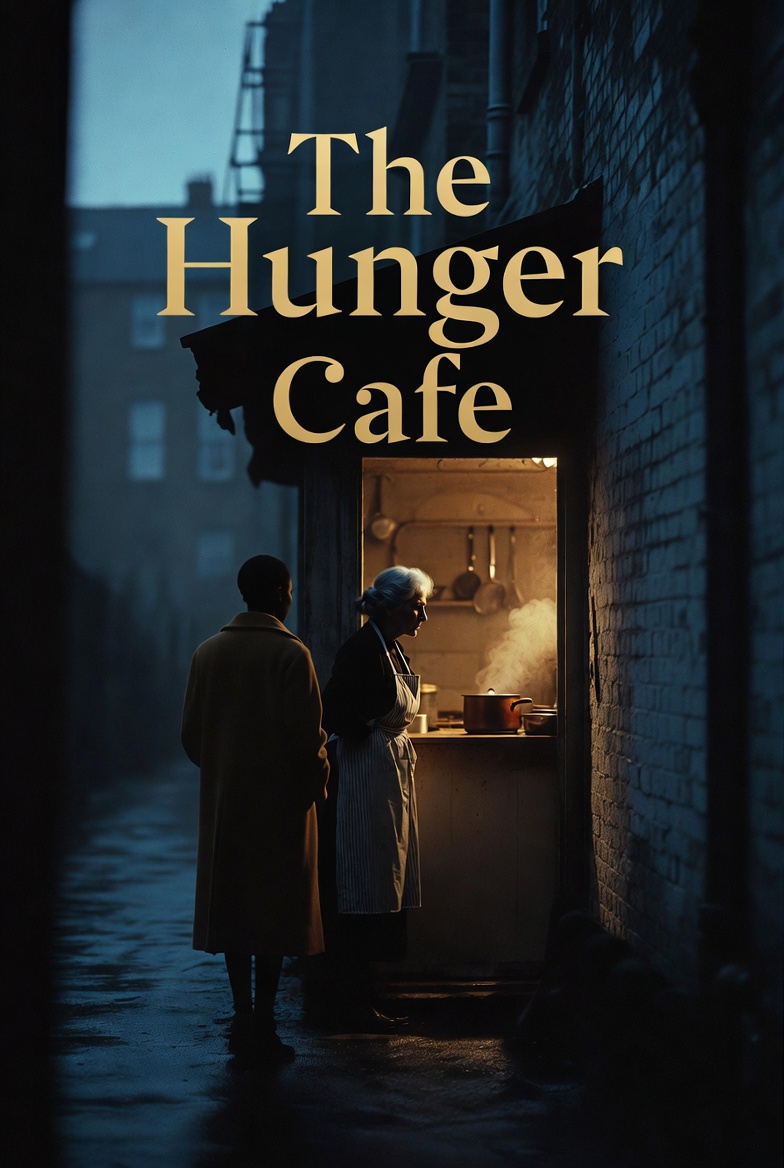
London. Pre-dawn, mid-winter. MAYA OKAFOR, 28, British-Nigerian, walks an empty street with empty pockets. Six months ago she was made redundant as a social care key worker. Now she is ten days from eviction — nine pounds forty, a final notice folded so many times the paper has gone soft. She has tried to call her mother and hung up without speaking. She has nowhere to go.
Drawn by the smell of hot water and vegetables from a narrow brick alley, she finds an unmarked wooden door. No sign. No handle — only a small brass plate worn smooth by thousands of contacts. She presses it. Inside: five mismatched tables, people eating quietly, no menu, no prices, no questions. At the stove is ELARA, early sixties, moving with the economy of someone who has made soup in small rooms for forty years. One word: sit. She sets a bowl down and turns away. Maya picks up the spoon. The soup hits the back of her throat. Her shoulders drop. She hadn't known she'd been holding them.
Maya returns. Then again. Elara shows her the stove through proximity, not instruction. The onion first, always. Small potato, not thin. She meets the café's community: PAPA KOFI, a Ghanaian elder of quiet dignity; DANIEL, a rough-sleeping mathematician days from a teaching post he must survive to reach; LEO, a supplier with his own history of back doors. Then a council inspector arrives with a compliance notice. Behind the procedure sits a property developer who wants the entire block demolished.
On the fourteenth — the date on her eviction notice — Maya is locked out of her flat. On the café counter she finds a folded blanket and a note in Elara's handwriting: Trust the bowl to know what it's for. Elara knew. She prepared without a word, without making Maya ask. Maya sleeps on three chairs with the blanket over her. Homeless and exactly where she is. Both are true.
Elara leaves without warning and a closure directive arrives. Maya turns the sign to CLOSED, then turns it back to OPEN. People come in, read the notice, and sit anyway. She takes names in a sixty-pence notebook with a cartoon rocket on the cover. She films a crowdfunding appeal alone in the empty café: people need things. That is not shameful. That is just true.
The campaign succeeds. A Guardian article runs. A ward councillor raises concerns about the demolition. Fifty-three people eat the first Thursday in the community hall. Maya writes every name. She visits her mother. She stays the night.
Three weeks later, Elara returns and sits on the step before dawn. Maya opens the door. Two notebooks lie open on the counter — Elara's ledger with twenty-three years of names, the rocket notebook with fifty-three more. The planning hearing is two days away. The onion is already in the pot.