Director's statement:
An ode to storytelling itself, Violet tells a tale about people who have slipped through the cracks, and what happens when they finally allow themselves to be seen.
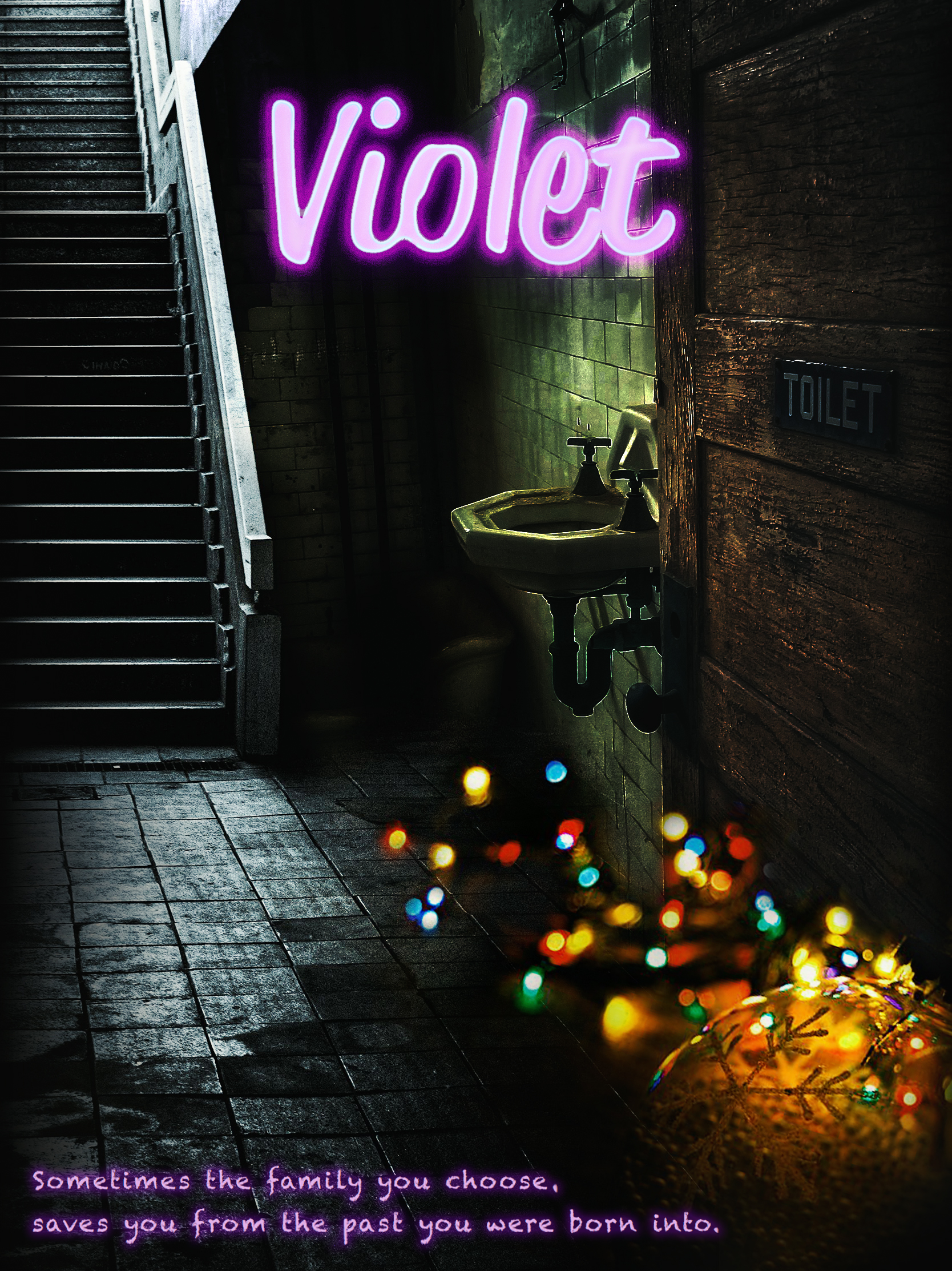
The seed for Violet was planted years ago, when I read an article about a couple who managed Vancouver’s underground public toilets in one of the city’s most dangerous neighbourhoods. What struck me wasn’t the bleakness of the setting, but the dignity with which they treated the people society had abandoned. Having grown up close to someone who spen years living on the streets, I’ve always been drawn to stories about forgotten lives — not as tragedies, but as sites of humanity, resilience, and grace. Inspired by people In my own life, I take telling these stories as a truly sacred responsibility.
Lena has survived by disappearing. Years of hiding from violence have taught her that emotional distance is the safest form of self-preservation. Leonard, punished early for his desire to wear women’s clothing, has learned the same lesson: stay quiet, stay small, stay alone. Stella is their opposite. An out transgender woman, fiercely devoted to her child, she lives unapologetically in a world that offers her almost no safe or dignified choices. Where Lena and Leonard retreat inward, Stella exists in full exposure — though the mask she wears to survive her work is just as protective.
Together, their differences allow the masks to slowly fall. Lena and Leonard learn how to open themselves to connection, while Stella finally finds a space where she doesn’t have to perform. What emerges is a chosen family — one built on mutual recognition, care, and the vulnerable act of letting oneself be loved.
Visually, I want the audience to feel drawn into this world without being aware of the camera. I plan to shoot single-camera on the ARRI Mini LF with primarily Cooke prime lenses, using a “close presence” style that keeps us physically near the performers while grounding them in their environment. The goal is intimacy without spectacle — no flashy rack focuses or camera pyrotechnics — allowing nuance, stillness, and performance to carry the emotional weight.
The film will begin with a cold, grimy look, evoking old-school 16mm: dirty greens, high contrast, and a sense of claustrophobia inside the underground washroom. As the characters grow closer, the image will subtly warm and soften, becoming smoother and more romantic.
The flashbacks will break from this world entirely: Leonard’s childhood in desaturated greys, Lena’s past in dark, earth-toned browns, each memory carrying its own emotional temperature. Stella’s final reveal will feel almost mythic by contrast — sunflowers, blue skies, and open space — a visual fairy tale earned through survival.
Set in the early 1990s, Violet reflects a time when many identities had to remain hidden, and survival often required silence. This film is my way of honoring those stories with empathy, integrity, and the belief that even in the grimmest of places, connection through storytelling can still create magic.